ONLINE AGE

(Online version of the Arunachal Age newspaper)

State News

Latest News, Popular News, State News

Keyi Panyor reviews governance gaps, manpower needs highlighted

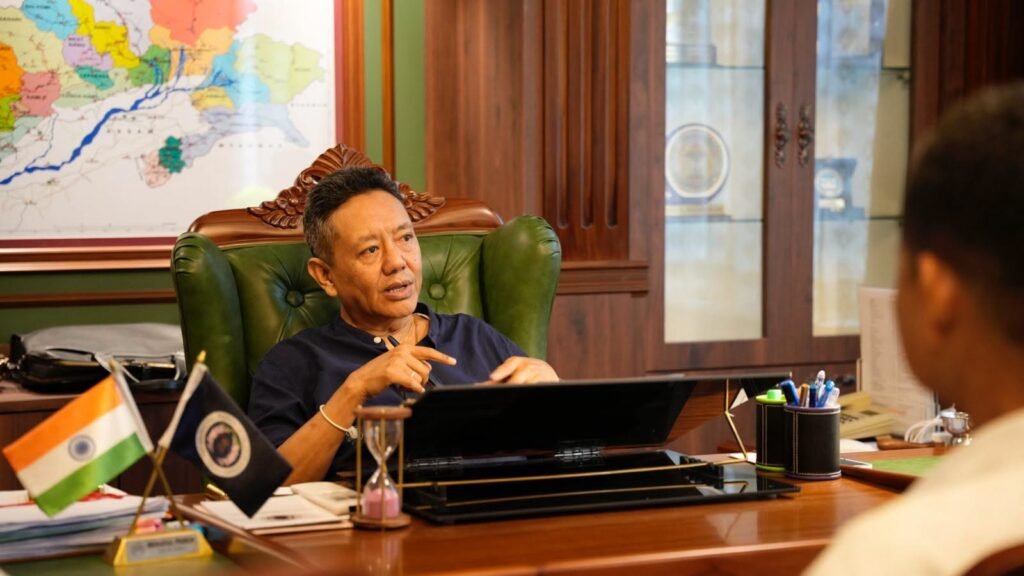
YACHULI : A high-level review meeting held at the Chief Minister’s Office focused on strengthening governance and accelerating development in Keyi Panyor district, highlighting both progress and key administrative challenges. The meeting was attended by Keyi Panyor MLA Toko Tatung, Deputy Commissioner Shweta Nagarkoti and Superintendent of Police Angad Mehta. Officials noted that the district has made encouraging progress in housing under the Pradhan Mantri Awas Yojana (Urban) and in laying the foundation for administrative infrastructure, including the upcoming Yachuli District Secretariat. However, the leadership also flagged what they described as “growing pains” in establishing a fully functional administrative setup for the district’s nearly 25,000 residents. Key concerns included urgent requirement for filling vacant Group A and Group C posts, shortage of official vehicles for departmental functioning, and digital connectivity challenges across 224 villages. Officials emphasised that addressing these gaps is essential to ensure effective e-governance and to bridge the divide between administration and citizens. The meeting underscored the need for swift augmentation of manpower, improved connectivity and strengthened logistical support to enable efficient service delivery. It was observed that building a new district is not only about infrastructure creation but also about ensuring strong human resources and seamless administrative outreach to transform Keyi Panyor into a fully functional and citizen-centric district.    

Latest News, Popular News, State News

DoTCL reviews ongoing development projects in Tirap

KHONSA : A comprehensive review meeting of the Department of Tirap, Changlang and Longding (DoTCL) was held here on Friday to assess the progress of ongoing developmental schemes and projects in Tirap district. The meeting was chaired by DoTCL Secretary Wayong Khimhun in the presence of Tirap Deputy Commissioner Techu Aran, Khonsa Additional Deputy Commissioner Namneet Singh, DoTCL Deputy Director Wangton Lowang, DoTCL Assistant Director Montu Mossang and officers of various line departments. Officials from the Rural Works Department, Public Works Department, Public Health Engineering and Water Supply Department, Horticulture Department, Agriculture Department and Rural Development Department participated in the meeting. During the review, departments presented the status of their ongoing schemes and projects through PowerPoint presentations. Detailed discussions were held on the progress, implementation and impact of developmental activities being undertaken across the district. Officials also carried out inspections of ongoing projects to assess ground-level implementation and ensure effective execution of schemes for public benefit. The meeting emphasised impactful and sustainable investments aimed at improving public welfare and socio-economic development in the region. The meeting also stressed the need for awareness programmes against drug addiction and substance abuse among youths and local communities. Departments were encouraged to take coordinated initiatives to strengthen preventive measures and public awareness campaigns. Suggestions were made to promote cluster farming in villages to enhance agricultural productivity and ensure better utilisation of resources. The meeting also discussed the importance of Special Assistance to States for Capital Investment (SASCI) and proper planning in the education and development sectors. All departments were directed to maintain proper coordination and accountability to avoid duplication of schemes and projects. Emphasis was also laid on transparency, effective monitoring and responsible implementation. Speaking during the meeting, Khonsa Additional Deputy Commissioner Namneet Singh said, “Proper guidelines and monitoring mechanisms are essential for DoTCL. The outcomes and benefits of the schemes for beneficiaries must be regularly inspected and evaluated.” The day-long meeting concluded with a collective commitment from all departments to work in close coordination for accelerating developmental activities and ensuring efficient delivery of public services in Tirap district. (DIPR)  

Latest News, Popular News, State News

‘Ekta Bhawan’ inaugurated at Yazali PS

  YAZALI : The ‘Ekta Bhawan’ at Yazali Police Station was formally inaugurated on Friday in a well-attended ceremony, marking a significant step towards strengthening community policing and fostering greater public engagement in the region. The programme commenced with a ceremonial welcome of the chief guest and other dignitaries, followed by the ribbon-cutting and unveiling of a commemorative plaque symbolising enhanced transparency and strengthened police-public partnership. A plantation drive was also conducted as part of the inaugural event, led by the chief guest and joined by Lower Subansiri Deputy Commissioner Shweta Nagarkoti, Superintendent of Police Angad Mehta, Zilla Parishad Chairperson Nabam Piju, and other local community representatives, reflecting the collective commitment to environmental responsibility. Addressing the gathering, IPS (Probationary) Anurag Chopra, Officer-in-Charge of Yazali Police Station, described the Ekta Bhawan as a dedicated community space aimed at bridging the gap between the police and the public, and promoting trust-based policing. Subsequent speeches by ZPC Nabam Piju, SP Angad Mehta, and the chief guest underscored the importance of mutual trust, cooperation, and shared responsibility in ensuring a safer and more cohesive society. The event concluded with a high tea session, providing an informal platform for interaction between officials and residents, and reinforcing the spirit of collaboration envisioned through the establishment of the Ekta Bhawan. (DIPR)  

Latest News, Popular News, State News

CAU intensifies awareness on sustainable agriculture, alternative energy

PASIGHAT :  The Central Agricultural University (CAU) has intensified its awareness initiatives on sustainable agriculture, climate-resilient farming and alternative energy use across the North Eastern Hill (NEH) region through a series of outreach programmes. Addressing the media on Friday, a team of faculty members led by CAU Prof BR Phukan highlighted the university’s initiative titled “Alternative Energy Initiatives and Increasing Nutrient Use Efficiency through Organic Sources.” The programme aims to create awareness among farmers and stakeholders on sustainable agricultural practices, renewable energy, and efficient nutrient management. He said agriculture in the NEH region continues to face multiple challenges, including fragile ecosystems, difficult terrain, soil degradation, nutrient leaching, acidic soils, biodiversity loss and poor accessibility in remote areas. “Despite these challenges, CAU has consistently worked to bridge the gap between scientific institutions and farming communities through education, training and dissemination of technology,” Prof Phukan added. Over the past few months, the university has conducted extensive awareness campaigns across the seven hill states through print media and field outreach programmes. With 13 campuses spread across the region, CAU has been sensitising farmers and stakeholders on climate-resilient agricultural practices. The awareness programmes focused on technologies and practices such as solar irrigation systems, agrivoltaics, solar-powered farm operations, artificial intelligence-based greenhouse management, precision farming, conservation tillage, biomass gasification, vermicomposting, solar dryers, wind energy applications and smart farming techniques aimed at improving nutrient-use efficiency and reducing dependence on fossil fuels. Faculty members also spoke on bio-fertilisers, natural farming, soil health management, biodiversity conservation, protected cultivation of high-value crops and flowers, post-harvest management through solar dryers and conversion of agricultural and kitchen waste into vermicompost for sustainable organic manure production. The university appealed to media organisations and stakeholders to actively support awareness initiatives related to sustainable agriculture, alternative energy use, soil health improvement, biodiversity conservation and long-term agricultural sustainability in the Northeast. (DIPR)      

Latest News, Popular News, State News

Guv condoles Bengia Tolum’s demise

  ITANAGAR : Governor Lt Gen KT Parnaik (Retd) has expressed profound grief over the demise of noted social activist and community leader Bengia Tolum. Condoling his passing, the Governor described Late Tolum as a visionary social reformer, dedicated educationist and tireless cultural crusader who devoted his life to the welfare and upliftment of society. “Bengia Tolum worked relentlessly to strengthen unity and harmony among different tribes and communities while serving as a messenger of peace and understanding,” Parnaik said. He said Tolum’s contributions towards preserving the rich cultural heritage and indigenous traditions of the State would always be remembered with deep respect and gratitude. The Governor also acknowledged his significant role in fostering goodwill, friendship and stronger people-to-people relations between Assam and Arunachal Pradesh. Describing his demise as an irreparable loss, the Governor said, “His passing away is a great loss not only to his family and community but also to the entire State. His life and works inspired countless people towards social service, harmony and collective progress.” The Governor joined the people of Arunachal Pradesh in offering prayers to Almighty Donyi Polo for eternal peace of the departed soul and conveyed his heartfelt condolences to the bereaved family members, friends and admirers.

Latest News, Popular News, State News

12 acres of wild cannabis destroyed

  PASIGHAT :  The East Siang district administration, in coordination with the Police and Forest Department, carried out a destruction drive of wild Cannabis sativa (ganja) spread over nearly 12 acres behind the Veterinary Training Institute at 2 Mile, Pasighat, on May 14. The operation was conducted jointly by police personnel, forest officials and district administration staff in the presence of East Siang Sub-Divisional Officer (SDO) and Town Magistrate Sanjay Taram and East Siang Deputy Superintendent of Police (DySP) Ayup Boko, who is in-charge of the Anti-Drug Squad. Officials informed that all necessary legal formalities, including videography of the destruction process, were duly carried out during the operation. East Siang Superintendent of Police Pankaj Lamba reiterated the district police’s zero-tolerance policy against the drug menace. “We maintain a zero-tolerance approach against drugs and illegal cannabis cultivation. The public should remain vigilant and immediately report any such activities in the district,” he said. The destruction drive was undertaken as part of the district administration’s continuing efforts to curb illegal narcotic growth and strengthen anti-drug enforcement in the region. (DIPR)

Latest News, Popular News, State News

Cabinet approves anti-paper leak rules, ILP reforms, austerity measures

ITANAGAR : The Arunachal Pradesh Cabinet on Thursday approved a series of major policy and administrative decisions, including new anti-paper leak rules for recruitment examinations, stricter Inner Line Permit (ILP) regulations, and a set of austerity measures for ministers and government officials. The cabinet meeting chaired by Chief Minister Pema Khandu deliberated on several governance, recruitment, urban development, welfare and institutional reform proposals concerning multiple departments of the state government. The cabinet announced austerity measures following Prime Minister Narendra Modi’s appeal, including a one-year ban on foreign travel by ministers and officials, a 50 per cent reduction in VIP convoys, adoption of a “virtual first” meeting policy, restriction on new vehicle purchases, promotion of e-office systems, energy-saving measures and encouragement of organic farming and “buy local, buy swadeshi” initiatives. Among the key decisions, the cabinet approved the framing of the “Arunachal Pradesh Public Examination (Measures for Prevention of Unfair Means in Recruitment) Rules, 2026″ to strengthen safeguards against question paper leaks and other malpractices in recruitment examinations, a statement from the CMO said. The rules operationalise provisions of the Arunachal Pradesh Public Examination Act, 2024, and provide for monitoring mechanisms, reporting procedures for examination-related offences, and engagement of examination authorities and functionaries. The cabinet also approved amendments to recruitment rules for administrative officers, chief engineers and several other categories of posts to streamline recruitment procedures and update service conditions. In the Agriculture department, amendments to the planning officer group ‘B’ recruitment rules were approved to regularise changes relating to pay scales, promotion criteria and consultation procedures with the Arunachal Pradesh Public Service Commission. The revised rules will now be known as the General Arunachal Service ‘Planning Officer Group ‘B’, Gazetted, Non-Ministerial Rules, 2026”. Recruitment rules were also approved for 20 newly-created Group-C posts under the land management department, including 10 computer assistants and 10 senior computer assistants. The cabinet approved a Home department proposal to merge the lone post of compounder at the Police Training Centre, Banderdewa, with the pharmacist cadre under the directorate of Health Services. The move seeks to remove pay anomalies and ensure compliance with the Pharmacy Act, 1948, the statement said. A one-time exemption from physical efficiency test and physical standard test was also approved for eligible candidates who had already qualified the physical tests and later appeared in the written examination conducted by the Arunachal Pradesh Staff Selection Board in July 2025 for recruitment of constables in civil Police, Arunachal Armed Police Battalion and India Reserve Battalion. On ILP reforms, the cabinet was informed about new 2026 guidelines introducing a fully digital e-ILP system with QR-code verification, Aadhaar-based authentication, police verification for work permits, stricter penalties for violations and district-level enforcement drives. In the urban affairs sector, the cabinet approved the Arunachal Pradesh Tenancy Rules, 2026, aimed at creating a transparent rental housing system through the establishment of Rent Authorities, Rent Courts and Rent Tribunals. The cabinet also discussed the proposed “Arunachal Pradesh Airport Area Development Authority Bill, 2026” for planned urban development around airport regions, including areas adjoining Donyi Polo Airport at Hollongi, Tezu and Pasighat. The proposed law seeks to incorporate modern urban planning concepts such as land pooling and sustainable aero-city development. The finance department received approval for amendments to recruitment rules for assistant auditors and framing of new rules for sub-treasury accountants to strengthen financial administration. The cabinet further approved the enhancement of cash grants for gallantry award recipients from the state. Assistance for Param Vir Chakra awardees was increased from Rs 50 lakh to Rs 1 crore, while recipients of the Ashok Chakra and Maha Vir Chakra will now receive Rs 50 lakh instead of Rs 30 lakh. Recruitment rules were also approved for newly-created posts of principals and wardens in nursing colleges and schools under the Health and Family Welfare department. The cabinet additionally directed the constitution of a committee to examine upgrading five ANM schools into GNM institutes within a month. The government also approved revised guidelines for financial assistance from the Chief Minister’s Relief Fund, the statement added. (Source: CMO/PTI)      

Latest News, Popular News, State News

AITF president Bengia Tolum passes away; leaves legacy of unity, reform

NAHARLAGUN : One of the most iconic figures of the state and president of the Arunachal Indigenous Tribes Forum (AITF), Dr Bengia Tolum, passed away on Thursday evening at TRIHMS here. He had been unwell for some time and was undergoing treatment at the hospital. Born in 1956 at Chulyu village in present-day Keyi Panyor district, Tolum served six terms as president of the Nyishi Elite Society (NES) and was also the president of the All Nyishi Youth Association (ANYA). He was the founder president of AITF and played a pivotal role in uniting various tribes of the state under its umbrella. In 2013 he as president NES launched pan Arunachal movement in Yazali to unite tribes. He was awarded state gold medal for preservation and promotion of traditional art and culture. He also served three terms as chairman of the Central Nyokum Committee (CNC), the oldest socio-cultural organization of the Nyishi community from  2013 – 2015, 2015 – 2019 and 2019 – 2022. Tolum began his journey in social and community service in 1968 by forming the first Nyishi-based social organization, the Nyishi Students’ Multipurpose Society (NSMPS), at Ziro, with its headquarters at Yazali, to address the hardships faced by poor Nyishi students. Thereafter, he became the founder president of the All Nyishi Youth Association (ANYA) during its first-ever conference at Yazali in 1978. The organization had been rechristened from the All Nyishi Youth Organization (ANYO), which was formed at Yazali in 1976 and in which he had also served as a founder executive member. The movement for changing the nomenclature from “Dafla” to “Nyishi,” along with the Nyishi unification movement, was spearheaded by him from that period onward. As president of ANYA, he led the first Nyishi Unification Expedition to the then Seppa Sub-Division in 1978, at a time when ANYA was the only Nyishi community-based social organization. The expedition became a historic benchmark in the Nyishi unification movement. Later, during his tenure as president of NES, the Seppa Nyishi unification initiative culminated in the historic “Ligu Affirmation” of 1998 at Ligu village in Upper Subansiri district on 19 December 1998. On the cultural front, Tolum played a key role in introducing centralized Nyokum celebrations at Joram village in 1967, replacing the earlier fragmented village and clan-wise celebrations. He also served as the cultural adviser for the first feature film on the Nyishi social system, Mera Dharam; Meri Maa, directed by late Dr. Bhupen Hazarika in 1976. He patronized Komchi-Lella (Vol I & II), the first audio album of the state and the community, and was a major sponsor of its production in 1989. The album became a repository of Nyishi patriotic songs and inspired momentum in the Nyishi unification movement, with Tolum himself contributing as a lyricist. Under his leadership as NES president, several important peace and reconciliation initiatives were undertaken. The second Nyishi-Bodo Accord was signed at Seijosa in East Kameng district on 16 February 2012 to curb anti-social activities along the Assam-Arunachal border, following the first accord signed in Itanagar in 2002. On 4 September 2012, the Nyishis and Akas (Hrusso) signed the Bomdila Declaration under his leadership. Again, following the Seppa turmoil, the Seppa Peace Resolution of 2013 was signed under his guidance as NES president. The historic Nyishi-Apatani Summit 2015, popularly known as NAS-15, was inked between the Nyishi and Apatani communities on 19 September 2015 after three rounds of Ziro Dialogues initiated in 2012. As president of AITF, he also facilitated the Roing Declaration of 2011 and later the Namsai Declaration of 2021 after years of peace missions in the region. As a vernacular academician, Tolum gifted the Nyishi community its own script, modeled on the Roman script but incorporating seven vowels instead of five. He authored the Nyishi language textbooks Nyishi Agam Kitap – Akin for Class VI, Nyishi Agam Kitap – Enyi for Class VII, and Nyishi Agam Kitap – Oum for Class VIII. The third language was adopted in 2019 under his NES presidentship and is now being taught in the schools. Under his leadership, numerous conflict resolution initiatives such as the Roing Peace Mission, Bomdila Declaration, Seppa Peace Resolution, Nyishi-Apatani Summit, Namsai Declaration, and the NES-ABK social reconciliation of September 2024 strengthened the spirit of brotherhood and inter-community harmony. Recognizing peace as a prerequisite for development, Tolum also took responsibility for maintaining law and order during the volatile PRC issue of February 2019 and the APPSC fiasco of 2022. While many knew him as the president of NES or AITF, Tolum never waited for a position to serve society. His dedication to public service was reflected in every aspect of his life. In the early 1970s, when rice was scarce due to climatic challenges and crop damage, he opened a fair price shop at Yazali — the first in the entire Keyi Panyor district — ensuring access to rice not only for local residents but also for people from neighboring Mengio block in Papum Pare district. In 1987, he established the first photo studio in Yazali, enabling people to obtain photographs for official purposes and preserve personal memories at a time when travel to Ziro or Lakhimpur for such services was extremely difficult. During the 1980s, when Yazali Higher Secondary School was struggling to accommodate students from Keyi Panyor, Kurung Kumey, and Kra Daadi districts, Tolum envisioned providing quality education within the community itself. This vision led to the establishment of Abotani Academy on 14 July 1993. The institution has since produced numerous civil servants, police officers, doctors, engineers, teachers, administrators, politicians, and social leaders. His mission was never profit-driven. Fees at the institution were minimal and often waived entirely for economically weaker students. He firmly believed that education should remain accessible to all. He was especially compassionate toward orphans, many of whom received free education and shelter at his own residence when guardians could not take them home during vacations. In the 1980s, owing to the absence of medical stores in the region, he facilitated the

Latest News, Popular News, State News

36-hour bandh disrupts ICR; Home minister appeals for normalcy

ITANAGAR : A partial shutdown was observed across the Itanagar Capital Region (ICR) following a 36-hour bandh called by the Arunachal ST Bachao Andolan Committee, which demanded stricter implementation of the Inner Line Permit (ILP) system and protection of indigenous tribal identity. The bandh evoked a mixed response, with several shops, schools and business establishments remaining closed in parts of the capital region. However, vehicular movement and public activity continued in many areas, and the overall situation remained largely peaceful. Police detained five persons allegedly associated with the bandh call, while security arrangements were intensified across sensitive locations to maintain law and order. Home Minister Mama Natung visited several parts of the capital region, including Akashdeep, Naharlagun, Nirjuli and Banderdewa, and appealed to traders and residents to maintain normalcy. He interacted with shopkeepers, local residents and officials, assuring them that no official authorisation had been granted for the bandh and urging citizens to continue normal activities without fear or confusion. “Our government remains firmly committed to strengthening the ILP system and safeguarding the interests of the indigenous people of the state. However, bandh calls that disrupt normal life and cause financial losses, particularly to small and medium businesses, cannot be considered a constructive solution”, Natung said. Following the minister’s appeal, some shops reopened in parts of the capital, while several establishments continued to remain closed in certain areas. The situation remained largely peaceful throughout the day under close police monitoring. Meanwhile, the Arunachal Indigenous Tribes’ Forum (AITF) has appealed to the ST Bachao Andolan Committee to call off the ongoing ICR bandh in view of the demise of AITF president Dr Bengia Tolum, describing his death as a major loss for the indigenous people of the state. In a letter addressed to the chairman of the ST Bachao Andolan Committee, the apex tribal body said Tolum, who passed away at the Tomo Riba Institute of Health and Medical Sciences (TRIHMS), Naharlagun, had rendered yeoman service to the people of Arunachal Pradesh through decades of selfless social work. The forum stated that Tolum remained committed to safeguarding the interests of indigenous communities and served as president of the AITF for 16 years, from 2010 until his death. “Dr Bengia Tolum breathed his last a while ago at TRIHMS, Naharlagun, which is a great loss not only to the family but also for the state of Arunachal Pradesh,” the letter said. Seeking suspension of the bandh, the organisation urged the agitators to allow people from all communities to pay their final respects to the departed leader during his last rites at Yazali. “In honour of his dedicated services rendered for our indigenous people of the state, the Arunachal Indigenous Tribes’ Forum (AITF) would request ST Bachao Andolan Committee to call off the ongoing capital bandh,” the appeal stated.

Latest News, Popular News, State News

Bengia Tolum’s demise irreparable loss to Arunachal: CM

ITANAGAR : Chief Minister Pema Khandu has expressed deep grief over the untimely demise of Bengia Tolum, a towering social leader, cultural icon, academician, and one of the foremost architects of socio-cultural integration in Arunachal Pradesh. Khandu stated that his passing is an irreparable loss not only to the Nyishi community but to the entire State of Arunachal Pradesh. In his condolence message, Khandu observed that Tolum dedicated his entire life to public service with extraordinary commitment, vision and wisdom, playing a historic role in strengthening communal harmony, promoting indigenous identity and preserving cultural heritage through his leadership of apex organisations, including the Nyishi Elite Society (NES) and the Arunachal Indigenous Tribes Forum (AITF). Recalling his long association with Tolum and his late father Dorjee Khandu, the Chief Minister said both had worked closely for the dignity and empowerment of the Nyishi community. He highlighted that a key milestone of that period was the removal of the derogatory term “Dafla” from the Constitution of India and the restoration of the rightful identity of the Nyishi people. The Chief Minister further noted that their collective efforts also contributed to the creation of new districts such as Pakke-Kessang, Kamle and Keyi Panyor, aimed at improving governance and administrative reach in remote regions. “At this moment of profound grief, I extend heartfelt condolences to the bereaved family members, relatives, admirers and the Nyishi community. I pray that the Almighty grants strength to bear this irreparable loss and that the departed soul rests in eternal peace”, he said. Meanwhile, Deputy Chief Minister Chowna Mein also expressed deep sorrow over the demise of Bengia Tolum. In his condolence message, Mein Minister described Bengia Tolum as a visionary leader and committed social reformer who dedicated his life to the welfare, identity and rights of indigenous communities. He stated that Tolum’s leadership in the Arunachal Indigenous Tribes Forum significantly contributed to strengthening tribal unity and social harmony in the State. Mein also noted that Tolum played an important role in various peace and reconciliation initiatives and made notable contributions to education and social upliftment through the establishment of Abotani Academy and support for underprivileged students. The Deputy Chief Minister further highlighted that Tolum was conferred several honours, including an honorary doctorate in 2022 for his contribution towards socio-cultural integration, and extended condolences to the bereaved family and community. Several leaders, organizations and community-based organizations from across the state also mourned the demise of the veteran social reformer and community leader.