

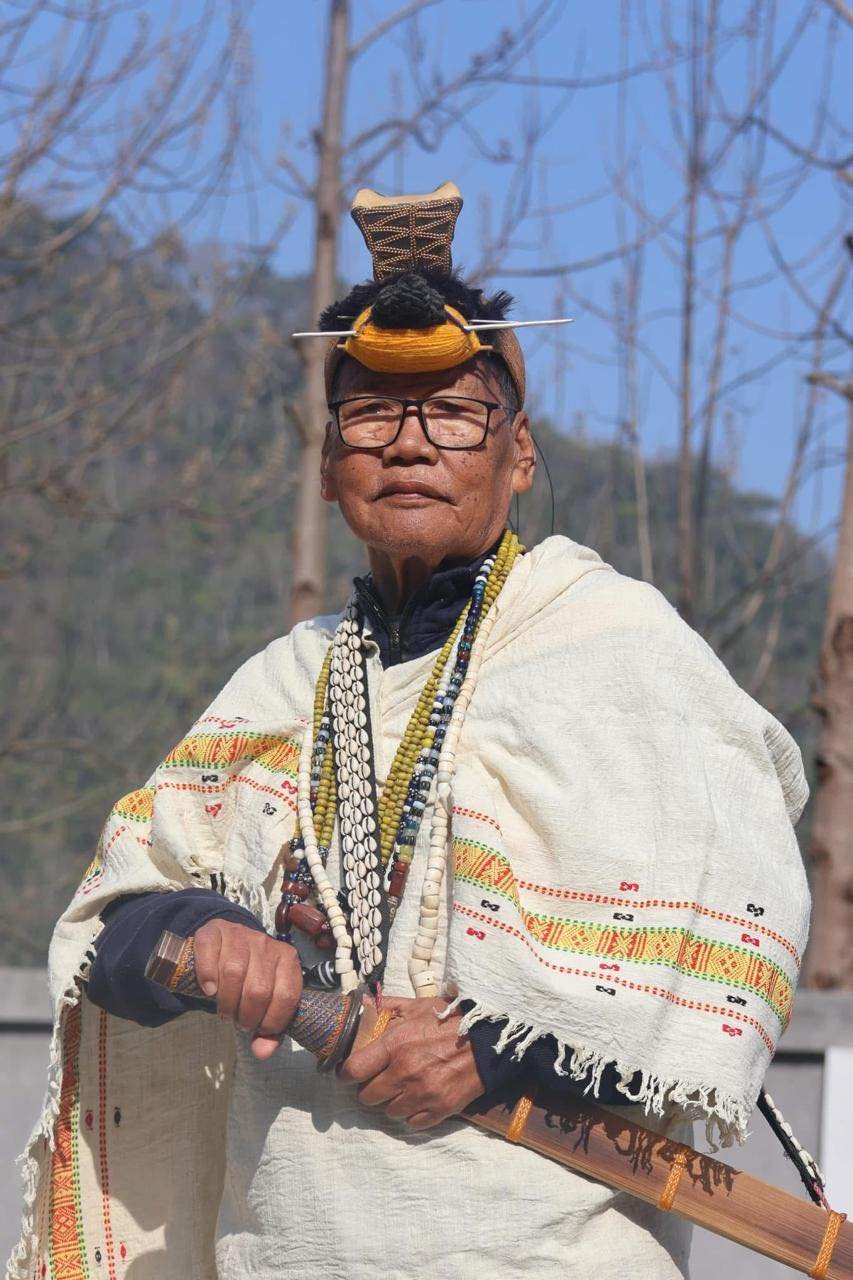
NAHARLAGUN : One of the most iconic figures of the state and president of the Arunachal Indigenous Tribes Forum (AITF), Dr Bengia Tolum, passed away on Thursday evening at TRIHMS here. He had been unwell for some time and was undergoing treatment at the hospital.
Born in 1956 at Chulyu village in present-day Keyi Panyor district, Tolum served six terms as president of the Nyishi Elite Society (NES) and was also the president of the All Nyishi Youth Association (ANYA). He was the founder president of AITF and played a pivotal role in uniting various tribes of the state under its umbrella. In 2013 he as president NES launched pan Arunachal movement in Yazali to unite tribes. He was awarded state gold medal for preservation and promotion of traditional art and culture.
He also served three terms as chairman of the Central Nyokum Committee (CNC), the oldest socio-cultural organization of the Nyishi community from 2013 – 2015, 2015 – 2019 and 2019 – 2022.
Tolum began his journey in social and community service in 1968 by forming the first Nyishi-based social organization, the Nyishi Students’ Multipurpose Society (NSMPS), at Ziro, with its headquarters at Yazali, to address the hardships faced by poor Nyishi students. Thereafter, he became the founder president of the All Nyishi Youth Association (ANYA) during its first-ever conference at Yazali in 1978. The organization had been rechristened from the All Nyishi Youth Organization (ANYO), which was formed at Yazali in 1976 and in which he had also served as a founder executive member.
The movement for changing the nomenclature from “Dafla” to “Nyishi,” along with the Nyishi unification movement, was spearheaded by him from that period onward. As president of ANYA, he led the first Nyishi Unification Expedition to the then Seppa Sub-Division in 1978, at a time when ANYA was the only Nyishi community-based social organization. The expedition became a historic benchmark in the Nyishi unification movement. Later, during his tenure as president of NES, the Seppa Nyishi unification initiative culminated in the historic “Ligu Affirmation” of 1998 at Ligu village in Upper Subansiri district on 19 December 1998.
On the cultural front, Tolum played a key role in introducing centralized Nyokum celebrations at Joram village in 1967, replacing the earlier fragmented village and clan-wise celebrations. He also served as the cultural adviser for the first feature film on the Nyishi social system, Mera Dharam; Meri Maa, directed by late Dr. Bhupen Hazarika in 1976.
He patronized Komchi-Lella (Vol I & II), the first audio album of the state and the community, and was a major sponsor of its production in 1989. The album became a repository of Nyishi patriotic songs and inspired momentum in the Nyishi unification movement, with Tolum himself contributing as a lyricist.
Under his leadership as NES president, several important peace and reconciliation initiatives were undertaken. The second Nyishi-Bodo Accord was signed at Seijosa in East Kameng district on 16 February 2012 to curb anti-social activities along the Assam-Arunachal border, following the first accord signed in Itanagar in 2002. On 4 September 2012, the Nyishis and Akas (Hrusso) signed the Bomdila Declaration under his leadership. Again, following the Seppa turmoil, the Seppa Peace Resolution of 2013 was signed under his guidance as NES president.
The historic Nyishi-Apatani Summit 2015, popularly known as NAS-15, was inked between the Nyishi and Apatani communities on 19 September 2015 after three rounds of Ziro Dialogues initiated in 2012. As president of AITF, he also facilitated the Roing Declaration of 2011 and later the Namsai Declaration of 2021 after years of peace missions in the region.
As a vernacular academician, Tolum gifted the Nyishi community its own script, modeled on the Roman script but incorporating seven vowels instead of five. He authored the Nyishi language textbooks Nyishi Agam Kitap – Akin for Class VI, Nyishi Agam Kitap – Enyi for Class VII, and Nyishi Agam Kitap – Oum for Class VIII. The third language was adopted in 2019 under his NES presidentship and is now being taught in the schools.
Under his leadership, numerous conflict resolution initiatives such as the Roing Peace Mission, Bomdila Declaration, Seppa Peace Resolution, Nyishi-Apatani Summit, Namsai Declaration, and the NES-ABK social reconciliation of September 2024 strengthened the spirit of brotherhood and inter-community harmony.
Recognizing peace as a prerequisite for development, Tolum also took responsibility for maintaining law and order during the volatile PRC issue of February 2019 and the APPSC fiasco of 2022.
While many knew him as the president of NES or AITF, Tolum never waited for a position to serve society. His dedication to public service was reflected in every aspect of his life.
In the early 1970s, when rice was scarce due to climatic challenges and crop damage, he opened a fair price shop at Yazali — the first in the entire Keyi Panyor district — ensuring access to rice not only for local residents but also for people from neighboring Mengio block in Papum Pare district.
In 1987, he established the first photo studio in Yazali, enabling people to obtain photographs for official purposes and preserve personal memories at a time when travel to Ziro or Lakhimpur for such services was extremely difficult.
During the 1980s, when Yazali Higher Secondary School was struggling to accommodate students from Keyi Panyor, Kurung Kumey, and Kra Daadi districts, Tolum envisioned providing quality education within the community itself. This vision led to the establishment of Abotani Academy on 14 July 1993. The institution has since produced numerous civil servants, police officers, doctors, engineers, teachers, administrators, politicians, and social leaders.
His mission was never profit-driven. Fees at the institution were minimal and often waived entirely for economically weaker students. He firmly believed that education should remain accessible to all. He was especially compassionate toward orphans, many of whom received free education and shelter at his own residence when guardians could not take them home during vacations.
In the 1980s, owing to the absence of medical stores in the region, he facilitated the establishment of a pharmacy at Yazali by bringing in a pharmacist from Assam. He also introduced daily bus services connecting Yazali with Ziro and Itanagar, significantly improving connectivity. In addition, he established a vehicle repair workshop and tyre resoling centres, namely Miranda Motorworks and Monalisa Trade and Tyres.
Despite running multiple establishments, his efforts were never motivated by profit. Charges remained nominal, often just enough to sustain operations. Though he appeared prosperous from the outside, he and his wife frequently faced financial struggles.
Among his many passions, preservation of tradition and culture remained foremost. In 1996, he organized a Nyishi language workshop at his own expense, covering travel, accommodation, and food for participants. This eventually led to the publication of Nyishi literature books such as Nyishi Kitab Akin, Nyishi Kitab Enyi, and Nyishi Kitab Oum, which were the result of years of research.
In 1997, he introduced Nyishi as a third language for Classes V, VI, and VII and personally taught students. He also trained them in Nyishi songs and encouraged the use of the language in daily conversations within school and hostel premises.
He extended his cultural efforts beyond his own institution by collaborating with VKV Sher, where he personally taught Nyishi songs alongside students of Abotani Academy. He also contributed to Nyedar Namlo, Yazali, by teaching devotional songs composed by him.
Tolum was a strong supporter of artists, providing them both financial assistance and platforms to showcase their talent. Many artists he supported in their early years later went on to achieve success.
His compassion transcended district boundaries. During the 1980s and 1990s, when students from Kurung Kumey and Kra Daadi struggled to secure admission in Yazali, he became their local guardian. Many of those students today serve the state in various capacities.
A proud Nyishi and a committed patriot, Tolum displayed remarkable courage during the Nyishi-Apatani conflict. At a time when the administration and law enforcement machinery were largely paralyzed, he coordinated with authorities and personally ensured the safe escort of Apatani civilians to Hapoli in Ziro.
When a former chief minister reportedly remarked that “Nyishis are only in quantity, not in quality,” Tolum led a strong protest by uniting community leaders and politicians. The movement became so impactful that the chief minister personally visited Tolum’s residence and reportedly offered him the post of EAC along with official perks. Tolum refused the offer, maintaining that a leader holding such views had no moral authority to govern. The protest eventually contributed to the fall of that government.
He also played a major role in opposing the proposed NEEPCO dam project that threatened to submerge Yazali town and displace thousands of residents. Despite being offered the position of liaison officer to withdraw his opposition, he remained firm in his stand. Eventually, NEEPCO abandoned the project, preserving Yazali’s land, heritage, and future.