

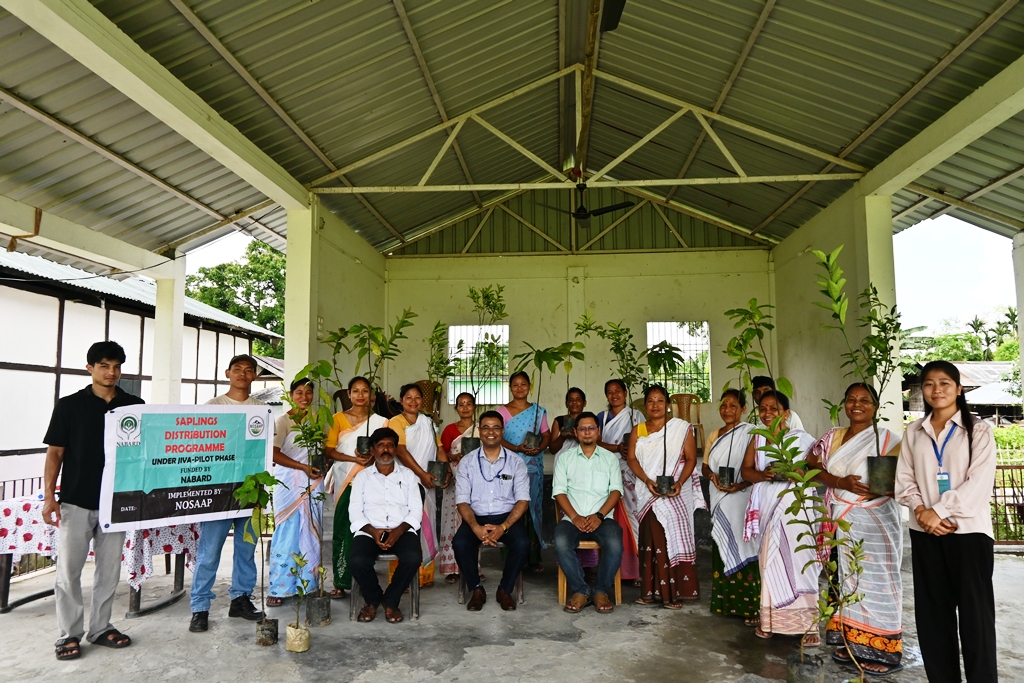
NAMSAI : A sapling distribution programme was organised at Jona Kochari village in Namsai district on Tuesday under the NABARD-funded JIVA (Natural Farming) Project to promote sustainable and climate-resilient agricultural practices.
As part of the initiative, saplings of guava, malta, mousambi, cocoa, lemon and other suitable species were distributed to project farmers for plantation along farm bunds.
The programme was conducted under the project component, “Regeneration of Soils and Improving Moisture/Water – Plantation on Farm Bunds”, aimed at improving soil health, conserving moisture, preventing soil erosion, enhancing biodiversity and creating additional sources of nutrition and income for farming households.
The JIVA Project, an agroecology-based initiative promoting environmentally sustainable and low-input natural farming practices, is being implemented by Namsai Organic Spices Agricultural Products Producer Company Limited (NOSAAP) as the Project Facilitating Agency.
In his opening remarks, NOSAAP Chief Executive Officer Chau Athina Chauhai highlighted the project’s objectives, including restoration of soil health, promotion of natural farming, strengthening nutrition security and improving the livelihoods of tribal farmers.
Addressing the gathering, NABARD Assistant General Manager (District Development) Kamal Roy informed farmers about the recently launched nationwide “Khet Bachao Abhiyan”, which will be observed throughout June. He said the campaign focuses on balanced fertiliser use, soil health management, promotion of natural and organic farming, prevention of counterfeit agricultural inputs and saturation of Kisan Credit Cards among eligible farmers.
Roy noted that the JIVA Project complements the campaign’s objectives by encouraging the adoption of sustainable and nature-friendly farming practices. He further stated that the project was launched by NABARD following the successful implementation of the TRIBES/Integrated Tribal Development (WADI) Project and reflects the institution’s holistic approach towards sustainable agriculture, natural resource management and livelihood enhancement.
The programme was attended by project beneficiaries and Self-Help Group (SHG) members. It concluded with the distribution of saplings and an appeal to farmers to actively participate in natural farming and environmental conservation initiatives. (DIPR)