

ITANAGAR : Chief Minister Pema Khandu on Friday reaffirmed the state government’s commitment to transforming Arunachal Pradesh’s rich handloom tradition into a vibrant economic sector by integrating traditional weaving with modern design, entrepreneurship and global market access while preserving its indigenous heritage.
Addressing the inaugural function of the three-day celebration of the 12th National Handloom Day at the DK Convention Centre here, Khandu described handloom as much more than a livelihood activity, calling it the cultural identity and living heritage of the indigenous tribes of Arunachal Pradesh.
“Every woven fabric of Arunachal tells the story of our people, our traditions and our identity. Our handloom sector has the potential to become a major driver of rural livelihoods, women empowerment and sustainable economic growth,” he said.
Highlighting the state’s weaving tradition, the Chief Minister said Arunachal Pradesh is home to more than 32,000 handloom weavers, the majority of them women, making the sector one of the largest sources of livelihood for rural households.
He said the government has been strengthening the handloom ecosystem through improved infrastructure, skill development, design innovation, marketing support and entrepreneurship promotion. Common Facility Centres (CFCs) have been established, weaving infrastructure upgraded and modern equipment introduced to improve productivity while preserving the authenticity of traditional designs.
Khandu said weavers are also being trained in contemporary design techniques, natural dyeing, quality improvement and product diversification to enhance their competitiveness in national and international markets. He added that various state and central government schemes are providing financial assistance, raw materials, modern looms and marketing support to weavers and artisan groups.
Urging young entrepreneurs to explore opportunities in the sector, he called for combining traditional craftsmanship with modern branding, digital marketing and e-commerce platforms.
Emphasising the pivotal role of women in preserving the state’s textile traditions, the Chief Minister said generations of women have safeguarded Arunachal’s cultural heritage through weaving.
“Our women have preserved our heritage through handloom for centuries. It is now our responsibility to ensure that this heritage also provides sustainable income and economic independence,” he said.
Khandu called for closer collaboration among government departments, designers, educational institutions, self-help groups, cooperatives and private entrepreneurs to develop Arunachal’s handloom products into globally recognised brands. He stressed the need for innovation without compromising the originality of indigenous designs, stating that value addition and quality enhancement would enable local products to access premium domestic and international markets.
The Chief Minister also highlighted the importance of securing Geographical Indication (GI) registration for the state’s indigenous textile products. He said GI certification would protect traditional knowledge, preserve the unique weaving traditions of different tribes, prevent imitation of indigenous designs and enable artisans to command better prices in the market.
Speaking on the potential of sericulture, Khandu described it as a natural extension of Arunachal Pradesh’s handloom ecosystem and a sector capable of generating sustainable livelihoods across rural areas. He noted that the state’s favourable climatic conditions support the production of Eri, Muga, Mulberry and Oak Tasar silk, making Arunachal one of the few states capable of producing all four commercially important varieties of silk.
He said strengthening the entire sericulture value chain—from host plant cultivation and silkworm rearing to spinning, reeling and weaving—would boost rural incomes while ensuring a steady supply of quality raw material for the state’s growing handloom industry.
Calling for greater convergence between the handloom, textiles and sericulture sectors, the Chief Minister urged officials to promote value addition, branding and stronger market linkages so that Arunachal Pradesh emerges as a leading producer of premium silk and handloom products in the country.
Expressing confidence in the sector’s future, Khandu said that with sustained government support, technological intervention and active participation of artisans and entrepreneurs, Arunachal Pradesh can emerge as one of India’s leading handloom destinations.
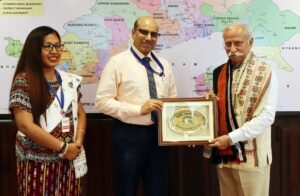
During the programme, the Chief Minister launched the Department of Textiles and Handicrafts’ official website, the Artisan Data Bank and Atii – Arunachal Honey. He also felicitated outstanding weavers and artisans and distributed SAMARTH certificates and Yarn Pass Books to support handloom artisans.
The inaugural function was attended by ministers, legislators, senior government officials, representatives of the handloom sector, master weavers, artisans, self-help groups and other stakeholders from across the state.