

Aina Darang
KOMSING, AUG 14:
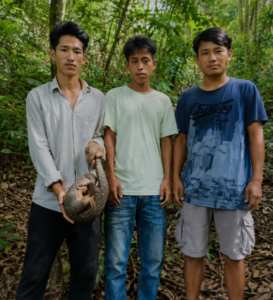
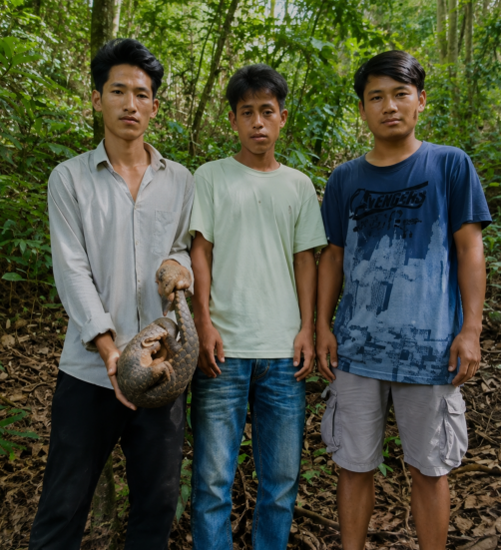
A quiet journey along a newly constructed village road in Komsing, Siang district, took an unexpected turn on Friday night when a group of local youth encountered a pangolin crossing the road.
Recognising the animal and the danger posed by passing vehicles, the youth stopped and rescued it from the road. The animal was carefully observed to assess its health condition and, after it was found to be in suitable condition for release, was safely returned to the wild in the presence of the Gaon Bura, Tayam Taloh.
“The pangolin is not commonly seen in our area anymore. To help protect this species, we decided to release it back into the wild. I appeal to anyone who encounters a pangolin to do the same and safely release it back into its habitat. This is an example we are trying to set, and we hope others will follow it,” said Tayam Taloh, Gaon Bura of Komsing.
The incident may appear to be a small act of helping an animal in distress, but for one of the world’s most threatened mammals, it carries a wider conservation message.
The Chinese pangolin (Manis pentadactyla) is a nocturnal and elusive mammal, making it difficult to observe in the wild. Pangolins are insectivorous, and their main diet consists of ants and termites, earning them the nickname “scaly anteaters.” They are primarily active at night and spend considerable time in burrows, making direct sightings relatively uncommon. Classified as Critically Endangered on the IUCN Red List, the species continues to face threats from hunting, illegal trade and habitat loss. The Chinese pangolin is protected under Schedule I of the Wildlife (Protection) Act, 1972, and listed under Appendix I of CITES.
From a research perspective, an encounter like this is important because the Chinese pangolin is a difficult animal to observe. Every well-documented sighting can help us understand where the species is still found and how it uses the landscape. Although considerable research has been carried out on pangolins globally, there are still gaps in our understanding of their ecology and population status in India, particularly in the Northeast. Arunachal Pradesh is considered an important stronghold for the Chinese pangolin, making it especially important to understand the species and the habitats it uses while there is still an opportunity to protect it. Without knowing where pangolins occur, how they use their habitat and what threats they face, it becomes difficult to plan effective conservation measures.
The Komsing rescue also highlights why community awareness is important for pangolin conservation. In landscapes where villages, roads, agricultural areas and natural habitats exist alongside one another, residents may be among the first people to encounter wildlife. Knowing how to respond when an animal is found can therefore make a real difference.
My work on Chinese pangolin conservation in Komsing has also involved working with local Self-Help Groups to link conservation with livelihoods, including adding pangolin conservation messages to the packaging of locally made pickles. These efforts are gradually encouraging community members to take an active role in pangolin conservation. Similar community-led efforts have also emerged elsewhere in the Siang landscape. In 2023, farmers in Silluk village rescued a Chinese pangolin from a poacher and helped return it safely to the wild. The recent rescue in Komsing is another encouraging example of how local awareness can translate into action when communities encounter wildlife.
For the community, the rescue demonstrates how simple actions recognising wildlife, preventing harm and allowing an animal to return safely to its habitat can contribute to conservation. Pangolin habitat is not always far from people. These animals can occur close to villages, agricultural areas and other places where people live and work. In the past, people and wildlife may have shared these landscapes with fewer conflicts. But as roads, settlements and other changes continue to reshape the landscape, an important question remains: Can people and pangolins continue to coexist in the same places today?
In the case of the Chinese pangolin, every encounter is an opportunity not only to protect an individual animal, but also to learn more about a species that remains difficult to see and increasingly important to conserve.