

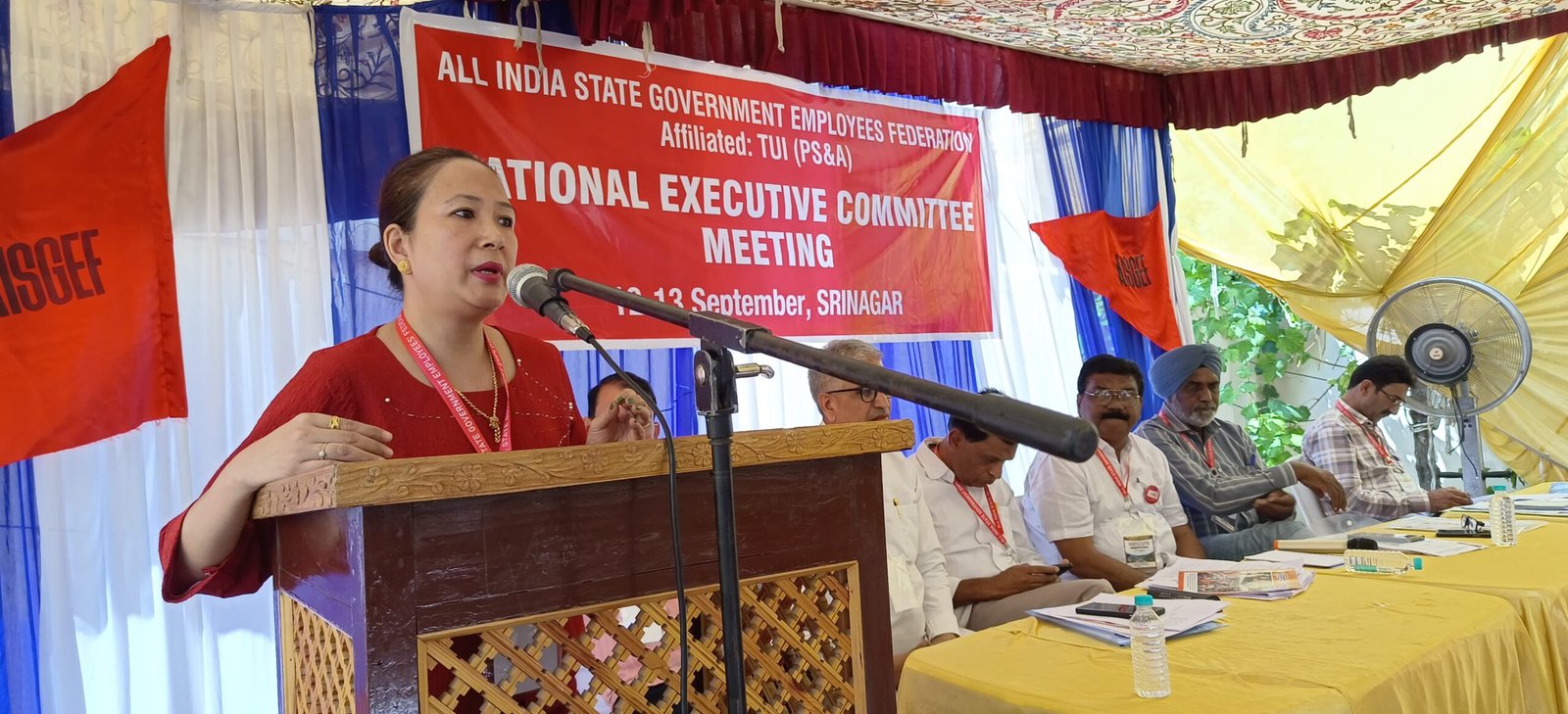
SRINAGAR (J&K), SEP 15:
The Confederation of Service Associations of Arunachal Pradesh (CoSAAP) has urged the All-India State Government Employees Federation (AISGEF) to formally endorse and pursue special incentives, allowances and other service-related demands for government employees serving in Arunachal Pradesh and the North-Eastern Region before the 8th Central Pay Commission (8th CPC) and the Government of India.
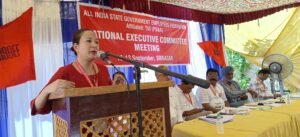
The demands were placed during the two-day National Executive Committee (NEC) meeting of AISGEF being held in Srinagar from September 12, with representatives of employees’ associations, federations and unions from 22 states participating.
CoSAAP President Likha Tech and Secretary General Leena Taggu represented the organisation and highlighted the distinctive geographical, administrative, socio-economic and service-related challenges faced by government employees in the Northeast. The proposals were placed through the North Eastern States Government Employees and Teachers’ United Forum (NESGETUF), an initiative of CoSAAP.
Representatives of employee organisations from Assam, Meghalaya, Nagaland, Mizoram, Manipur, Sikkim and Tripura supported the proposals.
CoSAAP sought a substantial enhancement and extension of Special Duty Allowance (SDA), proposing a minimum rate of 20–25 per cent of basic pay for eligible state government employees serving in the Northeast. It also sought a dedicated Border Area Allowance of 10–15 per cent of basic pay for employees posted in notified international-border areas, besides a separate allowance for those serving in highly remote, inaccessible and difficult areas.
The organisation said the region’s difficult terrain, limited connectivity, scattered habitations, challenging climatic conditions, high transportation and logistics costs and inadequate access to healthcare, education and other infrastructure make postings particularly difficult. It said these factors could affect the attraction and retention of specialised manpower, administrative continuity and effective public service delivery.
CoSAAP also urged AISGEF to pursue, as a priority, a field visit by the Chairperson and members of the 8th CPC to the Northeast, particularly remote, difficult and international-border areas of Arunachal Pradesh. If visits to extremely remote locations are not feasible, it suggested that the Commission visit the capitals of all eight North-Eastern states and consult state governments, employee organisations and other stakeholders.
According to CoSAAP, such visits would provide first-hand understanding of difficult terrain, inadequate road, air and communication connectivity, high logistics costs, limited healthcare and educational facilities, shortage of specialised manpower, inadequate government accommodation, climatic challenges and security sensitivities associated with international-border postings.
The organisation further proposed that eligibility for border and remote-area benefits be determined through objective criteria such as geographical remoteness, terrain, connectivity, distance from headquarters, availability of healthcare and educational facilities, climatic conditions and security sensitivity.
CoSAAP stressed that the strategic importance of the Northeast, particularly its international boundaries with China, Bhutan, Myanmar and Bangladesh, warranted special consideration in employee incentive policies. It called for eligible border districts, subdivisions, circles and other administrative areas to be identified and notified on the basis of objective geographical and administrative criteria rather than merely district nomenclature.
AISGEF accepts proposal
Considering the nature of the issues raised by CoSAAP, the AISGEF National Executive Committee unanimously resolved to place and pursue the proposals before the Government of India and the Chairperson and members of the 8th CPC.
CoSAAP also sought broader employee-related reforms, including comprehensive pension reform with assured retirement security, consideration of restoration of the Old Pension Scheme (OPS) and a minimum fitment factor of 3.25 or higher, as deemed appropriate by the 8th CPC. It specifically urged AISGEF to pursue the scrapping of the National Pension System (NPS) and restoration of the OPS.
CoSAAP maintained that the working conditions of government employees in the Northeast, particularly Arunachal Pradesh, should not be assessed solely through statistical or documentary data. It said the ground realities of employees posted in remote and border areas needed to be taken into account while framing the 8th CPC recommendations.
On the sidelines of the NEC meeting, the CoSAAP leadership also urged delegates to condemn all forms of racial discrimination and prejudice. It called upon employees’ organisations to take a proactive and collective stand against discrimination faced by people from the Northeast in different parts of the country and stressed that the dignity, equality and constitutional rights of every citizen must be respected irrespective of region, ethnicity, appearance, language or cultural identity.
CoSAAP welcomed the AISGEF resolution and expressed hope that the federation would continue to pursue the demands collectively in the larger interest of government employees of the Northeast, particularly Arunachal Pradesh.