

PASIGHAT, OCT 10:
Contemporary Hindi poetry cannot be confined to a single ideology and should be understood as a form of resistance that challenges dominant cultural practices, said Dr. Arundhati, Assistant Professor at Satyawati College, University of Delhi, during a special lecture at Arunachal Pradesh University (APU) on Thursday.
The lecture on contemporary Hindi poetry and feminist discourse was organised by the APU Department of Hindi in collaboration with the Central Hindi Directorate under the Ministry of Education’s Pradhyapak Vyakhyan Mala programme.
Tracing the evolution of contemporary poetry from the Renaissance, Dr. Arundhati said poets across generations had enriched the literary landscape by sensitively portraying diverse life experiences, including their smallest manifestations.
Focusing on women’s voices in contemporary poetry, she referred to poets Katyayani and Anamika to discuss women’s expression, identity and position in society. She also highlighted the contributions of Adivasi writers and the lived experiences reflected in their works.
“Women’s liberation is not limited to women alone but is closely linked to the liberation of society as a whole,” she said, adding that feminism contributes to building a more equal and sensitive society. She observed that contemporary poetry seeks to capture multiple layers of reality while resisting market-driven values.
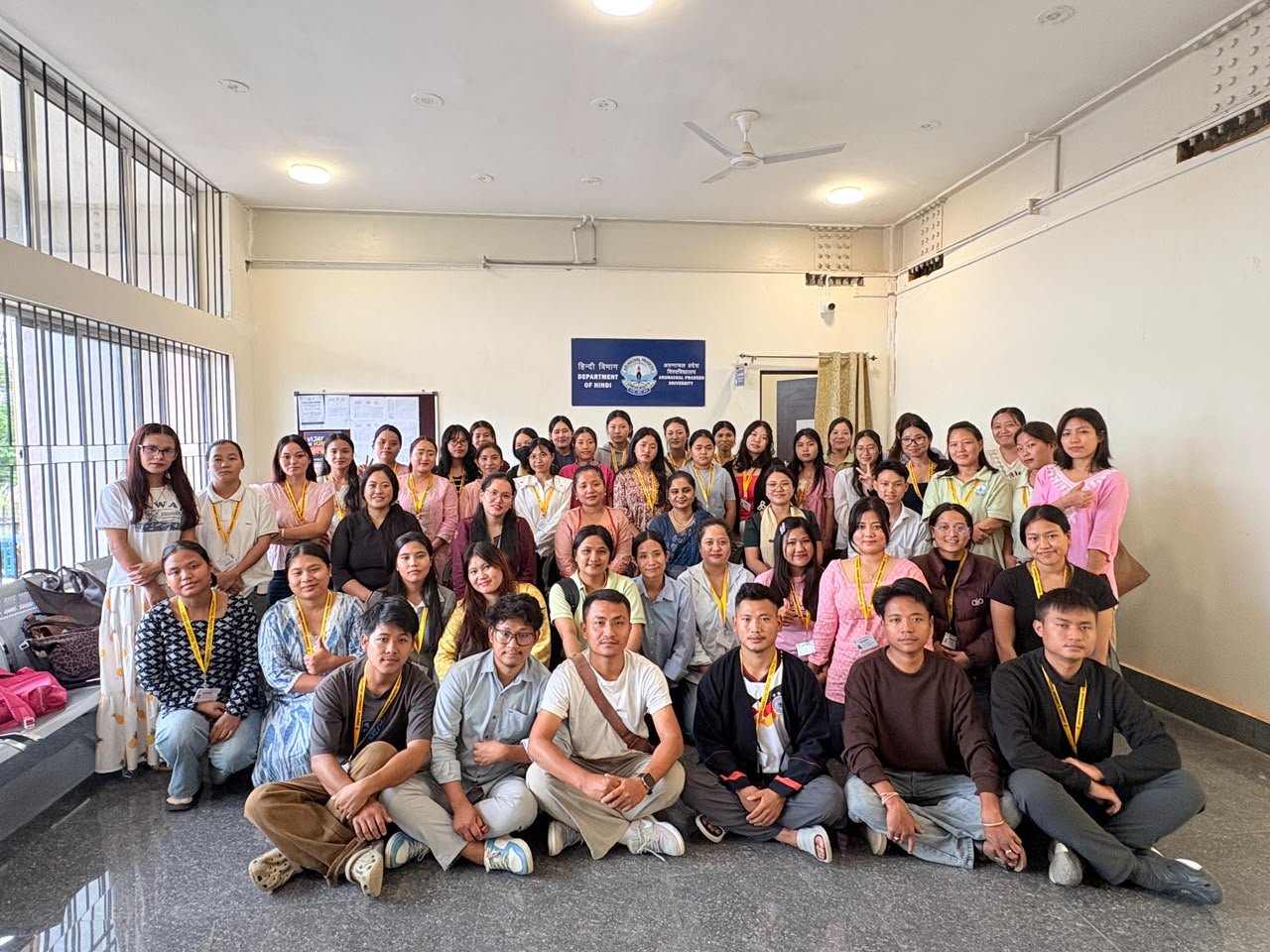
Earlier, programme coordinator Nanang Yirang, Assistant Professor (Guest Faculty), welcomed the speaker and said the lecture would help M.A. Hindi students gain a deeper understanding of their syllabus and explore the subject through expert insights.
An interactive session followed, during which research scholars and students engaged with the speaker. Dr. Arundhati encouraged them to create platforms for creative expression and incorporate the cultural sensibilities, experiences and local realities of Arunachal Pradesh into Hindi poetry.
Head of the Department Dr. Ing Perme thanked the speaker for explaining curricular themes in a simple and comprehensive manner and expressed the department’s intention to organise more such lectures.
The programme concluded with research scholars and postgraduate students presenting their original poems and songs.