

NIRJULI, NOV 7:
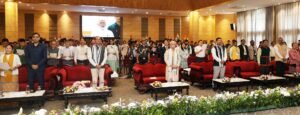
The two-day international conference, titled ‘Invisible Struggles: Mental Health and the Lived Realities of the Peripheralized’, concluded at the North Eastern Regional Institute of Science and Technology (NERIST) here on Friday.
The event was organised by the Department of Humanities and Social Sciences, NERIST, in collaboration with the Ministry of Tribal Affairs, Government of India and the Department of Social Justice and Empowerment and Tribal Affairs, Government of Arunachal Pradesh, in association with two knowledge partners – Kolkata-based BRIDGE and Mumbai-based Mariwala Health Initiative.
The seminar brought together leading experts in the field from prominent institutions and organization across the country and abroad, including university of Kent, United Kingdom, IIT Bombay, Gauhati university, George institute of Global Health, Rajiv Gandhi University, Mariwala Health initiative, AP queer station, Rainbow Hills Association, the Collective Trust, Sikkim; Xomonnoy, Guwahati; All Trans Man Association, Manipur, who deliberated over two technical sessions on relevant themes.
On the second day, two panel discussions took place. The first panel discussion titled: “Cultural and Tribal Perspectives on Mental Health and Suicide Prevention” was curated by MariwalaHealth Initiative, Mumbai. Aleen Barwa, Associate at Mariwala Health Initiative for Indigenous Mental health was the moderator.
The four panellists: Binita Ekaa Psychiatric Social Worker, Department of Health & Family Welfare, Government of Odisha, Dr Raile R Ziipao Associate Professor of Sociology, Department of Humanities and Social Sciences, IIT Bombay, Dr Tarun Mene Assistant Professor, Arunachal Institute of Tribal Studies, Rajiv Gandhi University, Arunachal Pradesh, Dr Reep Pandi Lepcha Assistant Professor, Department of English, SanchamanLimboo Government College, Gyalshing, West Sikkim.
The panel explored mental health through the lens of indigenous knowledge, justice and cultural identity, emphasizing the importance of contextual and community-based approaches to suicide prevention.
The session concluded with a call to recognize indigenous worldwide views and collective practices as centre to building inclusive, virtually grounded mental health frameworks.
The second panel, “Mental Health Ecosystem – Reflections and Lived Experiences of LGBTQ+ Individuals,” curated by BRIDGE, Kolkata, highlighted that mental health is profoundly shaped by social acceptance, home, and community support, extending far beyond clinical settings.
The discussion, featuring panellists namely Rudrani Rajkumari, Trans Queer Activist, Xomonnoy Assam; Viveka Gurung, Assistant Professor, Department of Sociology Nar Bahadur Bhandari Government College cum Executive Member, Rainbow Hills Association, Sikkim; Sopin Laishram, Executive Member, All Trans Man Association, Manipur; Sawang Wangchha, Founder, AP Queer Station alongwith the moderator Prithviraj Nath, Founder Director, BRIDGE, explored the complex intersections of identity, stigma, and well-being, pointing to persistent challenges like transphobia, unemployment, and institutional neglect.
Participants strongly underscored the need for sustained funding, gender sensitization, and the inclusion of gender studies in education. Furthermore, the conversation stressed integrating indigenous and community-based approaches into mental health frameworks, noting the significant gap between policy and the real-world implementation of queer rights.
A critical point raised by AP-Queer Station was that, given the limited resources in Arunachal Pradesh, the community’s immediate need is not just for formal therapy but for genuine allies who will listen and understand.
Addressing the common narrative, the panel asserted that while the community uses the language of human rights, their identities and struggles are indigenous to the region, urging society to validate and see their realities.
Overall, the session called for the creation of an inclusive and empathetic ecosystem to support the mental well-being of all LGBTQ+ individuals.
The conference concluded with a valedictory function in which Dr P Parida, Organizing Chair, kicked off the event with a sincere welcome, setting an inclusive tone by wishing every attendee would “leave as a friend”.
Dr Geling Modi Joint Convener gave an overview of the international conference. This spirit of openness was leveraged in the addresses, starting with ProfRajive Mohan Pant, Vice Chancellor, Assam University poignant reflection on the academic sector. He underscored that in this fast-changing world, stress is inevitable, and urged the educational system to discuss these pressures and “see the invisible” distress among students – recalling a tragic suicide over high math scores – and to advocate for the unconditional support championed by Prof. Anand Prakash.
Prof.Sarsing Gao, the Dean Academic, confirmed the conference’s impact, noting the significance of viewing mental health not from a purely individual perspective rather a systemic one, and praised the inclusion of gender issues.
This urgency was amplified by Prof. Narendranath S, Director of NERIST, who issued a compelling call to action: the duty now is to translate learned experiences into “concrete actions” and uphold integrity to build community momentum, stressing the necessity of openly discussing the “limitations of the institute and education” itself to overcome them.
Beyond the keynote addresses, the conference successfully fostered creative dialogue through student competitions commemorating Suicide Prevention Month, with Nani Pinky (PhD, Physics) taking first in Poster Making, Pophi Tapi (BTech III, Mechanical) winning the Poetry Competition, and Merelyn Remruatpuii (BTech III, Electrical) securing the top spot in Creative Writing.