


Staff Reporter
ITANAGAR : The All Arunachal Pradesh Students’ Union (AAPSU) on Tuesday submitted a comprehensive 13-point charter of demands to Chief Minister Pema Khandu, seeking stronger constitutional safeguards, protection of indigenous rights, enhanced employment opportunities for local youth and measures to secure the socio-political future of the state’s tribal communities.
Addressing a press conference at the Arunachal Press Club (APC) here, AAPSU president Mize Taku described the memorandum as the “collective voice and aspirations of the indigenous people of Arunachal Pradesh”, stating that the issues raised concern the protection of identity, land, livelihood and constitutional rights.
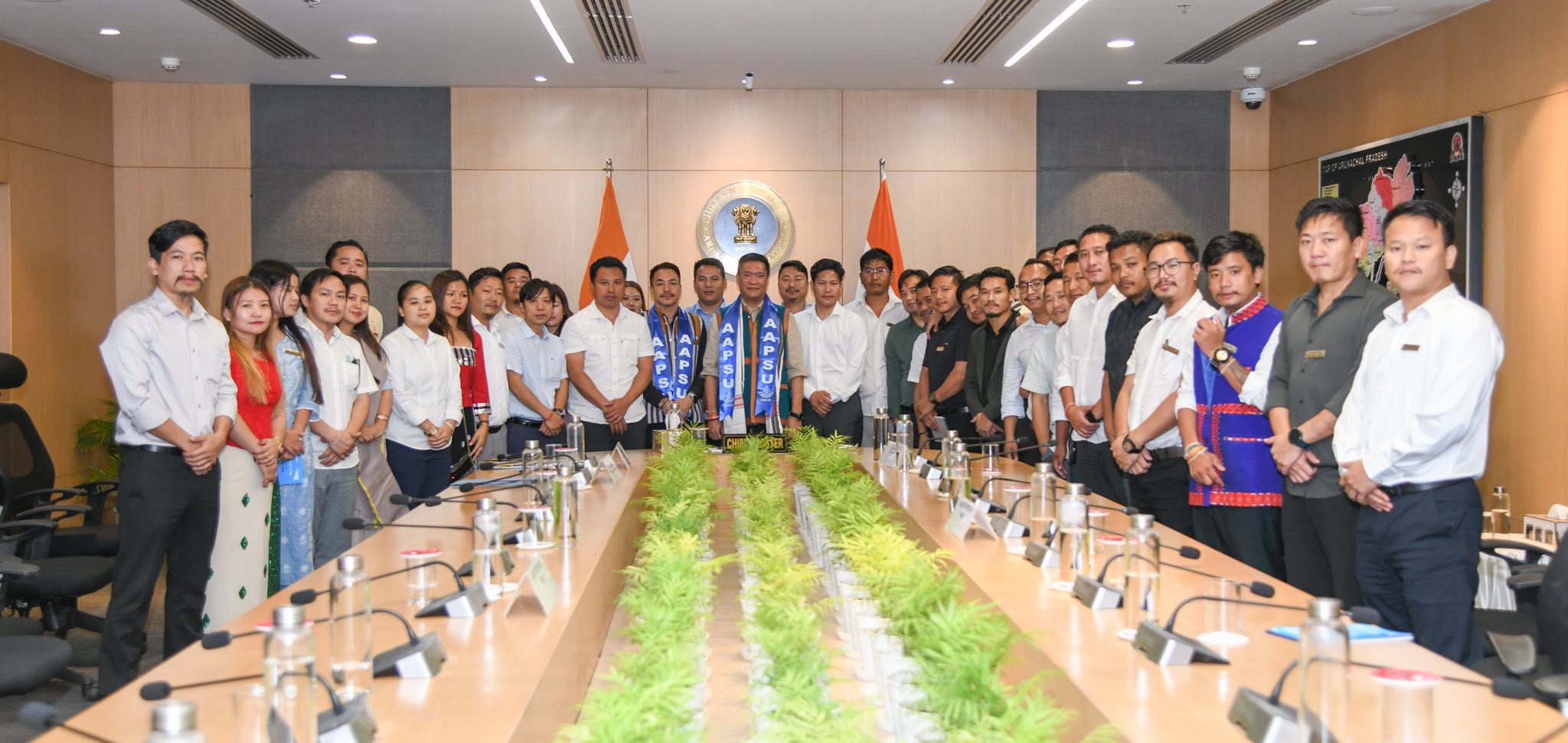
The memorandum was submitted during a meeting between the Chief Minister and AAPSU’s central executive members at the Civil Secretariat earlier in the day.
Among its key demands, AAPSU called for the abolition of the existing 80:20 recruitment ratio in state government jobs, under which 80 per cent of posts are reserved for Arunachal Pradesh Scheduled Tribe (APST) candidates and 20 per cent remain open to non-APST applicants. The union argued that the policy, introduced in 1990, has become outdated and no longer adequately safeguards indigenous interests.
The students’ body also sought mandatory submission of Permanent Resident Certificate (PRC) and APST certificates in all competitive recruitment examinations conducted in the state. It further urged amendments to recruitment rules to prevent misuse of fraudulent documents and plug existing loopholes.
AAPSU demanded amendments to the Arunachal Pradesh Panchayati Raj Act, 1997, making PRC and APST certificates compulsory for candidates contesting Panchayati Raj Institution (PRI) elections.
The union cited the election of a non-APST candidate from Vijaynagar in Changlang district during the 2025 Panchayat elections as an example of a legislative gap requiring urgent correction.
On constitutional issues, the union reiterated its demand for the re-amendment of Article 371(H), terming it the most significant issue in its charter. AAPSU maintained that the provision does not provide adequate constitutional safeguards for customary laws, land ownership and natural resources compared to protections available under Articles 371(A) and 371(G) in neighbouring tribal-majority states.
The union also renewed its opposition to the permanent settlement of Chakma and Hajong refugees in Arunachal Pradesh and urged the government to pursue a long-term and honourable resettlement solution outside the state while ensuring that no additional land is allocated to non-indigenous settlers.
While welcoming progress made in resolving the Arunachal Pradesh-Assam boundary dispute through recent agreements, AAPSU noted that several disputed villages remain unresolved. It demanded construction of a dedicated corridor road along the inter-state boundary to strengthen territorial security, improve connectivity and prevent future encroachments.
The memorandum also raised concerns over the continued issuance of stapled visas to residents of Arunachal Pradesh by foreign authorities, terming the practice an affront to India’s sovereignty. It further called for stricter implementation of the Inner Line Permit (ILP) system and stronger measures to curb illegal immigration into the state.
Expressing concern over incidents of racial discrimination against people from the Northeast in different parts of the country, the union demanded a dedicated national anti-racism law, stricter legal action against racial abuse and violence, and inclusion of Northeast India’s history and culture in school curricula.
To address unemployment, AAPSU proposed a dedicated startup package for indigenous youth, including collateral-free financial assistance, mentorship support and market linkages. It also sought the introduction of a Chief Minister’s Research Fellowship for APST scholars pursuing doctoral studies in institutions across the state.
Other demands included establishment of permanent Common University Entrance Test (CUET) centres in Itanagar, Naharlagun and Pasighat, creation of a government-recognised protest ground in the Itanagar Capital Region, and setting up of a government-run Working Women’s Hostel to provide safe and affordable accommodation for women from remote districts.
Taku urged the state government to take time-bound action on the demands and warned that the union may resort to democratic forms of agitation if the issues remain unaddressed.