

Staff Reporter
ITANAGAR : The All Arunachal Pradesh Students’ Union (AAPSU) on Saturday strongly opposed the proposed consultative meeting on the inclusion of the Kachari community of Namsai and Changlang districts as a Scheduled Tribe (ST), sub-tribe or plains tribe in the National Population Census, prompting the state government to cancel the exercise.
The consultative meeting, convened by the Department of Social Justice, Empowerment and Tribal Affairs (SJETA), was scheduled to be held at the Civil Secretariat on July 13 under the chairmanship of the state’s Chief Secretary.
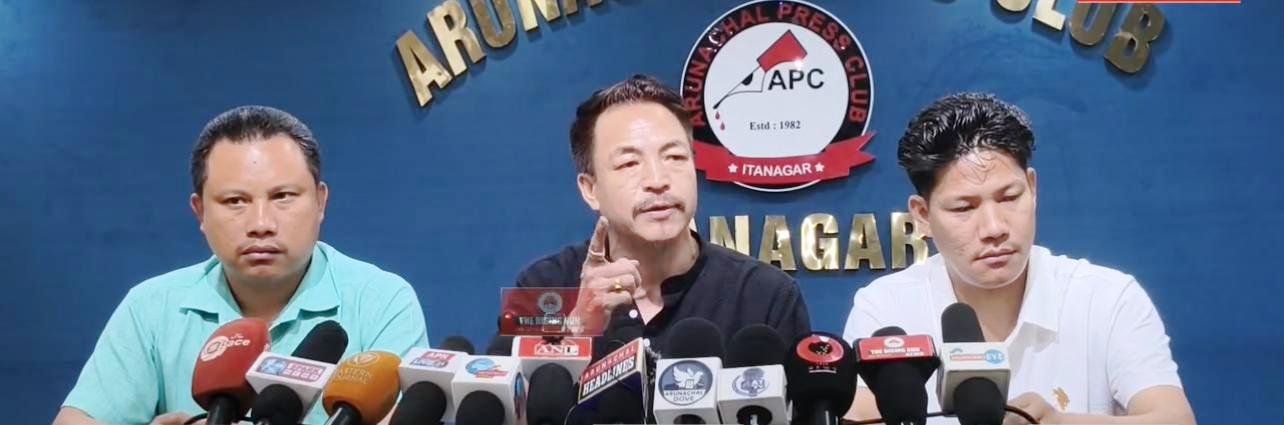
Addressing a press conference at the Arunachal Press Club here, AAPSU president Meje Taku said the apex students’ body was firmly against any move to extend Scheduled Tribe status to communities that are not indigenous to Arunachal Pradesh. He warned that the union would intensify its democratic agitation if the proposal was pursued.
“Arunachal Pradesh is a 100 per cent tribal state protected by the Inner Line Permit (ILP) regime under the Bengal Eastern Frontier Regulation, 1873. Any move to extend ST status to non-indigenous communities will weaken the constitutional and legal safeguards protecting the state’s indigenous population,” Taku said.
Questioning the basis of the proposal, he pointed out that the Sonowal Kachari community already enjoys Scheduled Tribe (Plains) status in neighbouring Assam. He cautioned that relaxing the existing criteria for ST recognition in Arunachal Pradesh could encourage similar demands from other communities with historical or ethnolinguistic links to the state, thereby affecting its demographic and political balance.
Taku also warned that proceeding with the proposal could disturb peace and social harmony in the state and held the government responsible for any consequences arising from the process.
Following AAPSU’s strong opposition, the SJETA later issued a circular on Saturday announcing that the consultative meeting “stands cancelled.”
Meanwhile, AAPSU reiterated its demand that no recruitment advertisement be issued by the Arunachal Pradesh Public Service Commission (APPSC) or the Arunachal Pradesh Staff Selection Board (APSSB) until the high-level committee reviewing the existing 80:20 recruitment ratio submits its final report.
Taku informed that the state government had constituted a high-level committee, headed by Industries, Skill Development and Labour & Employment Minister Nyato Dukam, to examine the feasibility of abolishing the 80:20 reservation ratio in state government recruitment and making Permanent Resident Certificate (PRC) and APST certificates mandatory in all competitive recruitment processes. The committee was constituted through an order issued by the Department of Administrative Reforms and Training (AR&T) on July 6.
The AAPSU president also recalled that the union had earlier submitted a 13-point memorandum to Chief Minister Pema Khandu seeking urgent government intervention on issues concerning indigenous rights, employment, education and constitutional safeguards.
Among its key demands, the union sought the abolition of the 80:20 recruitment ratio, mandatory verification of PRC and APST certificates in all recruitment processes, and strict action against candidates found using forged documents to obtain government jobs and benefits.
The memorandum also called for the introduction of a single-window scholarship disbursement system, effective implementation of the Chief Minister’s Research Fellowship for APST scholars, and the establishment of Common University Entrance Test (CUET) centres within Arunachal Pradesh to reduce the burden on students travelling outside the state for examinations.
Additionally, AAPSU reiterated its demands for strengthening constitutional safeguards for indigenous communities, resolving the Chakma-Hajong issue, curbing illegal immigration, and addressing racial discrimination against people from the Northeast.
Taku said Chief Minister Pema Khandu had received the memorandum positively and assured the union that the issues raised would be examined at the earliest.