

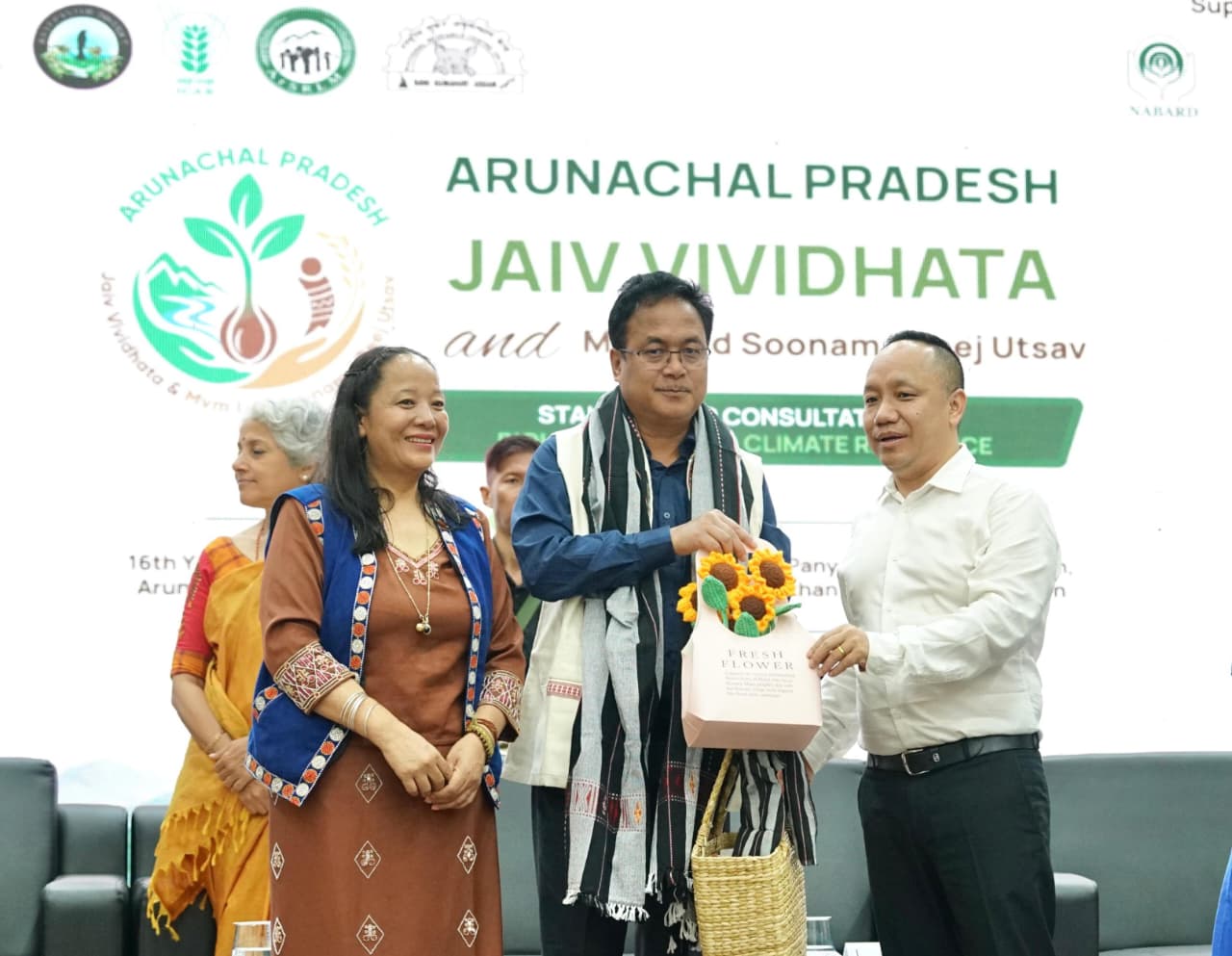
YAZALI : Arunachal Pradesh Agriculture and Allied Departments Minister Gabriel D Wangsu on Thursday said Arunachal Pradesh has the potential to emerge as a national model for sustainable and community-driven development, while inaugurating the two-day Arunachal Pradesh Jaiv Vividhata and Mvm Liid Soonam/Beej Utsav 2026 at Government Higher Secondary School, Yazali in Keyi Panyor district.
The programme, which also included a stakeholder consultation on biohappiness and climate resilience, was jointly organised by the 16th Yachuli MLA Office, Krishi Vigyan Kendra Keyi Panyor, Arunachal State Rural Livelihoods Mission and the M S Swaminathan Research Foundation, Chennai.
Addressing farmers, scientists, researchers, policymakers and indigenous community representatives from across the state, Wangsu said the answers to sustainable development already exist within Arunachal Pradesh’s traditional knowledge systems and farming practices.
“The world is searching for sustainable models of development, and the answers already exist in Arunachal Pradesh,” he said.
Highlighting the growing impact of climate change on agriculture, the Minister said erratic rainfall, shorter winters and increasing floods are adversely affecting farmers and rural communities. He stressed that indigenous rice varieties and traditional crops preserved by local farmers over generations are naturally adapted to local ecosystems and are crucial for future food security and climate resilience.
“Losing these traditional crops would not only be a cultural loss, but also a serious threat to our future food security and resilience,” he said.
Calling for collective action, Wangsu said biodiversity conservation and climate resilience cannot be achieved through government efforts alone.
“Community participation is the key because no government alone can protect biodiversity, and no scientist alone can conserve seeds,” he remarked, urging villages, panchayat institutions, youth groups and farming communities to actively participate in conservation initiatives.
The Minister also welcomed increasing awareness on the Protection of Plant Varieties and Farmers’ Rights Act and appreciated efforts to secure intellectual property rights protection for 12 indigenous paddy varieties from Lower Subansiri district.
Describing quality seeds as the foundation of agricultural transformation, Wangsu stressed the need to strengthen seed villages, community seed banks, local seed certification systems, cold storage infrastructure and farmer-led seed production systems across the state.
He further highlighted the role of women in preserving agrobiodiversity, describing them as the “true custodians of biodiversity” in tribal communities.
Encouraging greater youth participation in agriculture, Wangsu urged young people to view the sector as a modern and innovative profession linked to sustainability, entrepreneurship, food processing, eco-tourism and digital marketing.
“Our young people must see agriculture not as a last option, but as a meaningful profession that connects livelihood with sustainability,” he said.
Reaffirming the commitment of the state government under Chief Minister Pema Khandu, the Minister said the state is working closely with premier institutions and stakeholders to promote climate resilience and sustainable development suited to the ecological conditions of the Northeast.
A major attraction of the programme was the Arunachal Seed Festival and Agrobiodiversity and Sustainable Livelihoods Exhibition, where community seed conservers, particularly from the Nyishi and Apatani communities, showcased indigenous crop varieties, traditional farming practices and biodiversity-based livelihood models.
The inaugural programme was attended by 16th Yachuli MLA Toko Tatung, M S Swaminathan Research Foundation Chairperson Dr Soumya Swaminathan, architect Rajeev Sethi, Protection of Plant Varieties and Farmers’ Rights Authority Guwahati Dr Atul Chandra Sharma, Keyi Panyor Deputy Commissioner Shweta Nagarkoti Mehta, M S Swaminathan Research Foundation Biodiversity Programme Director Dr E D Israel Oliver King, representatives from NABARD, Rajiv Gandhi University, Indian Council of Agricultural Research institutions and farmers from different districts.