

NEW DELHI, AUG 22:
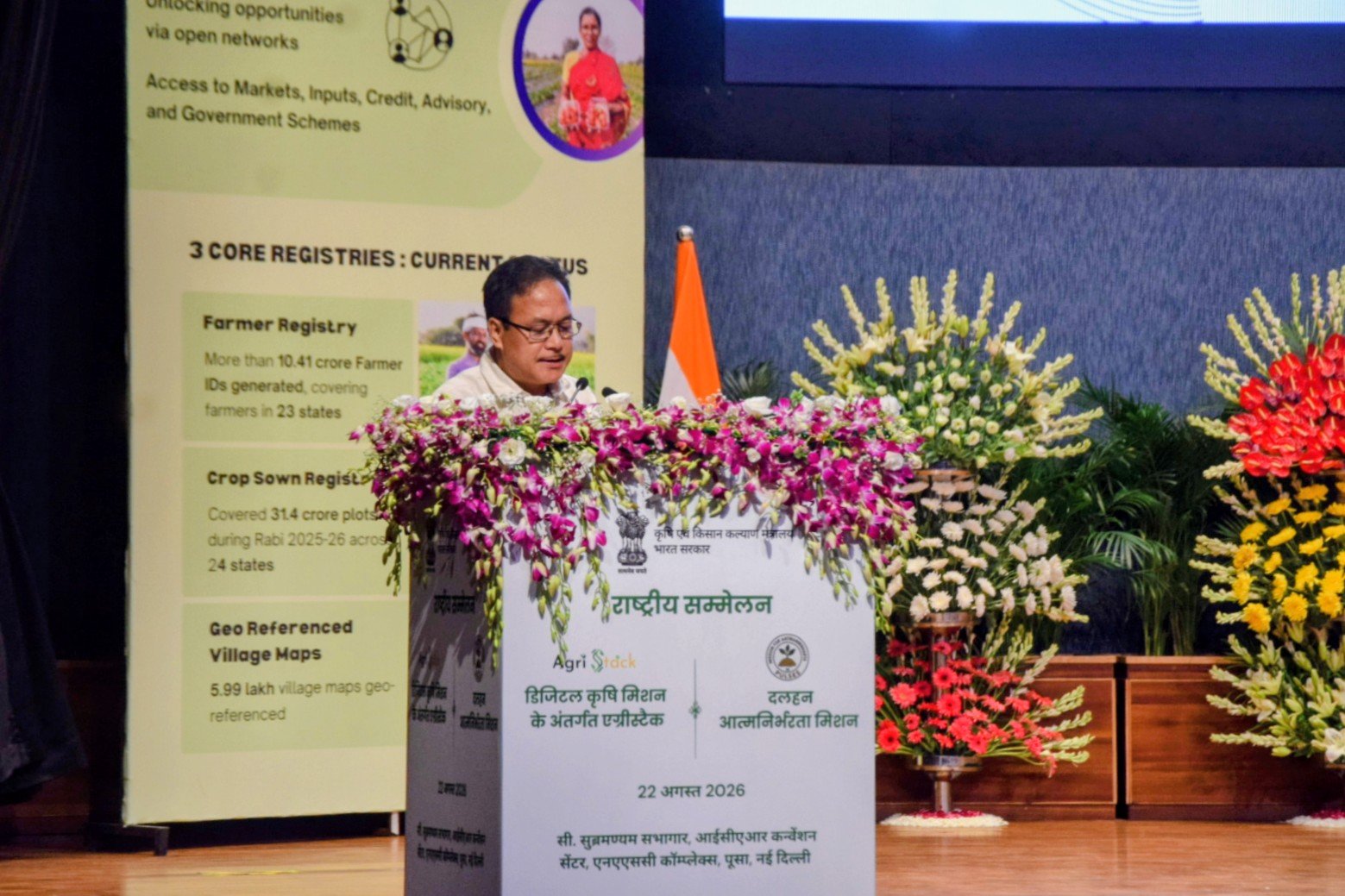
Arunachal Pradesh has showcased its experience of developing a digital agricultural ecosystem in the absence of conventional land records at the National Conference on AgriStack under the Digital Agriculture Mission and Mission for Aatmanirbharta in Pulses at the ICAR Convention Centre Pusa here.
Representing the State, Agriculture Minister Gabriel D Wangsu highlighted the challenges posed by the State’s Non-Record of Rights (Non-RoR) land environment and called for greater methodological flexibility in implementing AgriStack in geographically and administratively diverse regions.
Wangsu said the absence of conventional digitised land records posed a fundamental challenge to the standard AgriStack architecture, particularly in establishing a reliable link between farmers and agricultural land parcels. Instead of treating the limitation as an obstacle, the State developed a customised Non-RoR methodology and Standard Operating Procedure for identifying and validating farm plots and the farmers cultivating them.
The methodology was developed by the Department of Agriculture in technical partnership with the Arunachal Pradesh Space Application Centre (APSAC). The AgriStack pilot has so far been undertaken in six districts—Tawang, Namsai, Pakke Kessang, Lower Dibang Valley, Lower Subansiri and East Siang—covering diverse geographical conditions.
Around 25,000 geo-referenced farm plots have undergone technical and field-level validation, while the first batch of 8,502 Farm IDs has been generated in coordination with the Central Project Management Unit. Farmer ID generation has also been initiated.
Wangsu said the Ministry’s Proof of Concept had been successfully completed, demonstrating that the State’s Non-RoR methodology was technically viable and adaptable to Arunachal Pradesh’s varied terrain.
With the pilot successfully completed, the State has begun scaling up AgriStack to the remaining 21 districts with the objective of bringing the entire State under the digital agriculture framework in mission mode, in continued partnership with APSAC.
The Agriculture Minister urged the Union Ministry to allow Arunachal Pradesh to continue and expand its State-developed methodology through the Department of Agriculture and APSAC rather than adopt implementation arrangements designed for conventional land-record systems.
He clarified that the State was not seeking any relaxation in AgriStack’s objectives, quality standards or validation requirements, but methodological flexibility to account for its distinct land-record environment.
“The absence of conventional RoR need not become a barrier to building a digital agricultural ecosystem,” Wangsu said, highlighting the use of satellite technology, remote sensing, Geographic Information System (GIS), Artificial Intelligence/Machine Learning (AI/ML) and field verification to establish digital identities for farms and farmers.
The Minister also raised two issues under Part-VII of the Scheme for Agriculture and Rural Development (SASCI), relating to the Geo-referenced Village Maps Registry and mapping of satellite plot segments to owner plots.
He said Arunachal Pradesh did not possess conventional geo-referenced village maps as envisaged under the standard framework, but had developed geo-referenced farm-boundary maps through its AgriStack pilot. He requested the Ministry to examine whether the farm-boundary mapping could serve as an alternative or functional equivalent under Component C, subject to technical examination and validation.
A similar consideration was sought under Component D, where the State’s existing farm-level geospatial framework could be supplemented with satellite-based plot-segment mapping and technical validation.
Wangsu also highlighted the logistical challenges of conducting Farmer ID generation camps in Arunachal Pradesh, citing dispersed settlements, difficult mountainous terrain, remote villages and connectivity constraints. He sought enhanced financial assistance for such camps, taking into account the higher costs involved in reaching farmers in remote areas.
The Minister expressed confidence that with continued support from the Centre, Arunachal Pradesh could emerge as a practical model for AgriStack implementation in Non-RoR, mountainous and geographically challenging regions, while contributing to the national vision of a farmer-centric digital agricultural ecosystem and greater self-reliance in agriculture.