

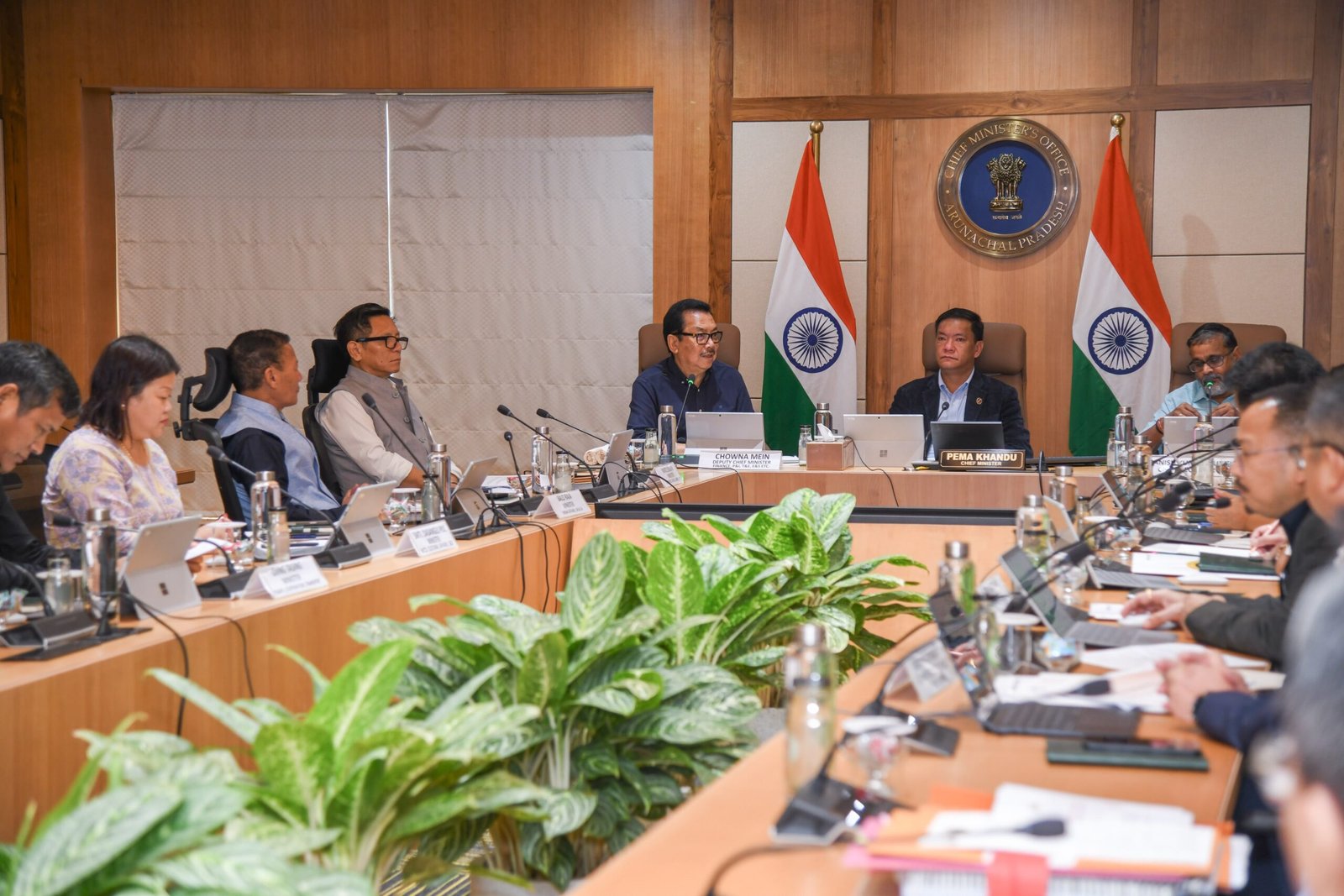
ITANAGAR : The State Cabinet on Friday approved a series of major policy decisions and development initiatives, including a cumulative investment of ₹7,834 crore for four flagship Chief Minister’s comprehensive schemes during 2026-29, aimed at strengthening infrastructure, education, power, entrepreneurship and governance while improving the ease of living and ease of doing business in Arunachal Pradesh.
Chaired by Chief Minister Pema Khandu, the Cabinet approved ₹2,334 crore for Phase-II of the Chief Minister’s Comprehensive State Road Development Plan (CMCSRDP) to improve connectivity in district headquarters, township roads, Deputy Commissioner, Additional Deputy Commissioner and Sub-Divisional Officer headquarters, besides easing traffic congestion in the Capital Complex.
The Cabinet noted that 62 of the 67 projects sanctioned under Phase-I of the CMCSRDP, with an outlay of ₹899.58 crore during 2019-24, have been completed and directed that the remaining works be finished by March 2027.
To improve rural connectivity, the Cabinet sanctioned ₹2,000 crore under the Chief Minister’s Comprehensive State Rural Road Development Programme (CMCSRRDP) over the next three years for construction of roads and bridges to provide all-weather connectivity to habitations not covered under the Pradhan Mantri Gram Sadak Yojana (PMGSY).
Another ₹2,000 crore was approved under the Chief Minister’s Comprehensive State Power Development Programme (CMCSPDP) for upgrading and modernising the state’s power infrastructure, with the objective of reducing Aggregate Technical and Commercial (AT&C) losses to 18 per cent by March 2029.
The Cabinet also approved ₹1,500 crore for Phase-II of Mission Shikshit Arunachal (2026-29) to bridge infrastructure gaps in schools, strengthen teacher training and enhance real-time monitoring through the Arunachal Vidya Nidhi (AVN) platform. It reviewed the success of Phase-I, under which ₹3,112.50 crore was invested in improving school infrastructure between 2023 and 2026.
The Cabinet launched the Enterprise Human Resources Management System (E-HRMS) 2.0, an artificial intelligence-powered platform to digitise and automate the entire government employee lifecycle from recruitment to retirement, and directed all departments to adopt the system expeditiously.
Among the new welfare initiatives, the Cabinet approved the Chief Minister’s Frontier Sainik School Scholarship Scheme to support Arunachali students studying in eight notified Sainik Schools and the Rashtriya Indian Military College, Dehradun. It also cleared an Indian Army-led coaching and mentorship programme to prepare students for admission to Sainik and military schools and future careers as Armed Forces officers.
To strengthen the state’s economy, the Cabinet approved the launch of the ARUN MSME Mission, which aims to revive and upgrade 500 micro, small and medium enterprises (MSMEs) annually while providing market linkage, export and capacity-building support.
The Cabinet also approved the Arunachal Human Capital and Economic Transformation Vision 2036, which envisages skilling one lakh youths, creating 10,000 entrepreneurs, facilitating 10,000 apprenticeships, enabling 10,000 overseas placements, forging 100 industry partnerships and upgrading all 10 Industrial Training Institutes (ITIs) into modern skill hubs.
In a significant employment decision, the Cabinet approved 20 per cent reservation for retired Agniveers from Arunachal Pradesh in constabulary and equivalent posts in the Arunachal Pradesh Police, Arunachal Armed Police, Indian Reserve Battalion, Fire and Emergency Services, Forest Guards, Mineral Guards, Special Tiger Protection Force, Foresters and Prison Wardens. It clarified that unfilled vacancies under the ex-Agniveer quota would revert to the regular Arunachal Pradesh Scheduled Tribe (APST) quota.
The Cabinet also approved the Arunachal Pradesh Apiculture and Honey Policy, 2026, aimed at promoting scientific and commercially viable beekeeping, enhancing farmers’ and women Self-Help Group (SHG) incomes and positioning Arunachal honey as a premium product.
To improve the ease of doing business, it approved the Non-applicability of Trade Licence (for Statutory Licence Holders) Notification, 2026, exempting businesses holding valid statutory licences under specified Central and State laws from obtaining separate trade licences. It also exempted 56 categories of business activities from trade licence requirements to reduce regulatory duplication.
The Cabinet further recommended promulgation of the Arunachal Pradesh Fire and Emergency Services (Amendment) Ordinance, 2026, approved amendments to the Arunachal Pradesh Staff Selection Board (APSSB) Rules, 2018 by increasing the waitlist to 20 per cent of vacancies or up to five candidates, extending its validity from six months to one year, and approved the establishment of six new fire stations at Nyapin, Dambuk, Nari, Kaying, Jairampur and Menchuka.
It also approved the Common Examination Scheme for Direct Recruitment to Group A and Group B Technical Posts Rules, 2026, the proposed Arunachal Pradesh Advocates Protection Bill, 2026, new service rules for the State Legal Services Authority and amendments to the Junior Librarian (Law) Recruitment Rules, 2020.
To strengthen administrative capacity, the Cabinet approved the creation of 36 Assistant Sub-Inspector (ASI) posts under the 1st and 2nd Arunachal Armed Police Battalions and granted special grade designations to various categories of prison personnel.