


ONLINE AGE

(Online version of the Arunachal Age newspaper)

Latest News

Latest News, Popular News, State News

Guv calls for GIS-driven governance in Arunachal

ITANAGAR : Governor Lt Gen KT Parnaik (Retd) on Thursday called for making Geographic Information System (GIS) technology a cornerstone of governance in Arunachal Pradesh, saying data-driven decision-making is essential for efficient service delivery and sustainable development. Addressing the ‘Geo Vision Itanagar’ seminar organised by Esri India, the Governor said the state’s rugged terrain, dense forests, scattered habitations and extensive international borders require innovative, technology-driven governance, where geospatial intelligence serves as an indispensable tool. Emphasising the need for all government departments to adopt GIS-based systems, he proposed the creation of a State Geospatial Governance Platform integrating data from key departments, including Revenue, Planning, Rural Development, Public Works, Forest, Agriculture, Disaster Management and Power. According to the Governor, a unified geospatial ecosystem would improve inter-departmental coordination, facilitate seamless data sharing, eliminate duplication of work and promote evidence-based policymaking. Highlighting land management as a priority area, Parnaik stressed the need to accelerate GIS-based cadastral surveys, digitisation of land records and implementation of the Unique Land Parcel Identification Number (ULPIN) system. He said transparent and reliable land records would help resolve disputes, expedite infrastructure projects, enhance public confidence and create a more investment-friendly environment. The Governor also underscored the importance of geospatial technology in infrastructure development and border area management. He advocated extensive use of drone-based mapping and geospatial monitoring for roads, bridges, educational institutions, healthcare facilities, power networks and other strategic infrastructure, noting that real-time monitoring would improve project execution and accountability while supporting initiatives such as the Vibrant Village Programme. On disaster management, he called for closer collaboration among the Arunachal Pradesh State Application Centre (APSAC), disaster management agencies and district administrations to develop advanced hazard mapping and early warning systems for floods, landslides, earthquakes and glacial lake outburst floods. Referring to emerging technologies, the Governor highlighted the growing importance of GeoAI, Digital Twins, drone analytics and mobile GIS in enabling predictive analysis and real-time decision-making, making governance more proactive, efficient and citizen-centric. He said geospatial technology could significantly strengthen agriculture, horticulture, forestry, biodiversity conservation, healthcare and urban planning. GIS-based suitability analysis, he noted, could help identify ideal locations for high-value crops such as kiwi, apple, orange, walnut and large cardamom, thereby improving agricultural productivity and farmers’ livelihoods. The Governor also highlighted the role of geospatial intelligence in supporting social initiatives, including the ‘Nasha Mukt Yuva for Viksit Bharat’ campaign, by identifying vulnerable areas for targeted interventions. He added that GIS-enabled dashboards could provide real-time monitoring of developmental projects, ensuring greater transparency and efficient utilisation of public resources. Appreciating Esri India for organising the seminar, the Governor expressed confidence that the deliberations would contribute to building a technologically advanced, environmentally responsible and future-ready Arunachal Pradesh. He urged all stakeholders to embrace data-driven governance in line with the vision of Viksit Bharat@2047. The seminar was attended by senior state government officials, district police officers, planners, technologists, administrators and industry experts. Experts from Esri India showcased the concept of “Arunachal One”, a unified geospatial platform designed to support integrated planning and decision-making across departments. The discussions also focused on the application of GIS, GeoAI and drone technologies in land records management, agriculture, forestry, disaster management, border security, smart policing and utility management, while highlighting the need for capacity building to promote transparent, efficient and citizen-centric governance.    
Latest News, Popular News, State News

CJP to launch nationwide campaign against unemployment: Abhijeet Dipke

CHHATRAPATI SAMBHAJINAGAR : Cockroach Janta Party (CJP) founder Abhijeet Dipke on Thursday described unemployment as a major problem in the country, and said it would be taken up as a nationwide issue. He was addressing a press conference after the conclusion of the CJP’s core team meeting in his hometown Chhatrapati Sambhajinagar in Maharashtra. The core team had been holding talks at Dipke’s residence since Wednesday. CJP chief spokesperson Saurav Das, spokesperson Ashutosh Ranka and other representatives were also present at the press conference. The protests, led by CJP at Jantar Mantar in New Delhi last month over the Neet paper leak and other exam irregularities, led to Dharmendra Pradhan resigning as the Union education minister. Dipke said, “Dharmendra Pradhan’s resignation is the biggest achievement of the students’ agitation.” There were not only students but also jobless youngsters who participated in the Jantar Mantar protest, he said. “Unemployment is a major problem, we will make it a nationwide issue. We will work on education reforms. Education has remained unaffordable since schooling. Education is used for making profits. But we want to change it,” he said. Sixty per cent of people in the country are below the age of 35 and protesters at Jantar Mantar also comprised such people, Dipke noted. The CJP founder also said there was a need to bring back the credibility of the media. (Source: PTI)    

Latest News, Popular News, State News

Illegal liquor seized in Passa Valley

PASSA VALLEY :  Pakke Kessang district police, in coordination with the Department of Tax, Excise and Narcotics, on Thursday conducted a joint surprise inspection and enforcement drive against the illegal liquor trade in Rilloh and Ngoleko villages under Passa Valley Circle. The operation covered shops, restaurants, hotels and roadside kiosks, during which officials seized 52.515 litres of liquor allegedly stored and sold without a valid excise licence. The seized liquor was handed over to the Department of Tax, Excise and Narcotics for safe custody and further legal action under the relevant provisions of the Excise Act. According to the police, the joint operation reflects the commitment of the district police and the Excise Department to curb illegal liquor trade, enforce the law and safeguard public health and safety. Police noted that liquor sold illegally and stored without proper safeguards may be contaminated or unfit for consumption, posing serious health risks in addition to violating the law. They added that similar enforcement drives will continue across the district to deter violations and promote lawful business practices. The district police appealed to shopkeepers, hotel owners, restaurant operators and members of the public to comply strictly with the provisions of the Excise Act and refrain from the illegal storage, sale or distribution of liquor. They also sought public cooperation in maintaining peace, public safety and the rule of law across the district.    

Latest News, Popular News, State News

APUTA seeks retirement age hike to 65, VC assures early action

PASIGHAT : The Arunachal Pradesh University Teachers’ Association (APUTA) on Thursday renewed its demand for enhancement of the retirement age of university teachers from 60 to 65 years, in line with the University Grants Commission (UGC) guidelines. A delegation of the association, led by President Dr Eli Doye and General Secretary Dr Lige Sora, met Arunachal Pradesh University (APU) Vice Chancellor Dr Milorari Modi at his chamber and reiterated its long-pending demand. The association informed the Vice Chancellor that it had submitted a memorandum to the Governor of Arunachal Pradesh, in his capacity as Chancellor of the University, on October 30, 2025, seeking revision of the superannuation age. However, it said no significant progress had been made on the issue over the past ten months. APUTA maintained that the existing retirement age at APU is not in conformity with the UGC guidelines and is also inconsistent with the practice followed by most Central and State universities across the country. The delegation said increasing the retirement age would enable the university to retain experienced faculty members, strengthen academic leadership, ensure continuity in teaching, research and administration, and facilitate the mentoring of younger faculty and research scholars. Responding to the representation, Vice Chancellor Dr Milorari Modi assured the delegation that the matter would be taken up positively and pursued with the appropriate authorities at the earliest.      

Latest News, Popular News, State News

Papum Pare DC reviews development works during Sagalee tour

YUPIA :  Papum Pare Deputy Commissioner Hage Mamu on Thursday conducted an extensive tour of the Sagalee Administrative Circle to review key infrastructure projects, inspect developmental works and interact with officials, farmers and students. The DC began her visit by inspecting the ongoing road restoration work at Waterfall Point along the NH-713A Hoj-Potin road. Interacting with engineers at the site, she directed them to expedite the restoration work on a war footing to restore road connectivity at the earliest. Accompanied by Sagalee Additional Deputy Commissioner Kipa Raja and Officer on Special Duty to Sagalee MLA Debia Lalum, she later visited the proposed site for the Field Ammunition Depot (FAD) at Mepsoro and reviewed the proposal after inspecting the earmarked land. The team also visited Toru Engineering College, where the DC reviewed the progress of infrastructure development and ongoing construction works. During her tour, Mamu visited a dragon fruit orchard at Kheel and interacted with progressive farmers. Appreciating their efforts to promote horticulture and diversified farming, she encouraged them to adopt innovative agricultural practices to improve productivity and enhance income. As part of her administrative review, the DC visited the Circle Offices at Toru and Leporiang, where she interacted with officers and staff, heard their grievances and assured them that genuine concerns would be addressed in a phased manner. She also visited the Tana Nana War Memorial at Deb village and paid homage to those associated with the historic site while acknowledging its significance. In the final leg of her tour, Mamu visited Government Secondary School, Leporiang, and Government Residential School, Pape Sango, Leporiang. Interacting with students, she encouraged them to uphold discipline, dedication and sincerity, describing discipline as the foundation of success. She also urged them to remain focused on their studies, uphold moral values and strive to become responsible and productive citizens. The visit formed part of the district administration’s ongoing efforts to monitor developmental activities, strengthen public service delivery and maintain close engagement with local communities across the district. (DIPR)    

Latest News, Popular News, State News

East Siang DA holds talks on land, encroachment issues in Pasighat

PASIGHAT : The East Siang district administration (DA) on Thursday held a meeting with representatives of the Bogong Banggo Kebang (BBK), Bogong Banggo Yameng Kebang (BBYK), Bogong Banggo Land Action Committee (BBLAC) and All Bogong Students’ Union (ABSU) to deliberate on land-related issues and other matters concerning Pasighat township. The meeting, chaired by East Siang Deputy Commissioner Sonalika Jiwani at the DC’s Conference Hall, focused on resolving issues through dialogue and ensuring adherence to legal procedures. Welcoming the participants, the DC stressed the importance of respecting all symbols of the State and urged stakeholders to conduct discussions peacefully to achieve constructive outcomes. She informed the meeting that the district administration has been taking stringent action against encroachments on government land under the provisions of the Arunachal Pradesh Public Premises (Eviction of Unauthorised Occupants) Act, 2003. Over the past year, 780 notices have been issued to alleged illegal encroachers and 72 eviction drives have been conducted across Pasighat township. The meeting deliberated on five demands submitted by the organisations, including cross-verification of land allotment proposals for 2024-25, eviction of illegal encroachers, inclusion of BBK and BBLAC in the District Land Allotment Committee (DLAC), removal of encroachments from educational institutions, and retention of the three MAUP Smart City buildings under local control. After detailed discussions, it was decided that all land allotment proposals for 2024-25 returned by the Directorate of Land Management would be cross-verified by the respective Administrative Officers-cum-Estate Officers. Representatives nominated by BBK and BBLAC will be permitted to submit information or complaints to the concerned Estate Officers. On the issue of encroachments, the administration reiterated that eviction drives would continue strictly in accordance with the law to ensure due process and withstand future litigation. It also assured that fresh encroachments would be removed immediately and urged BBLAC members to promptly report any new cases. Regarding the demand for inclusion of BBK and BBLAC in the DLAC, the meeting was informed that the District Land Revenue and Settlement Officer had already written to the Director of Land Management in February 2024 seeking inclusion of non-official members, including panchayat representatives and leaders of community-based organisations. Approval from the state government is still awaited. The meeting also resolved to accord top priority to the eviction of illegal encroachers from educational institutions. The Deputy Director of School Education and the concerned Block Education Officers were directed to issue eviction notices to all encroachers within seven days of issuance of the meeting minutes. On the three MAUP Smart City buildings at Pasighat Market, the district administration clarified that overall control of the buildings would remain with the administration. It also dispelled concerns over allotment by private parties, stating that shops would be allotted with special consideration for enterprising local youth of East Siang district, including members of the Bogong Banggo community. Guidelines and standard operating procedures for allotment will be framed in due course. East Siang Superintendent of Police Pankaj Lamba appealed to all stakeholders to resolve differences through dialogue and refrain from violence. He assured that the police would work in close coordination with the district administration to deal strictly with habitual encroachers and offenders in accordance with the law. The meeting concluded with all stakeholders reaffirming their commitment to maintaining peace, harmony and orderly development in Pasighat township. (DIPR)    

Latest News, Popular News, State News

Formation of Arunachal Pradesh and Political Legacy of Mein Family

Takam Padu The constitutional journey of Arunachal Pradesh reflects one of India’s most remarkable stories of democratic evolution. From its early administration as the North-East Frontier Tracts under British India to its emergence as the 24th State of the Republic of India on 20 February 1987, the region underwent a gradual transformation through constitutional reforms, representative institutions, and indigenous leadership. Following Independence, the frontier region continued under a special administrative arrangement and was formally redesignated as the North-East Frontier Agency (NEFA) in 1954. The administrative reforms that followed, together with the lessons of the 1962 Sino-Indian War, accelerated infrastructure development, governance, and political participation. The North-Eastern Areas (Reorganisation) Act, 1971 created the Union Territory of Arunachal Pradesh in 1972, while the State of Arunachal Pradesh Act, 1986 culminated in full statehood on 20 February 1987. Throughout this historic transition, several visionary leaders contributed to the political and democratic development of the region. Among them, the Mein family occupies a distinctive place for its multi-generational service in public life. The family’s political legacy can be traced to Chow Khamoon Gohain (Namshum), who became the first nominated Member of Parliament representing NEFA in the First and Second Lok Sabhas (1952–1962). At a time when NEFA had no elected parliamentary constituency, he served as the region’s voice in Parliament, advocating education, healthcare, connectivity, agriculture, and administrative development. The tradition of public service continued with Chow Chandret Gohain, who also represented the frontier region in Parliament, reinforcing indigenous participation in India’s democratic institutions. Another milestone came with Late Chow Pak (Chow Pook) Gohain, who was elected to the first Agency Council in 1969 following the introduction of the Panchayati Raj system in NEFA. As one of the earliest elected indigenous representatives, he helped lay the foundations of representative governance in the frontier region. His son, Chow Tewa Mein, carried the legacy forward as a member of the Pradesh Council (1972), the Provisional Legislative Assembly (1975), and later as a Member of the Arunachal Pradesh Legislative Assembly and Cabinet Minister. His contributions to public administration and development were significant during the formative years of the State. The next generation is represented by Chowna Mein, one of Arunachal Pradesh’s longest-serving political leaders. First elected to the Legislative Assembly in 1995, he has served as Speaker, Cabinet Minister, and Deputy Chief Minister since 2016. As Finance Minister and Deputy Chief Minister, he has played a central role in strengthening fiscal management, infrastructure development, investment promotion, cultural preservation, and sustainable economic growth. In 2025, he became India’s longest-serving incumbent Deputy Chief Minister and was awarded the honorary Doctor of Letters (D.Litt.) by Gauhati University for his contribution to public service. The family’s democratic legacy was further strengthened when Nang Sati Mein was elected to the Arunachal Pradesh Legislative Assembly from Namsai as an Independent candidate in 2009. Spanning more than seven decades, the Mein family’s contribution mirrors the constitutional evolution of Arunachal Pradesh from NEFA to Union Territory and finally to statehood. Their public service at every stage of democratic development represents an important chapter in the political history of the State. Their legacy stands as a testament to the role of indigenous leadership in shaping modern Arunachal Pradesh and strengthening its democratic institutions.      

Latest News, Popular News, State News

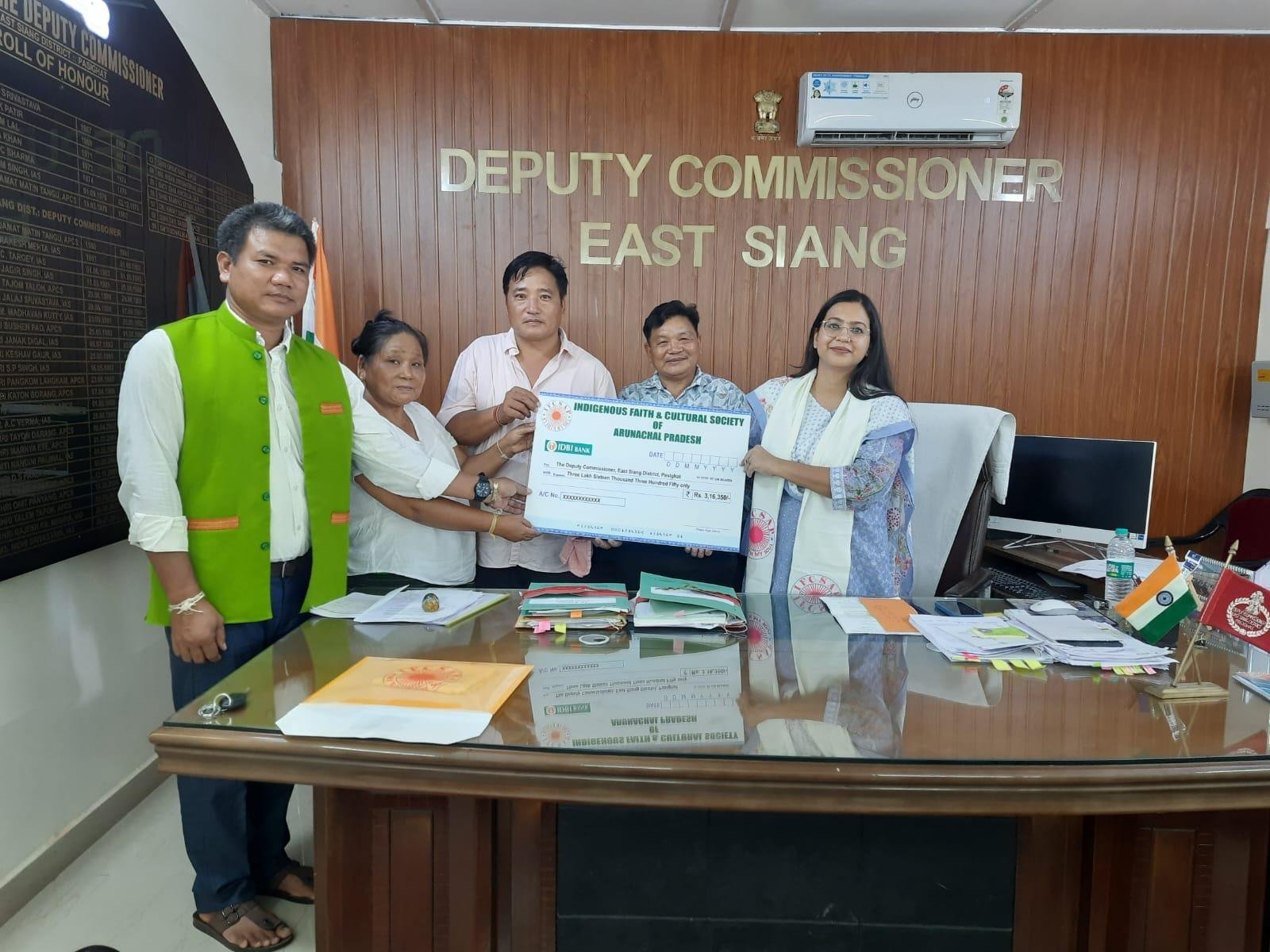
IFCSAP donates Rs 3.16 lakh for flood relief in East Siang

PASIGHAT : The Indigenous Faith and Cultural Society of Arunachal Pradesh (IFCSAP) on Thursday donated ₹3,16,350 to the East Siang district administration to support relief and rehabilitation efforts for families affected by the recent flash floods. The cheque was handed over to East Siang Deputy Commissioner Sonalika Jiwani by an IFCSAP delegation led by Central Executive Committee Youth Wing Vice President Olom Perme. The delegation also comprised IFCSAP East Siang Unit President Omir Tatin, East Siang Women’s Wing President Omem Tamuk Gao and East Siang Unit General Secretary Taken Payum. The contribution was mobilised through donations from IFCSAP East Siang Unit (₹25,000), Upper Siang Unit (₹34,850), Dibang Valley Unit (₹51,000), Lohit Unit (₹15,500), Namsai Unit (₹1,20,000), Longding Unit (₹20,000) and the IFCSAP Central Executive Committee (₹50,000), taking the total assistance to ₹3,16,350. Speaking on the occasion, the IFCSAP representatives expressed solidarity with the flood-affected families and reaffirmed the organisation’s commitment to supporting communities during times of crisis. They also appreciated the efforts of the East Siang district administration and all agencies engaged in relief and rehabilitation operations. Receiving the contribution, DC Sonalika Jiwani thanked IFCSAP for its humanitarian gesture and said such collective efforts strengthen relief initiatives and provide meaningful support to families rebuilding their lives after the disaster. The contribution reflects the spirit of community solidarity and collective action in assisting people affected by natural calamities. (DIPR)    

Latest News, National, Popular News, State News

Rahul Gandhi urges Congress workers to aid flood relief in Nagaland, Arunachal

NEW DELHI/KOHIMA : Leader of the Opposition (LoP) in the Lok Sabha Rahul Gandhi on Thursday urged Congress workers to extend every possible support for relief and restoration efforts in the flood-and landslide-affected states of Nagaland and Arunachal Pradesh, while expressing deep grief over the loss of lives and widespread destruction caused by the natural calamities. The Congress leader expressed profound sorrow over the deaths and extensive damage caused by landslides and flash floods that have ravaged the two Northeastern states over the past several days. Taking to his official X handle, Rahul Gandhi said: “Deeply saddened by the loss of lives and widespread devastation caused by landslides and flash floods across Nagaland and Arunachal Pradesh.” “My heartfelt condolences to the bereaved families, and wishes for a swift recovery to the injured. I urge Congress workers to support the relief and restoration efforts in every possible way. I stand in solidarity with every affected family in this difficult hour,” Gandhi said. Lok Sabha member from Odisha Saptagiri Sankar Ulaka, who is the Congress in-charge for Manipur, Nagaland, Sikkim and Tripura, also expressed deep anguish over the deaths and destruction caused by floods and landslides in Nagaland. In a post on his X handle, Ulaka said: “Deeply saddened by the loss of lives and widespread devastation caused by the floods and landslides in Nagaland. My heartfelt condolences to the bereaved families. Praying for everyone’s safety and swift recovery.” The Nagaland Pradesh Congress Committee (NPCC) also expressed deep sorrow over the loss of lives and large-scale destruction caused by the floods and landslides across the state. In a post on its official X handle, the party said that many people had lost their lives due to incessant rain, floods and landslides in Nagaland. The NPCC said that thousands of families have been displaced, while homes, roads, bridges, farmlands and livelihoods have suffered extensive damage due to the recent floods and landslides. “The tragedy that claimed the lives of young students and many others is a painful reminder that disaster preparedness and resilient infrastructure cannot be ignored,” the party said. The NPCC said it stands in solidarity with every affected family and called upon the government to ensure immediate relief, fair compensation, speedy restoration of roads and essential services, and the formulation of a long-term disaster mitigation plan to protect vulnerable communities. “The people of Nagaland cannot be left to rebuild alone,” the party added. Meanwhile, Congress Lok Sabha member from Nagaland S. Supongmeren Jamir, along with four other Members of Parliament from Nagaland and Arunachal Pradesh, recently met Prime Minister Narendra Modi and urged him to extend all possible Central assistance to the flood-affected people of the two states. The delegation, led by Union Parliamentary Affairs and Minority Affairs Minister Kiren Rijiju, met the Prime Minister at Parliament House in New Delhi and apprised him of the flood situation and the extensive damage caused by heavy rainfall in both states. The delegation also included Tapir Gao (Lok Sabha, Arunachal Pradesh), Tai Tagak (Rajya Sabha, Arunachal Pradesh) and S. Phangnon Konyak (Rajya Sabha, Nagaland). During the meeting, the Members of Parliament discussed the ongoing flood situation, relief measures and the urgent need for Central assistance to restore damaged infrastructure and rehabilitate the affected population. Prime Minister Modi assured the five parliamentarians from Arunachal Pradesh and Nagaland that the Central government would extend all necessary support and continue to work in close coordination with the respective state governments to effectively address the challenges arising from the ongoing heavy rainfall, floods and landslides. (Source: IANS)    

Latest News, Popular News, State News

Awareness prog on BBBP, World Breastfeeding Week held

BOMDILA : The Office of the Child Development Project Officer (CDPO), Bomdila, on Thursday organised a joint awareness programme on the Beti Bachao Beti Padhao (BBBP) initiative and World Breastfeeding Week at the Community Hall in Pedung village. Bomdila Assistant Commissioner Pooza Sonam attended the programme as the chief guest. The event was attended by Deputy Director of School Education Dr Ribom Basar, resource persons from various departments, Gaon Burahs, Gram Panchayat Members, teachers, students, parents, and pregnant and lactating mothers. During the programme, Dr L Modi from the Health Department highlighted the importance of breastfeeding and maternal and child healthcare. District Child Protection Unit (DCPU) Protection Officer Rinchin Megejee spoke on the establishment and role of the DCPU in implementing child protection laws and facilitating adoption processes. He also appealed to the public to support efforts against drug abuse and encouraged families facing issues involving their children to seek assistance without hesitation. Emphasising the importance of community participation, he said collective support plays a crucial role in addressing substance abuse. One Stop Centre (OSC) Centre Administrator Tsering Penzom delivered an awareness session on the services provided by the centre. She also explained the provisions of the Sexual Harassment of Women at Workplace (Prevention, Prohibition and Redressal) Act, 2013, and the Protection of Women from Domestic Violence Act, 2005. An awareness session on the Nasha Mukt Bharat Abhiyan was also conducted, highlighting the need for collective efforts to build a drug-free society. The programme concluded with the chief guest administering the Beti Bachao Beti Padhao Pledge to the participants. (DIPR)