

NAHARLAGUN, OCT 14:
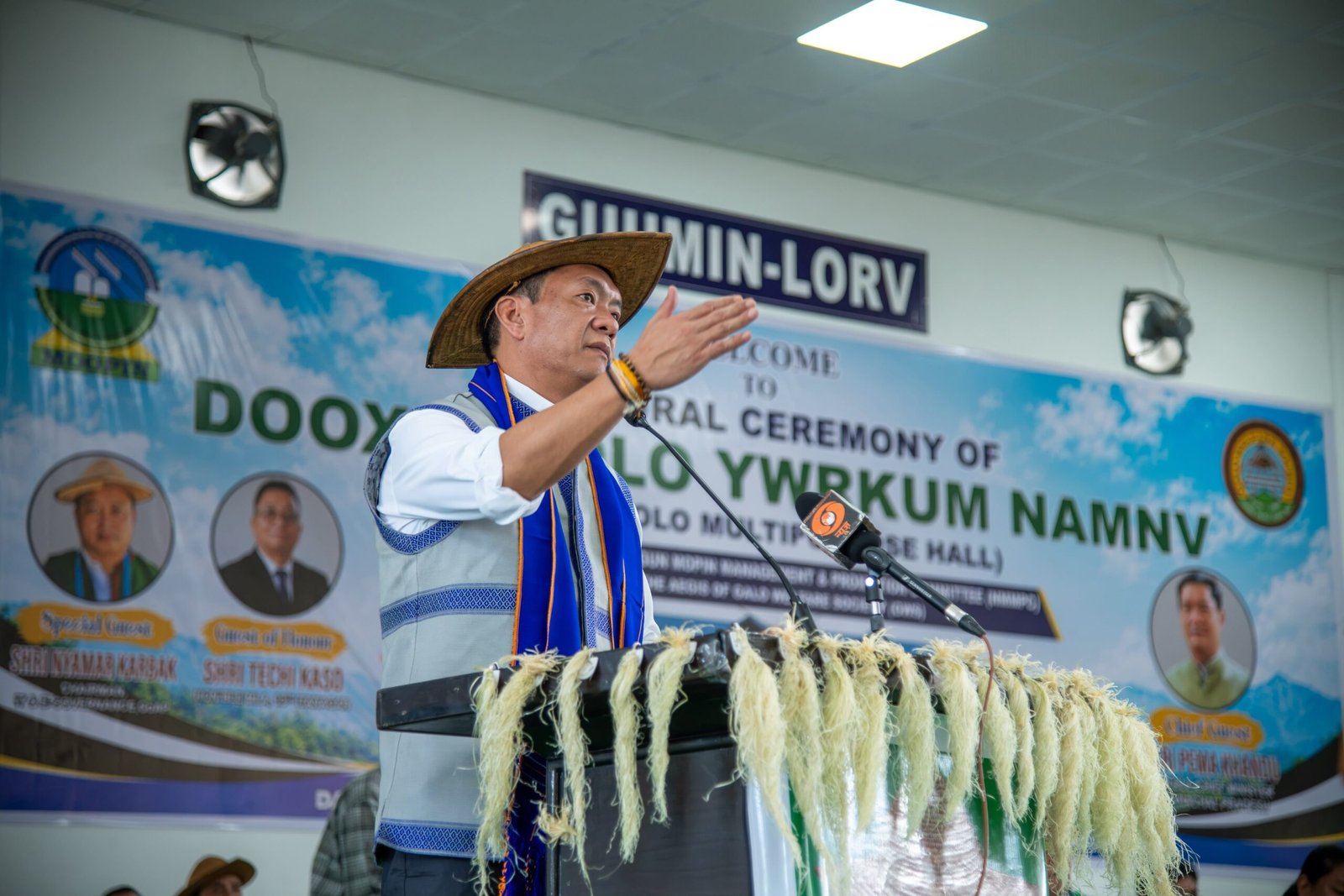
Chief Minister Pema Khandu on Wednesday urged the youth to remain rooted in their cultural identity while embracing new opportunities in a rapidly changing world, as he inaugurated the Donyi Polo Multipurpose Hall at the Galo Heritage Centre in Tarajuli, near Naharlagun.
Describing the hall as a landmark of community participation and cultural commitment, Khandu said it would serve as a permanent venue for Mopin celebrations and a centre for passing on traditional songs, dances, crafts and indigenous knowledge to younger generations.
The programme was organised by the Naharlagun Mopin Management and Promotion Committee, which looks after the Heritage Centre, in coordination with the Galo Welfare Society and clan-based organisations.
Highlighting the community’s contribution, Khandu said the Galo community had voluntarily handed over the Mopin ground at Naharlagun, which had been in use since 1976, to facilitate the establishment of the state’s first medical college, the Tomo Riba Institute of Health and Medical Sciences (TRIHMS).
The community subsequently purchased around 11,217 square metres of land at Tarajuli through its own contributions. Clan organisations constructed boundary walls and traditional gates, while more than 430 individuals contributed funds towards the initiative.
Sanctioned under the Centre’s Special Assistance to States for Capital Investment following an assurance by the Chief Minister in 2022, the hall was completed in about a year. Khandu credited the community’s collective effort and ownership for the timely completion, saying the initiative could inspire other tribes across the state.
He announced that approval for the drainage system required at the Heritage Centre would be accorded within the current year. A shed would also be constructed at the Itanagar Mopin and Solung ground for use by the Galo and Adi communities. The demands for a Galo Secretariat and heritage infrastructure would be pursued, he added.
Emphasising the need to preserve indigenous identity, Khandu cautioned that the state’s tribal populations were small in the national context and that the loss of language and traditions could threaten cultural continuity. While the government could extend support through policies, communities themselves had the responsibility to protect their heritage and pass it on to future generations.
Referring to artificial intelligence and machine learning, he urged people to use technology as a tool rather than become subservient to it. He also called for preparations to address its impact on employment without compromising age-old cultural traditions.
Stressing the dignity of labour, Khandu urged Arunachal Pradesh to cultivate a work culture that values all forms of work. He called for local youth to be trained in construction, electrical and plumbing trades to reduce dependence on skilled workers from outside the state.
Citing an example, he said a batch of 50 youths trained at the National Skill Centre in Hyderabad had subsequently completed a project in Pasighat for Rs 10 lakh, against an outside team’s quotation of Rs 18 lakh.
The Chief Minister also encouraged young people to explore entrepreneurship, including through the micro, small and medium enterprises (MSME) sector and the Arunachal Pradesh Entrepreneurship Development Programme. He said the programme’s capacity had been doubled, with 100 entrepreneurs in its latest cohort.
Under the Arunachal Academic Excellence initiative, the state government bears scholarship costs for students admitted to universities ranked among the top 150 in the QS rankings, he added.
Highlighting development initiatives over the past decade, Khandu said more than 1.5 lakh women were organised into over 16,000 self-help groups, while nearly 46 per cent of startups were women-led. More than Rs 3,000 crore had been invested under Mission Shikshit Arunachal Phase I, with another Rs 1,500 crore approved for Phase II. Enrolment in government schools had risen by over 13 per cent, he said.
He also cited the Vibrant Villages Programme, which covers 455 border villages under Phase I and another 122 under Phase II, along with support for indigenous Gurukul schools, 20 geographical indication-tagged products from the state and measures to strengthen legal protection for indigenous faiths.
Khandu said high-powered committees were examining safeguards for Arunachal Pradesh Scheduled Tribes (APST), the Inner Line Permit framework and illegal infiltration, adding that these issues would be addressed through dialogue and consensus.
Responding to a memorandum of demands submitted at the event, he said major road projects would take time. He reiterated that the Centre’s support for a two-lane road between Ruksin and Kimin was conditional on land being provided free of cost along the surveyed alignment, adding that the state government would proceed once the communities concerned submitted written consent.
On the Assam-Arunachal Pradesh boundary issue, Khandu said disputes involving 123 villages had been largely resolved and that 31 of the 32 contested areas in Papum Pare district had been settled following recent joint field visits by regional committees. Progress was also being made on other long-pending issues, including the Chakma question, he said.
As Arunachal Pradesh prepares to complete 40 years of statehood on February 20, 2027, Khandu urged every community to reflect on the state’s journey towards 2047 and called upon young people to remain proud of their roots while moving forward with confidence.