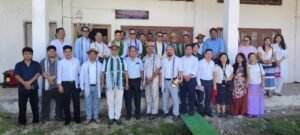



ITANAGAR : The National Bank for Agriculture and Rural Development (NABARD) on Sunday celebrated its 45th Foundation Day, commemorating more than four decades of service to rural India while reaffirming its commitment to inclusive, resilient and sustainable rural development in Arunachal Pradesh.
Established on July 12, 1982, NABARD has evolved from a rural credit institution into the country’s apex development financial institution for agriculture and rural development, combining finance, institution building, supervision, innovation and development interventions.
In Arunachal Pradesh, NABARD has worked closely with the State Government, banks, cooperative institutions, civil society organisations and rural communities to strengthen infrastructure, agriculture, livelihoods and financial inclusion. Its interventions span rural roads and bridges, irrigation, drinking water, health and education infrastructure, tribal orchard development, farmer collectives, spring rejuvenation, women empowerment through Self-Help Groups (SHGs), promotion of indigenous products and market linkages.
One of NABARD’s most significant contributions in the State has been through the Rural Infrastructure Development Fund (RIDF). Under the scheme, NABARD has sanctioned 534 projects involving cumulative assistance of ₹5,116.46 crore for the Government of Arunachal Pradesh. The projects cover rural roads and bridges, irrigation, drinking water, flood protection, soil conservation, healthcare, educational institutions and other public infrastructure aimed at improving connectivity and enhancing the quality of life in remote areas.
To strengthen rural credit, NABARD has extended refinance support to Arunachal Pradesh Rural Bank, sanctioning ₹109.56 crore for short-term agricultural loans and ₹86.05 crore for long-term agricultural credit. It also plays a key supervisory role over Regional Rural Banks and cooperative banks while preparing district-level Potential Linked Credit Plans and the State Focus Paper to guide rural credit planning.
Financial inclusion remains a core focus of the institution. Through the SHG-Bank Linkage Programme, Joint Liability Groups, financial literacy initiatives, capacity building and digital financial inclusion, NABARD has supported wider access to formal banking services. It has extended ₹2,890.22 lakh for various financial inclusion initiatives in Arunachal Pradesh.
Recognising the importance of collective farming, NABARD has promoted 17 Farmer Producer Organisations (FPOs) in the State, enabling farmers to aggregate produce, improve value addition, access institutional finance and strengthen market linkages.
The institution has also expanded livelihood opportunities through its Tribal Development Fund, popularly known as WADI (TRIBES) projects. These initiatives support orchard-based livelihood development, intercropping, soil and water conservation, livestock development and community institution building, helping tribal households establish sustainable long-term income sources.
To promote climate-resilient agriculture, NABARD is implementing the JIVA programme, encouraging natural farming practices through the use of Jeevamrit, Beejamrit, Ghanjeevamrit, biomass recycling and diversified cropping systems. The initiative seeks to improve soil health, reduce dependence on chemical inputs and enhance the resilience of farming systems.
In the farm sector, NABARD has sanctioned assistance of ₹2,853.27 lakh for various development initiatives, including the adoption of digital technologies and Internet of Things (IoT)-based solutions to improve farm productivity and resource management.
Addressing climate change and ecological challenges, NABARD is supporting springshed development, watershed management, biodiversity conservation, efficient water use and climate-resilient agriculture to strengthen water security and natural resource management across the Himalayan State.
The institution has also played a significant role in promoting Geographical Indication (GI) products. With NABARD’s support, 18 products from Arunachal Pradesh have secured GI registration, while another 18 products are in the pipeline. Beyond registration, the institution is assisting producer groups in branding, quality assurance, packaging and market access to ensure greater economic benefits for farmers and artisans.
To improve rural marketing, NABARD has supported Rural Haats, Rural Marts, exhibitions, buyer-seller meets and other marketing platforms that enable farmers, artisans, SHGs and producer groups to access wider markets.
Recognising the growing importance of rural entrepreneurship, NABARD has sanctioned ₹963.78 lakh for off-farm sector development and ₹245.95 lakh for skill development and capacity-building programmes. These initiatives support rural youth and women in establishing enterprises in food processing, tailoring, handicrafts, bakery and other locally viable sectors.
The institution has also strengthened the cooperative sector by supporting the computerisation of 14 Large-sized Multipurpose Cooperative Societies (LAMPS) in Arunachal Pradesh, alongside capacity building and governance reforms.
Throughout its development initiatives, NABARD has placed women at the centre of rural transformation by promoting SHGs, financial literacy, entrepreneurship, livelihood programmes and market access, enabling greater financial independence and community participation.
Highlighting its collaborative approach, NABARD said its work in Arunachal Pradesh has been anchored in partnerships with the State Government, banks, cooperative institutions, universities, research organisations, non-governmental organisations, FPOs, SHGs and community-based organisations to deliver locally relevant development solutions.
As NABARD enters its 45th year, it reaffirmed its commitment to supporting Arunachal Pradesh’s rural economy through investments in high-value agriculture, horticulture, natural farming, GI products, food processing, bamboo, handloom and handicrafts, renewable energy, eco-tourism, rural enterprises and technology-driven agriculture.
The institution said it would continue working alongside rural communities to strengthen infrastructure, build sustainable livelihoods, protect natural resources and promote inclusive economic growth across the State.