

ONLINE AGE

(Online version of the Arunachal Age newspaper)

National

Latest News, National, Popular News, State News

Modi highlights yoga, maritime prowess as drivers of national strength

KOLKATA : Prime Minister Narendra Modi on Sunday used two major public engagements in Kolkata to outline a broader vision for India’s future — one rooted in inner balance and collective well-being through yoga, and the other in national self-reliance and maritime strength. Speaking at the 12th International Day of Yoga celebrations on the city’s iconic Red Road and later at the commissioning of three indigenously built naval vessels in the Syama Prasad Mookerjee Port, Modi highlighted how personal discipline and national capability together shape a stronger, more confident India. While one message centred on harmony, health and peace, the other underscored security, technological advancement and strategic influence. Addressing thousands gathered on Red Road for the International Day of Yoga, Modi advocated the utility of yoga not only in boosting personal health but also as a catalyst for world peace. Against the backdrop of multiple global conflicts and geopolitical tensions, he argued that the ancient Indian practice holds relevance far beyond physical wellness. Quoting the Bhagavad Gita, Modi stressed that a balanced lifestyle involving work, nutrition and sleep is key to overcoming suffering. “That balance is yoga’s basic crucible, just as it is the crucible of our lives,” he said. Observing that modern lifestyles often disrupt this balance, he added, “Yoga teaches us the art of living our lives in a balanced manner; it teaches us dos and don’ts. When we learn to operate our bodies in the right manner, health becomes a habit.” The PM said yoga helps people discover physical fitness through mental well-being and self-awareness. Connecting individual transformation with global harmony, he remarked, “The consciousness of identifying the dos and don’ts not only brings inner peace, it opens up the path to world peace. That’s why yoga is not only required for our personal lifestyles, it is essential for a better future of this world.” His remarks reflected India’s longstanding emphasis on dialogue, coexistence and peaceful resolution of disputes at a time when several regions continue to grapple with wars and diplomatic strains. Urging people to make yoga a lifelong practice, Modi said, “Let us pledge not to restrict yoga to only one particular day or to an event; rather, make it a part of our lives and that of our families and our future generations.” He described yoga as a global movement that transcends national and cultural boundaries. “June 21, which marks the longest day on earth, has now become the largest community celebration day because of yoga. Yoga brings people together. I congratulate the people of the world on this occasion,” he said. Referring to this year’s theme, ‘Yoga for healthy ageing’, Modi emphasised that yoga benefits people of all age groups. “Yoga is not just physical exercise. It is not restricted to any age group. It is an expression of the human spirit,” he said. Highlighting the role of yoga in preserving vitality through the years, Modi said, “When we speak of yoga for healthy ageing, we can work to ensure that age does not reduce human potential.” Invoking the ideas of Rabindranath Tagore and Sri Aurobindo, Modi said human fulfilment lies in connection with society, the world and oneself. “The fundamental idea of yoga is that connectivity. Maharishi Arabinda said yoga is in our life, whether we realise it or not. When yoga becomes part of our living, it becomes the cradle of human unity,” he said. Dressed in a white T-shirt and white pants, Modi joined thousands of participants in a mass yoga demonstration on Red Road. He performed yoga alongside citizens of all ages, walked among participants during the 40-minute session, observed the protocols closely and even helped some participants correct their postures. Governor R N Ravi, Chief Minister Suvendu Adhikari and several ministers of the West Bengal government were among the thousands who also took part in the event. Later, at the Syama Prasad Mookerjee Port, Modi shifted focus from human potential to national capability, asserting that strong maritime power is essential for economic and strategic influence. “Strong maritime capabilities are the deciding factor for a country’s economic and strategic influence,” he said, adding that India understands this reality and is preparing accordingly. Modi commissioned three indigenously built naval vessels — the stealth frigate Dunagiri, survey vessel Sanshodhak and anti-submarine warfare shallow water craft Agray. Designed by the Indian Navy’s Warship Design Bureau and built by Kolkata-based Garden Reach Shipbuilders and Engineers Ltd, the vessels contain over 75 per cent indigenous content and involved the participation of more than 200 MSMEs. Emphasising self-reliance in defence, Modi declared, “The recognition of our capabilities lies in our self-reliance and not in becoming a market for the world.” He added that India does not want to remain merely a buyer in the global defence sector. The PM noted that India had already demonstrated its growing maritime strength through the commissioning of aircraft carrier INS Vikrant. More than 40 warships and submarines have been inducted in recent years, while 45 large naval platforms are currently under construction, he said. “No nation can become a big power without maritime prowess. Development, security and prosperity are tied to the seas,” he said. The events drew the prime minister’s two-day visit to West Bengal to a close which began on Saturday with his attending the state-level ‘Paschimbanga Divas’ celebrations in Tarakeswar in Hooghly district where he declared that the state had “broken free of its shackles” and has embarked on a new journey of development under the BJP government. He invoked the state’s Partition-era history to assert that June 20 was a defining moment that ensured the state remained within India. (Source: PTI)
Latest News, National, Popular News, State News

Cong makes pitch for making right to vote a Fundamental Right in light of ‘partisan EC, SIR’

NEW DELHI :  The Congress on Sunday made a strong pitch for making right to vote a fundamental right, saying it would be a powerful step in putting in place safeguards against voter suppression or arbitrary disqualifications that have taken place in different states in “astronomical numbers” under the SIR process. Congress leader Jairam Ramesh said that with the “blatantly partisan functioning” of the Election Commission of India “working at the behest” of Prime Minister Narendra Modi and Union Home Minister Amit Shah having been brutally exposed, it is now time to elevate the right to vote as a fundamental right that would offer it the highest level of judicial review and protection. Ramesh pointed out that on Friday last a two-judge bench of the Supreme Court declared the right to walk on a footpath as a fundamental right under the Constitution. The Constituent Assembly had set up an Advisory Committee on Fundamental Rights, Minorities and Tribal and Excluded Areas under the Chairmanship of Sardar Patel. In its meeting held on April 21-22 1947, there was an animated discussion on making the right to vote a fundamental right with Dr. Ambedkar and Babu Jagjivan Ram argued strongly in its favour, he recalled. Sardar Patel, C Rajagopalachari, and some others took the position that if the right to vote was made a fundamental right the princely states may be reluctant to join the Indian Union and that it is enough to provide for universal adult franchise in the Constitution, Ramesh said. “Sardar Patel himself took the position that universal adult franchise was, in itself, an implicit fundamental right. This is the background to Article 326 which provides for elections based on universal adult suffrage,” he said. Over the past seven decades there has been a continuing debate on whether the right to vote is a statutory right provided by the Representation of People Act, 1951 or is an explicit fundamental right, he said. “Different views have been expressed. Most recently, Justice Ajay Rastogi in a dissenting opinion in the Anoop Baranwal vs Union of India judgement of March 2023 held that the right to vote is a fundamental right,” Ramesh pointed out. The Supreme Court has itself recognised that voters have a Constitutional and fundamental right to know the criminal antecedents of candidates, their financial interests, and sources of political funding, he said. “It has protected ballot secrecy and recognized the right to reject all candidates through NOTA. It is, therefore, all the more anomalous that the right to vote remains only a statutory right. All surrounding rights have been declared fundamental but the core without which the former cannot exist still remains statutory,” Ramesh argued. “With the blatantly partisan functioning of the Election Commission of India working at the behest of the Prime Minister and the Union Home Minister having been brutally exposed, it is now time to elevate the right to vote as a fundamental right that would offer it the highest level of judicial review and protection,” he said. “It would be a powerful step in putting in place safeguards against voter suppressions or arbitrary disqualifications that have taken place in different states in astronomical numbers under the SIR (special intensive revision) process. It would also mean greater Supreme Court vigilance over the functioning of the Election Commission,” Ramesh said. On Friday, as the Supreme Court ruled that the right to walk on a demarcated footpath is a fundamental right, Ramesh had said how about declaring the Right to Vote also a fundamental right as it is of paramount importance in order to save Indian democracy from its present “death spiral”. In a significant verdict, the top court held that this right shall have priority over motorised vehicles on demarcated paths and it forms part of the right to movement guaranteed under Article 19 (1) (d) and other fundamental rights including Article 21 (right to life and liberty). A bench of justices P S Narasimha and A S Chandurkar held that a citizen’s fundamental right to walk on a demarcated footpath is primary and shall have priority over movement by motorised vehicles. (Source: PTI)

Latest News, National, Popular News, State News

CBSE announces Class 12 re-evaluation results

  NEW DELHI : The Central Board of Secondary Education (CBSE) declared the revaluation results on Sunday for students who applied for verification and re-evaluation of their Class 12 board exam answer sheets, with over 87 per cent of the applications announced in the first phase. “The CBSE has commenced the release of Class XII Verification of issues observed and Re-evaluation outcomes,” the CBSE said in a post on X. “The outcomes are being released in a phased manner, with over 87 per cent of the total applications received being declared today. The outcomes of the remaining applications will be available in phases, and the entire process is expected to be completed soon,” it said. Students can check their updated marks on the official CBSE website results.digilocker.gov.in using their login credentials, the board said. The CBSE assured students that every application was processed through a “robust, transparent, and carefully monitored system” to ensure fairness and accuracy. “Students are advised not to believe rumours or unverified social media posts and to rely only on official CBSE communications for authentic information,” the board said. “The CBSE offices will always remain available to provide guidance and assistance to students,” it said. The CBSE declared the results of the Class XII examinations 2026 on May 13, 2026, for approximately 17.69 lakh candidates. The CBSE provided candidates the facility to obtain scanned copies of their evaluated answer books from May 19 to May 25, 2026. Subsequently, candidates could apply for verification of observed issues and/or re-evaluation from June 2 to June 7, 2026. The board said the post-result services platform functioned under the supervision of technical experts from the Digital India Corporation, IIT Kanpur and IIT Madras. To ensure the integrity of the entire process, the board said these experts supported the CBSE team to safeguard the system against unauthorised and malicious access. “As was done last year, in all cases where a candidate’s claim regarding observed issues is established, the CBSE corrects the evaluation, updates the marks, and the candidates can see the status of their requests on DigiLocker,” it said. The board said candidates who applied for verification of observed issues and for whom CBSE reported the outcome as “No-change,” if they wish to inspect their answer books at the concerned CBSE Regional Office. It said the schedule for this would be released soon. The declaration of revaluation results comes amid an anxious wait from students seeking revised scores for admission and other academic purposes. The board was recently embroiled in controversy after some Class 12 students claimed that the scanned copies of their answer sheets uploaded by CBSE did not match their handwriting, raising concerns over possible mismatches in the OSM system. (Source: PTI)

Latest News, National, Popular News, State News

PRIs take Yoga Day celebrations to grassroots across country

NEW DELHI : Panchayati Raj Institutions (PRIs) and rural local bodies across the country participated in the 12th International Day of Yoga celebrations on Sunday, with this year’s theme being “Yoga for Healthy Ageing,” the Ministry of Panchayati Raj said. Union Minister for Panchayati Raj and Fisheries, Animal Husbandry and Dairying, Rajiv Ranjan Singh alias Lalan Singh, attended the Yoga Day programme at the Patliputra Sports Complex in Patna, Bihar. Meanwhile, Minister of State for Panchayati Raj SP Singh Baghel participated in an event at the Eklavya Sports Stadium in Agra, Uttar Pradesh. The ministry said the celebrations were organised in line with Prime Minister Narendra Modi’s letter to Gram Pradhans across the country, urging them to lead community participation and take the message of yoga to the grassroots. In New Delhi, the Ministry of Panchayati Raj organised a yoga session at the CSOI Lawns, attended by Secretary Vivek Bharadwaj, senior officers and staff of the ministry. Bharadwaj said yoga promotes physical fitness, mental well-being and holistic health, and encouraged people to make it part of their daily lives. The ministry said the celebrations reflected the participation of PRIs and rural local bodies in promoting healthy and active living among citizens. (Source: PTI)        

National, REGIONAL

Manipur militant wanted in UAPA case apprehended in Goa

PANAJI : A wanted member of the proscribed insurgent group People’s Liberation Army (PLA), on the run for 20 years and facing charges under the UAPA, has been apprehended in Goa, police said on Sunday. The crime branch on Friday detained Nongthongbam Ingo alias Krishna alias Lal, a self-styled Lt Colonel of the PLA, from Margao town in South Goa, and he has been handed over to the Manipur police, a senior official told PTI. Ingo had arrived in the coastal state on June 16, he said. (Source: PTI)

Latest News, National, Popular News, State News

Four of five glacial lakes in Arunachal basin expanded between 2016 and 2026: Study

NEW DELHI : Four out of five potentially dangerous glacial lakes located at Mago Chu Basin in Arunachal Pradesh’s Tawang district expanded in size between 2016 and 2026, according to a satellite-based assessment released on Thursday. Glacial lakes result by melting glaciers. Sudden releases of water from these lakes can trigger floods in downstream areas, a phenomenon known as glacial lake outburst (GLOFs) While GLOFs have occurred since the ice age, scientists say the risk has increased significantly due to rising global temperatures and accelerated glacier melt. The assessment, conducted by Noida-based geospatial intelligence firm Suhora Technologies, found that one of the lakes –” Sanhapo Lake — showed particularly notable expansion during the study period. According to the analysis, the lake’s area increased from 55.87 hectares (ha) in 2016 to 87.02 ha in 2026, before expanding further to 88.81 ha by June 15, 2026. The report noted that the expansion of glacial lakes does not, by itself, indicate an imminent flood event. However, it reflects a general trend of glacial retreat and increasing meltwater accumulation. As glacier lakes grow larger, they can become more dangerous because they are mostly dammed by unstable ice or sediment composed of loose rock and debris. The boundary around a glacier lake can break due to several triggers, including large landslides or ice avalanches entering the lake, which can result in a GLOF. In a statement, Amit Kumar, co-founder and COO of Suhora Technologies, said, “With the monsoon season approaching, continuous observation of glacial lakes becomes increasingly important and satellite-based observations can complement field investigations by providing timely information on lake expansion, glacier retreat and broader landscape changes across remote high-altitude environments. “Such assessments help build long-term datasets that can support scientific research, planning, and informed decision-making,” he added. (Source: PTI)      

Latest News, National, Popular News, State News

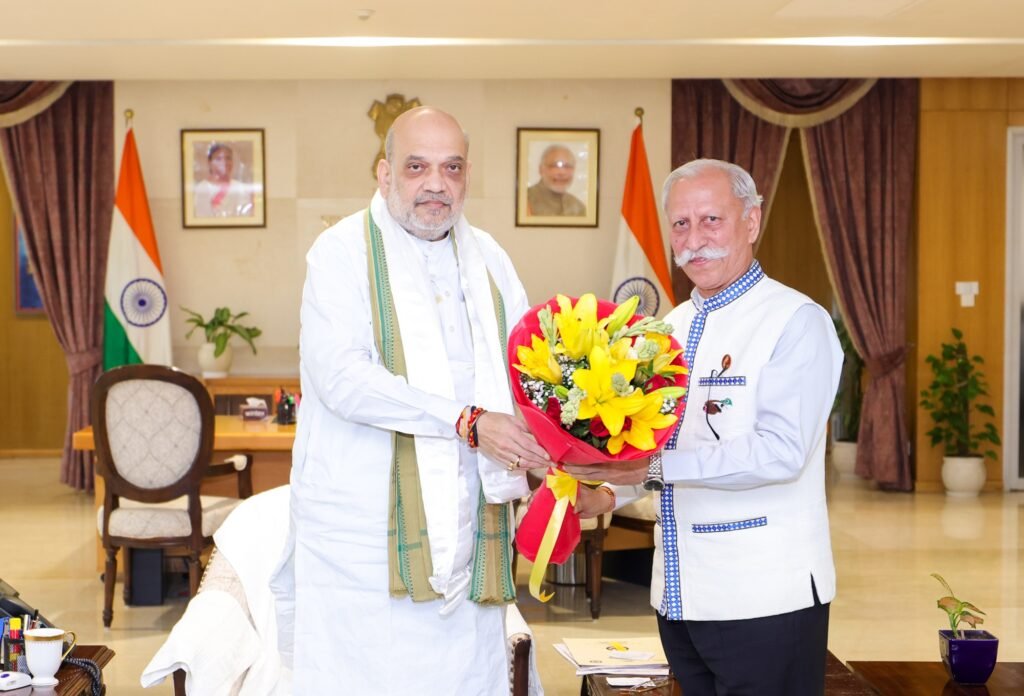
Guv discusses security, cooperative initiatives with Amit Shah

NEW DELHI : Governor Lt Gen KT Parnaik (Retd) called on Union Minister for Home Affairs and Cooperation Amit Shah in New Delhi on June 15 last and discussed a range of issues relating to law and order, internal security, border area development, geospatial applications and the strengthening of the cooperative movement in the state. According to a statement issued by Lok Bhavan, the Governor briefed the Union Minister on the prevailing law and order situation and recent developments concerning security and border management in Arunachal Pradesh. During the meeting, Parnaik highlighted the strategic importance of the Tirap, Changlang and Longding (TCL) region and discussed ongoing efforts to strengthen security infrastructure, including border fencing and surveillance measures. The Governor also expressed concern over the growing menace of drug trafficking and substance abuse, driven by narcotics originating across international borders and transiting through neighbouring states. He underscored the adverse impact of drug abuse on youth, social harmony and overall development, and stressed the need for sustained and coordinated action by all stakeholders. Emphasising the importance of geospatial applications, the Governor highlighted the need to equip young people with skills in the sector. He said such expertise could enhance governance, support land-related surveys and monitoring, aid disaster management, help curb drug circulation and improve oversight of infrastructure projects. On the cooperation front, Parnaik apprised the Union Minister of initiatives being undertaken to strengthen the cooperative movement in Arunachal Pradesh. He highlighted efforts to promote cooperative societies as instruments of inclusive growth, livelihood generation and rural prosperity. The Governor noted that a vibrant cooperative ecosystem has significant potential to empower farmers, women, Self-Help Groups and rural entrepreneurs by enhancing incomes, generating employment opportunities and fostering self-reliant village economies across the state.    

Latest News, National, Popular News, State News

Strike at paper leak mafia, not students: Rahul Gandhi slams Telegram ‘ban’

NEW DELHI : Congress leader Rahul Gandhi on Wednesday took a swipe at the government after it temporarily restricted access to Telegram, saying the “new trick” was akin to putting a lock on the victim’s house instead of catching the thief. Instant messaging app Telegram has stopped working for existing users in India after the government temporarily restricted access to the app, but it continues to remain operational through the Virtual Protocol Network (VPN). Google delisted the app on Tuesday, and Apple’s Appstore has also removed it now in compliance with the government order to block access to the app, ahead of the Neet-UG 2026 re-examination. In a post in Hindi on X, Gandh said, “‘Telegram Ban’ — Modi government’s new trick to stop paper leaks. Meaning, instead of catching the thief, just put a lock on the victim’s door.” “Lakhs of students have been studying on Telegram for years — notes, test series, discussions, preparation. How does snatching that facility become the solution to paper leaks? And it’s not even foolproof – every student in the country knows this, and so does the paper leak mafia. So, who will the next ban be on? WhatsApp?” Gandhi said. “On exam day, students will be frisked. Pockets will be cut open with scissors. Question papers will be sent via the Air Force. There won’t be any shortage of theatrics. But not a single strike at the root of the disease — because the paper leak mafia is thriving under this very government’s watch, and making the youth weep tears of blood. Modi Ji — drop the theatrics. Strike at the mafia, not the students,” Gandhi said. Listen to the ‘Echo of Students’ — – or else the youth of the country knows how to claim their rights, Gandhi said. The government on Tuesday temporarily restricted access to the Telegram messaging app ahead of the Neet-UG 2026 re-examination, with the National Testing Agency (NTA) saying the measure is aimed at tackling cheating rackets and misinformation. NTA Director General Abhishek Singh said the restriction on Telegram till June 22 is part of efforts to ensure that the June 21 re-test is conducted without malpractice. “We will not let anything go wrong. We will take all possible actions to ensure that the examination is conducted without any malpractice,” Singh had told PTI, when asked about the move. Telegram CEO Pavel Durov criticised the restriction on the messaging app in India, saying, “Banning it, even temporarily, is a mistake.” In a post on X, Durov said, “India’s IT ministry banned Telegram for one week because some users shared leaked exam questions. This punishes 150M+ ordinary Telegram users in India — not the insiders who leaked the exam materials. And the ban hasn’t stopped anything. The leaks just moved to other apps. (Source: PTI)    

Latest News, National, Popular News, State News

Joint committee seeks views of NHRC on bills for removing PM, CMs detained on serious charges

NEW DELHI : A joint committee of Parliament examining a key bill on automatic removal of the prime minister, chief ministers and ministers detained in custody for 30 consecutive days on serious criminal charges on Wednesday held consultations with the NHRC and other stakeholders here. The local study visit focused heavily on evaluating the civil liberties and administrative implications of the proposed laws. The committee’s meeting with the National Human Rights Commission served as the anchor of the day’s deliberations. The panel, which has been boycotted by the opposition, also met Delhi Chief Minister Rekha Gupta. The Constitution (130th Amendment) Bill, 2025, The Jammu & Kashmir Reorganisation (Amendment) Bill, 2025 and The Government of Union Territories (Amendment) Bill, 2025 were referred to the joint committee of Parliament for threadbare consultations. The Indraprastha (GGSIP) University offered academic and constitutional viewpoints on the legislative drafts. The JPC is expected to compile these diverse inputs from administrative leaders, human rights defenders, academics, and legal activists as it prepares its final report for Parliament. The opposition has described the bills as a tool to target states not ruled by the NDA. (Source: PTI)        

Latest News, National, Popular News, State News

TMC rebels’ plan to merge with NCPI bears resemblance to Khandu’s 2016 Cong split

NEW DELHI : The plan of 20 rebel Trinamool Congress Lok Sabha MPs to merge with a lesser-known unrecognised party has “striking similarities” with a split in the Congress’ Arunachal Pradesh unit led by Pema Khandu in 2016, former Election Commission officials have said. In 2016, Arunachal saw one of the biggest political realignments in the Northeast. In September that year, Khandu and 42 Congress MLAs joined the People’s Party of Arunachal (PPA), while former chief minister Nabam Tuki stayed with the Congress. The PPA, then a constituent of the BJP-led North East Democratic Alliance (NEDA), formed the government with Khandu as the chief minister. Two months later, in December, Khandu and 32 PPA legislators joined the BJP. The move gave the BJP its first full-majority government in Arunachal, increasing its strength in the 60-member Assembly to 45. The PPA was reduced to 10 MLAs and the Congress to three. In the 2019 Assembly elections, the BJP won 41 of 60 seats, with Khandu continuing as the chief minister. Cut to 2026. A group of 20 dissident TMC Lok Sabha MPs have told Lok Sabha Speaker Om Birla about their plans to merge with the Nationalist Citizens Party of India (NCPI), a registered unrecognised political party headquartered in West Bengal’s Howrah. In the 2023 Tripura elections, the party fielded four candidates. Of the four, two contested on the party symbol, one as an Independent, while the nomination of the fourth was rejected. All three lost, securing equal or fewer votes than NOTA. The Lok Sabha Secretariat is now seeking legal opinion in writing on the TMC rebels’ merger plea so that the Speaker’s final decision can withstand judicial scrutiny if challenged in court, sources said. Former Lok Sabha secretary general and constitutional expert P D T Achary cited paragraph 4 of the 10th Schedule of the Constitution to underline that only a political party is allowed to merge with another party and just MPs or MLAs cannot merge. Paragraph 4 of the 10th Schedule deals with the exception to disqualification in case of a merger. It says that a member of a House will not be disqualified if the original political party to which they belong merges with another political party and not less than two-thirds of the members of the legislature party concerned agree to such a merger. Achary told PTI that if the leadership of a political party decides to merge with another political party, its MLAs and MPs have to agree on the merger, “but the MPs or the MLAs alone cannot merge with another political party… This is the Constitutional provision”. A former Election Commission official, who dealt with political parties in the poll panel, termed the plan of the TMC rebels to merge with the NCPI an “innovation” that has no mention in either the anti-defection law or the Representation of the People Act. TMC national general secretary Abhishek Banerjee has already written to Birla, disputing the merger proposal of the rebel MPs. In the letter dated June 10, Banerjee cited a 2023 judgment by a Constitution bench of the Supreme Court on the Maharashtra political crisis, which held that a political party and the legislature party are different entities and that protection under Paragraph 4 requires a valid merger involving the original political party as well. “After the 91st Amendment, the only lawful route by which a body of members may lawfully realign is a merger within the meaning of Paragraph 4 of the 10th Schedule, when two conditions are satisfied – namely when the political party merges and, cumulatively, two-thirds of the legislature party switches,” Banerjee wrote to Birla. “The claims making the rounds in the media presume that only one condition has to be satisfied, which is incorrect. Therefore, assuming without admitting in any manner that two-thirds of the legislative party has switched, there has been no merger of the political party with any party or any creation of a new party called AITC,” Banerjee wrote. (Source: PTI)