ONLINE AGE

(Online version of the Arunachal Age newspaper)

Author name: OnlineAge

Latest News, National, Popular News, REGIONAL, State News

Inclusion of Khasi, Garo in CBSE a milestone: Meghalaya CM

SHILLONG : Meghalaya Chief Minister Conrad Sangma on Friday said the inclusion of Khasi and Garo in the CBSE’s three-language framework was a milestone for inclusive education and cultural preservation in the state. Expressing gratitude to Union Education Minister Dharmendra Pradhan, Sangma said the Centre’s decision would benefit students, reduce challenges faced by schools and support language teachers across Meghalaya. ”On behalf of the people of Meghalaya, I express heartfelt gratitude to Hon’ble Union Education Minister Dharmendra Pradhan Ji for his swift intervention in enabling the inclusion of Khasi and Garo languages in the CBSE R3 framework,” the chief minister said in a statement. ”This important step will benefit students, ease challenges for schools, support language teachers, and strengthen the preservation of Meghalaya’s rich linguistic heritage,” he said. Sangma said the decision reflected a collective commitment towards building an inclusive education system that respects and promotes linguistic diversity. ”More than a milestone, this reflects our shared commitment to an inclusive education system that respects every linguistic identity,” he said. The R3 framework refers to CBSE’s three-language formula, mandating students to study three languages starting from class 6. (Source: PTI)      

Latest News, National, Popular News, State News

Sonam Wangchuk calls himself ‘honorary cockroach’, urges govt to hear voices of youth

NEW DELHI : Environmentalist and educationist Sonam Wangchuk on Saturday voiced support for the online “cockroach” movement led by the self-styled “Cockroach Janta Party” (CJP), describing himself as an “honorary cockroach”, as he urged the government to engage with the concerns being raised by youngsters rather than suppressing their digital expression. The online campaign, which uses satire and the imagery of a cockroach as a symbol of resilience and dissent, has drawn attention in recent days amid claims by its founders of a crackdown on their social-media presence, including account suspensions and hacking allegations. The movement has framed itself around issues, such as unemployment, exam paper leaks and public accountability. Speaking on the controversy in an interview with PTI, Wangchuk said the campaign should be viewed as a form of democratic feedback and not as a threat. “First of all, I am very impressed,” Wangchuk told PTI. “Such creative expressions by our youth are nothing to worry about and nothing to be afraid of. The government should take the message — don’t kill the messenger. If we kill the messenger, the message will not end.” Asked whether he would formally join the movement, Wangchuk responded in a lighter vein, saying he does not qualify for membership but identifies himself with its message. “I have been asked from several quarters to speak on it. Some are saying I should also become a member,” he said. “I think I do not qualify — I am neither unemployed nor am I lazy. So sadly, I am not a member. But I consider myself an honorary cockroach,” he said. Drawing a comparison with political satire and caricatures published in newspapers, Wangchuk said dissent expressed through humour and symbolism is a legitimate democratic tool. “Like cartoonists in newspapers, you don’t shoot them because they made a caricature of the prime minister, the home minister or the defence minister. Similarly, this is also satire. See it as feedback,” he said. Wangchuk praised what he described as the movement’s non-violent and imaginative character, saying the youngsters of the country have chosen digital creativity over confrontation and it is things like these that make India a “Vishwaguru”. “I am very impressed that the youth of India wanted to bring out their frustration in such a creative way — not on the streets with stones, as has happened in other countries,” he said. “To respect it is the duty of the Indian government, to look at it lovingly and take its message.” He, however, warned that suppressing online spaces could aggravate frustrations among young people. Referring to reports that social-media accounts linked to the movement are being shut down, Wangchuk said authorities should avoid pushing dissent underground. “Otherwise, what will happen? I am hearing that their accounts are being closed. Then this anger can go anywhere,” he said. Drawing a parallel with political unrest in Nepal, Wangchuk argued that restricting creative expression online could have unintended consequences. “Violence did not happen just like that in Nepal. When they shut down the internet and stopped creative expressions online, youth came out on the streets and it became an ugly scene,” he said. He said the issues being raised by the “cockroach” movement, particularly alleged paper leaks and concerns over accountability, deserve attention rather than dismissal. “They are raising the issue of paper leak — there is nothing wrong with that,” he said. “In any country, ministers resign on such issues, so what is the big deal? Instead of suppressing them, their message should be taken.” He further said the movement reflects genuine anxiety among young people, who are trying to make themselves heard before frustrations deepen. “They are troubled, so they are expressing that they are worried — but not so much that they take to the streets. This could be the next step,” he said. “That is why, at this stage, their voices should be heard.” Wangchuk said the campaign has demonstrated a uniquely Indian form of protest and should be used as an opportunity to strengthen democracy. “It should be taken very positively and used to create a better India,” he said. “The creativity with which the youth of India have given this message — such things make us Vishwaguru. The youth of India do not take to the streets with stones, they present their point creatively.” He appealed to young people to remain peaceful, while urging the government not to corner them. “This is my message to the government — do not push them,” Wangchuk said. “And I request the youth to never go towards violence. Keep raising your voice, no matter how much you talk, never go towards violence. On the other hand, the government should not force them to take the path of violence,” he added. (Source: PTI)        

REGIONAL

10 illegal immigrants prevented from entering Assam: CM

GUWAHATI : Ten illegal immigrants from Bangladesh were prevented from entering India early on Saturday by joint efforts of the BSF and Assam Police, Chief Minister Himanta Biswa Sarma said. He asserted that detection and prevention were vital to ensure a secure Assam. “The strict vigil continues along our border. In the wee hours, @assampolice in coordination with @BSF_India identified and prevented the entry of 10 illegal infiltrators into Assam,” Sarma said in a social media post. He, however, did not mention the district where the infiltrators were detected. “Smart detection and immediate prevention are key to our vision of a Surakshit Assam,” the CM added. The state government has been cracking the whip on illegal immigrants from Bangladesh, pushing back infiltrators through its borders with the neighbouring nation. (Source: PTI)  

REGIONAL

Nagaland Police appeal to people to maintain peace, social harmony

KOHIMA : Amid concerns over the prevailing law and order situation in a neighbouring state and the possibility of disturbances spilling over into Nagaland, the state police urged citizens to maintain peace, communal harmony and vigilance. Nagaland Director General of Police Rupin Sharma appealed to the people to act responsibly and refrain from sharing or forwarding any unverified information, rumours or provocative social media content that could create panic, misunderstanding or communal tension. In an appeal issued on Friday, the police cautioned against the spread of false and misleading narratives through social media, stating that in the age of artificially generated content, the creation and circulation of fake information has become easier and more dangerous. The advisory came amid search operations being conducted in Manipur’s Kangpokpi district to rescue those who are still being held hostage by armed groups. Thirty-one of around 38 people belonging to the Kuki and Naga communities, who were held in captivity by armed groups in Kangpokpi and Senapati districts in Manipur, were released on May 14 and 15. These people were taken to undisclosed locations after suspected militants shot dead three church leaders and injured four others in Kangpokpi on May 13, while a civilian was gunned down and his wife was wounded in Noney district in the neighbouring state. Citizens have also been urged not to react emotionally to developments outside Nagaland and to avoid being influenced by rumours or provocative narratives circulating online. The Nagaland Police assured that the situation is being closely monitored and that all necessary measures are in place to maintain law and order in the state. It emphasised that public cooperation remains essential in ensuring continued peace and stability. Citizens have been advised to exercise utmost caution while consuming or sharing online content, especially material capable of disturbing ethnic and inter-community relations in the state, the Nagaland Police statement said. The police also warned that individuals deliberately spreading fake news, rumours or inflammatory content through social media or other platforms would face legal action under relevant provisions of the Bharatiya Nyaya Sanhita (BNS), Information Technology Act and other applicable laws. The advisory also called upon the public to remain alert and immediately report on any suspicious individuals or activities attempting to disturb the prevailing social harmony and peaceful coexistence among communities in Nagaland. Reiterating that Nagaland has maintained peace and normalcy despite tensions in neighbouring provinces, the police appealed for cooperation from all sections of society to preserve harmony in the state. (Source: PTI)    

REGIONAL

Assam Civil Service officer held on graft charges; over Rs 1.66 cr in cash seized

GUWAHATI : An Assam Civil Service (ACS) officer has been arrested on graft charges and over Rs 1.66 crore in cash and fixed deposits worth another Rs 86 lakh have been seized, along with other investment documents, a police officer said on Saturday. The accused, Lachit Kumar Das, posted as additional director, Land Records, Guwahati, was apprehended by sleuths of the Directorate of Vigilance and Anti-Corruption, acting on a complaint alleging that the officer had demanded a bribe for issuing an NOC for land sale permission. The police officer said Das had allegedly demanded Rs 1 lakh as bribe for issuing the No Objection Certification (NOC), and unwilling to pay the money, the complainant approached the Vigilance Directorate. A trap was laid by the Vigilance sleuths on Thursday at the ACS officer’s Guwahati office and he was caught red-handed in his chamber while accepting Rs 45,000 as part of the demanded bribe, the officer said. A case has been registered by the directorate. After his apprehension, Vigilance sleuths conducted searches in his two houses in Guwahati. During the first search operation, Rs 48.38 lakh in cash was retrieved from a locker inside one house and fixed deposits amounting to Rs 80 lakh in the names of the officer and his family members were seized. “Several general life insurance policies, postal life insurance policies in the names of him and his family members were found. Several bank accounts and documents of landed property have also been found, and analysis of these is underway,” the police officer added. The directorate, in a social media post, said, another search was conducted in another house of Das on Friday, and over Rs 1.18 crore in cash was seized. “On 22-05-2026, a team of @DIR_VAC_ASSAM again conducted a search in another house of Lachit Kumar Das, ACS, ADLR located at Queen’s Garden, Ranibagan, Beltola and recovered cash Rs. 1,18,30,000/- & some land related documents,” it said. (Source: PTI)    

REGIONAL

Rupamoni Gorh becomes first woman from Assam to scale Mt Everest

GUWAHATI/NORTH LAKHIMPUR : Rupamoni Gorh has become the first woman from Assam to scale Mount Everest, achieving the feat as part of an all-women expedition team of the Indo-Tibetan Border Police (ITBP), Chief Minister Himanta Biswa Sarma said on Saturday. Gorh, a resident of Lilabari in Lakhimpur district, reached the summit of the world’s highest peak on Thursday. Sarma said the state was proud of her historic accomplishment. “Assam’s daughter has reached the top of the world. Heartiest congratulations to Rupamoni Gorh for becoming the first woman from Assam to scale Mount Everest as part of the ITBP all-women expedition team,” he said in a social media post. “Her historic feat is a moment of immense pride for Assam and an inspiration for our youth to dream big and conquer new heights,” he added. Born into a farmer’s family, Gorh grew up in Lilabari with modest means. Her father, Joysing Gorh, is engaged in agriculture, while her mother, Kamalawati, works as an Anganwadi assistant. A graduate in Arts, she joined the ITBP in 2020 and continued to pursue her childhood passion for adventure and mountaineering, her family said. (Source: PTI)          

Editorial

Bracing for the viral threats

While the Coronavirus remains fresh in public memory, two other viruses with varying threat indicators have appeared in different parts of the world. They remain active, but their scope is largely localised. Hantavirus, which was recently discovered on a Dutch cruise ship in the South Atlantic, caused the death of three people on board. The risk from the virus has been categorised as low – the virus causes a zoonotic disease that spreads mainly through the inhalation of rodent saliva, urine or droppings. Human-to-human transmission is uncommon but not impossible. The ship started its voyage from Argentina, where the virus is endemic. Failing to detect its presence in time allowed it to circulate for weeks. The threat from Ebola is more serious. The World Health Organisation (WHO) has declared its spread in the Democratic Republic of Congo (DRC) and Uganda a “public health emergency of international concern.” This marks the outbreak as a serious threat, just below the level of a pandemic. WHO has confirmed 246 suspected cases and 80 suspected deaths in the DRC as of last week. Ebola’s presence has been reported in parts of Africa for over a decade, and the virus has caused over 11,000 deaths. It can spread from person to person and has a high fatality rate. No known vaccines are effective against the strain currently circulating – Bundibugyo – and no treatment protocols are currently available. The strain is not easily detected through tests, limiting the options of scientists and doctors in developing treatment strategies. WHO has indicated that the virus’s potency and transmission trends may point to a bigger outbreak. Ongoing conflicts in the affected regions, coupled with the migration and displacement of people, risk spreading of the disease. The countries affected by the outbreak are hampered in the fight to contain it. WHO’s operations have been hit by the cessation of funding by the United States and other constraints. African countries remain extremely vulnerable to such threats because their mitigation efforts hinge on the import of vaccines, medicines, and medical equipment. India has postponed two events scheduled in Delhi following the Ebola outbreak: the India-Africa Forum Summit (May 28-31) and the International Big Cat Alliance summit (June 1). Passengers from the affected countries are being tested. The WHO alert is significant as an early call for preparedness. Though the virus has not reached the proportions of a global threat, the need for caution cannot be overstated. (Source: DH)

Editorial

The case for incentivising population growth

Are populous nations better off than those with a smaller population is a question that is not easy to answer. Generally speaking, a large population is difficult to manage and has its downsides, as it puts pressure on resources, the environment and governance. As more people compete for limited resources, conflict is inevitable. However, on the other hand, many nations are struggling with sluggish or negative population growth and are even inviting people from outside to settle. Even China, which we have replaced as the most populous nation, is reeling under the negative impacts of pursuing an aggressive population control regime. In India, we have charted a cautious course. While public campaigns like ‘Hum Do Hamare Do’ and many incentives for having small families have been offered, it has never been coerced, and the choice has by and large remained voluntary, except for a brief period during the Emergency in the 1970s when it was aggressively pursued by Indira Gandhi’s government. The result was resentment, and the government fell. However, now it appears that views on population growth have come full circle, and Andhra Pradesh is now actively promoting larger families. The Andhra Pradesh government’s decision to incentivise larger families marks a sharp shift in India’s long-standing population policy. With the State’s Total Fertility Rate (TFR) falling to 1.5 — well below the replacement level of 2.1 — concerns are growing over an ageing population and a declining young workforce. Under the proposed “Pillale Sampada” initiative, families opting for a third and fourth child may receive financial incentives.  The concern is not merely statistical. Falling fertility rates eventually reshape economies, labour markets and social structures. A shrinking young population means fewer workers, lower productivity, reduced tax revenues and increasing pressure on welfare systems. As elderly populations grow, governments face mounting healthcare and pension burdens without a sufficiently large workforce to sustain them. This is precisely the demographic trap confronting countries such as Japan, South Korea, Italy and Germany. Even China, once synonymous with strict population control through its one-child policy, is now struggling with rapid ageing and declining productivity. However, what is right for Andhra Pradesh at the moment may not be suitable for the rest of the country. India has a largely unemployed population, and pressure on resources is immense. It would be difficult to join the club of developed nations if population growth is not checked. Encouraging larger families without simultaneously expanding social infrastructure could deepen economic inequalities. Moreover, demographic realities differ sharply across India. Northern States such as Uttar Pradesh and Bihar continue to record relatively high fertility rates, while southern States are ageing faster due to better literacy, urbanisation and healthcare outcomes. The larger lesson is that population is neither a burden nor an asset in isolation. Its value depends on how effectively governments invest in education, healthcare, skill development and employment generation. (Source: The Pioneer)

Latest News, Popular News, State News

Arunachal to set up state-level policy think tank: CM

ITANAGAR : Chief Minister Pema Khandu on Friday said the vision of establishing the Institute for Transforming Arunachal Pradesh (ITA) is steadily taking shape with proactive engagement between NITI Aayog and the state government. He described the initiative as a major step towards evidence-based policymaking and long-term development planning for the frontier state. In a social media post, Khandu said the proposed institute would serve as a dedicated state-level policy think tank aimed at providing strategic direction and development planning tailored to Arunachal Pradesh’s unique geographical, cultural and economic realities. “For long, we have strongly advocated the need for a dedicated state-level policy think tank that can provide strategic direction, evidence-based policymaking, and long-term developmental planning tailored to Arunachal Pradesh’s unique geographical, cultural, and economic realities,” the chief minister said in a post on X. Khandu expressed gratitude to NITI Aayog member Dr Joram Aniya, CEO Nidhi Chhibber and officials associated with the initiative for their commitment towards Arunachal Pradesh’s developmental journey. The proposed Institute for transforming Arunachal Pradesh is expected to function as a specialised policy and research body that can assist the state government in framing data-driven policies, monitoring developmental indicators, strengthening institutional governance and designing sustainable growth strategies suited to the state’s needs, officials said here. Arunachal Pradesh has, in recent years, intensified efforts towards infrastructure expansion, border area development, entrepreneurship promotion, tourism, hydropower and sustainable economic growth. The state government has also been working closely with NITI Aayog on several developmental initiatives, including aspirational district programmes, innovation ecosystems and youth empowerment strategies. NITI Aayog, the apex public policy think tank of the Centre, plays a key role in promoting cooperative federalism and supporting states in policy formulation and development planning through a collaborative approach. (Source: PTI)    

Latest News, Popular News, State News

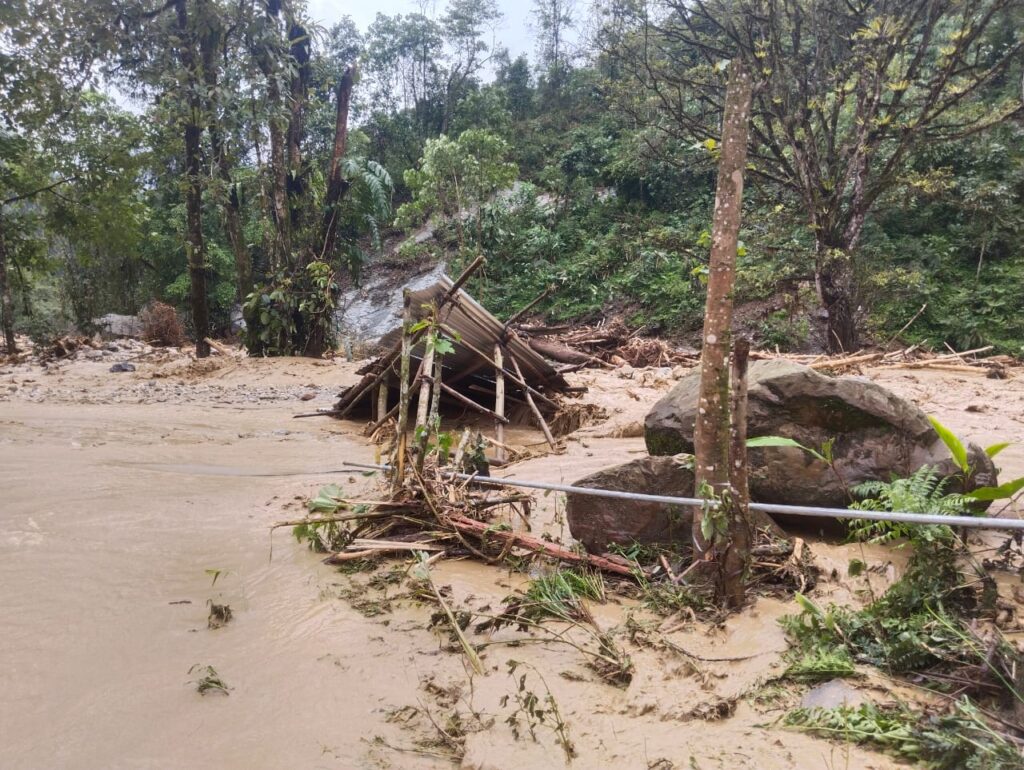
Flash floods triggered by downpour wreak havoc in Upper Subansiri

DAPORIJO : Flash floods triggered by heavy rainfall wreaked havoc in Upper Subansiri district, washing away crucial bridges, damaging houses, and disrupting connectivity in several villages, officials said on Friday. The District Disaster Management Authority (DDMA) has issued an advisory, urging people to refrain from venturing into rivers for fishing and other activities amid forecasts for more downpour. Among the bridges washed away were the RCC bridge at Nyo Koro near Ningping village and another connecting Longte village with the Giba headquarters, the officials said. In Ningping village, seven kutcha houses suffered extensive damage due to the flash floods, while agricultural fields, livestock, and other properties were also reportedly destroyed in the deluge, they said. The district administration is closely monitoring the evolving situation, while a detailed assessment of damages is currently underway, they said. Meanwhile, the Meteorological Centre here forecast heavy to very heavy rainfall accompanied by thunderstorms and lightning on Saturday in parts of Upper Subansiri, Kamle, Kra Daadi, Kurung Kumey, Lower Subansiri, Siang belt and adjoining districts. Extremely heavy rainfall in isolated areas is also likely on Sunday, it said. “Similar weather conditions are expected to continue till Tuesday,” an official said. (Source: PTI)