ONLINE AGE

Author name: OnlineAge

Latest News, Popular News, State News

RBI conducts financial literacy prog

JAIRAMPUR, NOV 7: The Reserve Bank of India (RBI), Itanagar, in collaboration with Arunachal State Rural Livelihoods Mission (ArSRLM), organized a field-level financial literacy programme at the conference hall of ADC office here on Friday. The programme witnessed active participation from more than 130 Self-Help Groups (SHGs) members mobilized under ArSRLM. The financial literacy session was delivered by RBI manager Amit Yadav, who covered a wide range of topics including Basics of Banking and Credit, Insurance and Pension Schemes, Social Security Schemes (PMJJBY, PMSBY, APY), Importance of KYC and Nominee details, Safe Digital & Internet Banking Practices, and procedures for claiming funds from the Depositor Education and Awareness Fund (DEAF). Participants were also introduced to the RBI Kehta Hai initiative through informative audio-visual presentations. BLCCT president Chandan Prasad highlighted various livelihood activities undertaken with support from NABARD and encouraged SHG members to come forward for enterprise development. He assured assistance in preparing business development plans for SHGs aspiring to scale up their activities. Lead District Manager, SBI, Binod Kumar Yadav, briefed the participants on banking services available to SHGs and emphasized the benefits of the Atma Nirbhar Arunachal Pradesh schemes. He assured support for strengthening credit linkage of SHGs with financial institutions. AGM, NABARD, Kamal Roy shared insights on the evolution of SHGs and the SHG–Bank Linkage Programme, along with various developmental interventions of NABARD in Farm, Off-Farm and MSME sectors. He also highlighted NABARD’s Geographical Indications (GI) initiatives, encouraging SHG members to register as authorised GI users. In addition, he emphasized the role of Cooperatives and Cluster Level Federations (CLFs) in enabling SHGs to scale sustainably, outlining initiatives undertaken by the Ministry of Cooperation and NABARD to strengthen the cooperative ecosystem. The programme concluded with an interactive Question & Answer session, during which SHG members actively engaged with the resource persons, seeking clarifications and sharing field-level experiences.

Latest News, Popular News, State News

Int’l conference on mental health concludes at NERIST

NIRJULI, NOV 7: The two-day international conference, titled ‘Invisible Struggles: Mental Health and the Lived Realities of the Peripheralized’, concluded at the North Eastern Regional Institute of Science and Technology (NERIST) here on Friday. The event was organised by the Department of Humanities and Social Sciences, NERIST, in collaboration with the Ministry of Tribal Affairs, Government of India and the Department of Social Justice and Empowerment and Tribal Affairs, Government of Arunachal Pradesh, in association with two knowledge partners – Kolkata-based BRIDGE and Mumbai-based Mariwala Health Initiative. The seminar brought together leading experts in the field from prominent institutions and organization across the country and abroad, including university of Kent, United Kingdom, IIT Bombay, Gauhati university, George institute of Global Health, Rajiv Gandhi University, Mariwala Health initiative, AP queer station, Rainbow Hills Association, the Collective Trust, Sikkim; Xomonnoy, Guwahati; All Trans Man Association, Manipur, who deliberated over two technical sessions on relevant themes. On the second day, two panel discussions took place. The first panel discussion titled: “Cultural and Tribal Perspectives on Mental Health and Suicide Prevention” was curated by MariwalaHealth Initiative, Mumbai. Aleen Barwa, Associate at Mariwala Health Initiative for Indigenous Mental health was the moderator. The four panellists: Binita Ekaa Psychiatric Social Worker, Department of Health & Family Welfare, Government of Odisha, Dr Raile R Ziipao Associate Professor of Sociology, Department of Humanities and Social Sciences, IIT Bombay, Dr Tarun Mene Assistant Professor, Arunachal Institute of Tribal Studies, Rajiv Gandhi University, Arunachal Pradesh, Dr Reep Pandi Lepcha Assistant Professor, Department of English, SanchamanLimboo Government College, Gyalshing, West Sikkim. The panel explored mental health through the lens of indigenous knowledge, justice and cultural identity, emphasizing the importance of contextual and community-based approaches to suicide prevention. The session concluded with a call to recognize indigenous worldwide views and collective practices as centre to building inclusive, virtually grounded mental health frameworks. The second panel, “Mental Health Ecosystem – Reflections and Lived Experiences of LGBTQ+ Individuals,” curated by BRIDGE, Kolkata, highlighted that mental health is profoundly shaped by social acceptance, home, and community support, extending far beyond clinical settings. The discussion, featuring panellists namely Rudrani Rajkumari, Trans Queer Activist, Xomonnoy Assam; Viveka Gurung, Assistant Professor, Department of Sociology Nar Bahadur Bhandari Government College cum Executive Member, Rainbow Hills Association, Sikkim; Sopin Laishram, Executive Member, All Trans Man Association, Manipur; Sawang Wangchha, Founder, AP Queer Station alongwith the moderator Prithviraj Nath, Founder Director, BRIDGE, explored the complex intersections of identity, stigma, and well-being, pointing to persistent challenges like transphobia, unemployment, and institutional neglect. Participants strongly underscored the need for sustained funding, gender sensitization, and the inclusion of gender studies in education. Furthermore, the conversation stressed integrating indigenous and community-based approaches into mental health frameworks, noting the significant gap between policy and the real-world implementation of queer rights. A critical point raised by AP-Queer Station was that, given the limited resources in Arunachal Pradesh, the community’s immediate need is not just for formal therapy but for genuine allies who will listen and understand. Addressing the common narrative, the panel asserted that while the community uses the language of human rights, their identities and struggles are indigenous to the region, urging society to validate and see their realities. Overall, the session called for the creation of an inclusive and empathetic ecosystem to support the mental well-being of all LGBTQ+ individuals. The conference concluded with a valedictory function in which Dr P Parida, Organizing Chair, kicked off the event with a sincere welcome, setting an inclusive tone by wishing every attendee would “leave as a friend”. Dr Geling Modi Joint Convener gave an overview of the international conference. This spirit of openness was leveraged in the addresses, starting with ProfRajive Mohan Pant, Vice Chancellor, Assam University poignant reflection on the academic sector. He underscored that in this fast-changing world, stress is inevitable, and urged the educational system to discuss these pressures and “see the invisible” distress among students – recalling a tragic suicide over high math scores – and to advocate for the unconditional support championed by Prof. Anand Prakash. Prof.Sarsing Gao, the Dean Academic, confirmed the conference’s impact, noting the significance of viewing mental health not from a purely individual perspective rather a systemic one, and praised the inclusion of gender issues. This urgency was amplified by Prof. Narendranath S, Director of NERIST, who issued a compelling call to action: the duty now is to translate learned experiences into “concrete actions” and uphold integrity to build community momentum, stressing the necessity of openly discussing the “limitations of the institute and education” itself to overcome them. Beyond the keynote addresses, the conference successfully fostered creative dialogue through student competitions commemorating Suicide Prevention Month, with Nani Pinky (PhD, Physics) taking first in Poster Making, Pophi Tapi (BTech III, Mechanical) winning the Poetry Competition, and Merelyn Remruatpuii (BTech III, Electrical) securing the top spot in Creative Writing.


Latest News, Popular News, State News

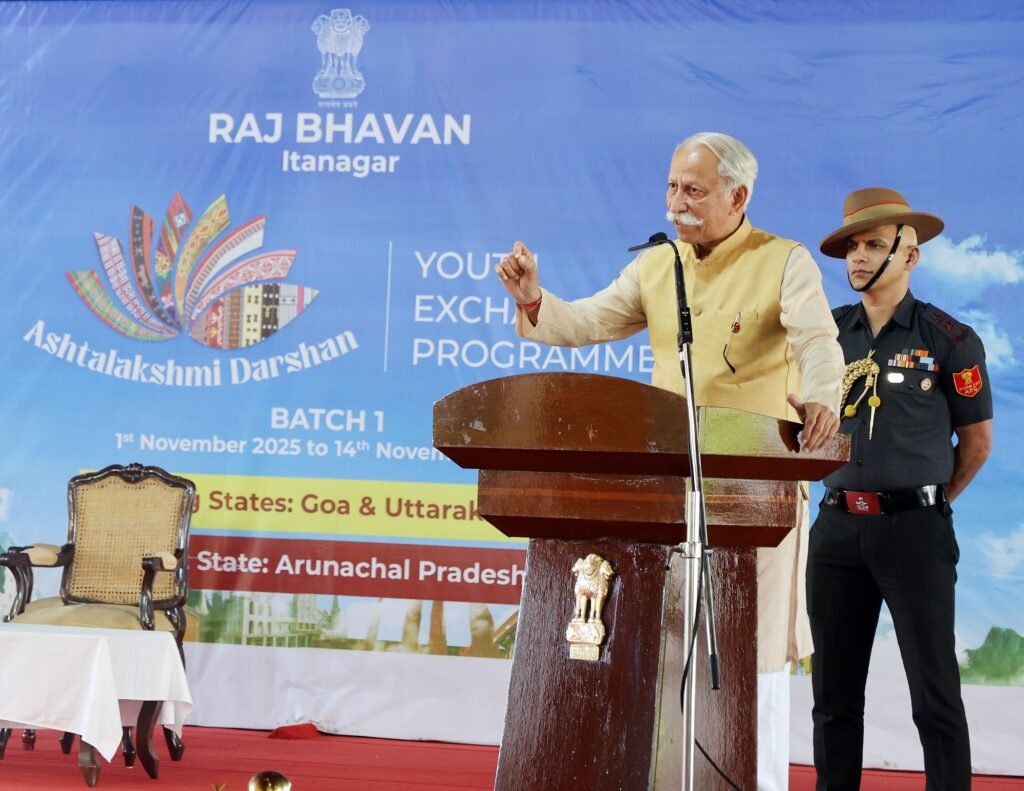
Ashtalakshmi Darshan: Guv interacts with students from Goa and Uttarakhand

ITANAGAR, NOV 7: Governor Lt General KT Parnaik(retd) interacted with a group of students from Goa and Uttarakhand at Raj Bhavan here on Friday. The students are visiting the state as part of Ashtalakshmi Darshan, a vibrant Youth Exchange Programme, designed to deepen national integration and strengthen bonds between young people from different regions of the country. Parnaik appreciated the vision behind the programme, describing Ashtalakshmi Darshan as a far-sighted initiative that brings together the youth of the Northeastern region and the rest of India. He said it promotes cultural understanding and mutual respect and also nurtures ‘youth ambassadors’ who carry with them the values of unity, diversity, and national harmony. Programmes like this, he added, play a significant role in advancing Prime Minister Narendra Modi’s vision of Viksit Bharat, where young minds drive progress with confidence and shared purpose. Advising the students on their responsibilities as future leaders, the Governor said that every young person must strive to be an ideal citizen, educated, disciplined, motivated, and rooted in strong moral values. He encouraged them to stay well-informed, uphold self-discipline, and adopt a selfless approach in life. Taking pride in one’s cultural heritage, knowing one’s traditions, and nurturing deep love for the nation are qualities that, he said, build character and strengthen leadership. The Governor also shared a simple but powerful mantra with the students. He advised them to be externally calm and internally intense, a balance that helps leaders stay focused and resilient. During the interaction, the Governor spoke about leadership, drawing from his vast experiences in the Indian Army, the corporate world, and his present role as a constitutional enabler. He also highlighted the remarkable development taking place in Arunachal Pradesh, the widespread use of Hindi as a connecting language, the state’s growing excellence in sports, and the deep respect for nature that shapes the local way of life. Adding colour and warmth to the programme, the Goa team presented Gomantak Sanskruti, while the Uttarakhand students showcased the rich folk traditions of the Kumaon and Garhwal regions. The host RGU team presented a vibrant Diversity Dance, portraying the beautiful cultural vibrancy of the many tribes of Arunachal Pradesh. The programme is organized by the North Eastern Council (NEC), Shillong, under the Ministry of Development of North Eastern Region (DoNER), Government of India. The first edition of the Ashtalakshmi Darshan initiative is being hosted by Rajiv Gandhi Universityfrom November 1 to 14.  

Latest News, Popular News, State News

DC visits ITI Pangin, interacts with new trainees

PANGIN, NOV 7: Siang Deputy Commissioner TayiTaggu, along with Chief Operating Officer (Rural Skills), DDUGKY, RuzingBellai, visited Industrial Training Institute (ITI), Panginon Friday to interact with the newly enrolled trainees. During the interaction, the DC emphasized the importance of skill development training as a means of value addition, encouraging trainees to utilize the opportunity to equip themselves with practical and employable skills. He highlighted that such initiatives not only enhance individual livelihoods but also contribute to the larger vision of a self-reliant and skilled India. ITI Pangin principal (in-charge) NiyangPertin informed that it is a matter of pride for the district that the institute has become operational. She expressed optimism that the ITI will emerge as a centre for excellence in vocational training in the region. ITI Pangin currently offers three trades – Digital Photography, Solar Technician, and Catering and Hospitality Assistant. (DIPR)  

Latest News, Popular News, State News

Review meeting on Akajan-Likabali-Bame road held

LIKABALI, NOV 7: A review meeting of the heads of departments and executive bodies of the district was convened by the Lower Siang deputy commissioner on Friday here to take stock of the progress of maintenance works being undertaken by the agencies on Akajan-Likabali-Bame road amidst threats of launch of democratic movement by the youth and student’s union. The meeting chaired by the Additional Deputy Commissioner Mokar Riba delved into the details of the facts compelling progress of pending works which eventually led to the crippling of traffic movement in the recent months to many upward districts of the states commuting through the road for a long period of time. The DGM NHIDCL Basar, representatives of the BRTF, President District Unit Galo Welfare Society (GWS), heads of departments, public leaders, Galo Youth Organization president, representatives from students’ unions attended the meeting. (DIPR)

Latest News, Popular News, State News

Indian Army troops in Arunachal commemorate 150 years of ‘Vande Mataram’

ITANAGAR, NOV 7: Troops of the Indian Army deployed in the remote and strategically significant Siang, Siyom, and Subansiri Valleys of Arunachal Pradesh on Friday commemorated 150 years of India’s National Song ‘Vande Mataram’ with great patriotic fervour and devotion at their forward posts. At first light, soldiers of the Indian Army assembled at their posts overlooking the Line of Actual Control (LAC) to join the nation in the collective singing of Vande Mataram. Against the backdrop of towering mountains and the turbulent rivers, their voices echoed through the valleys — a stirring reminder of India’s unity, strength and enduring spirit. The event, held in accordance with directives from the competent authority, marked the historic milestone with deep symbolism. Despite operating in challenging high-altitude conditions, the troops displayed exceptional enthusiasm, transforming their remote outposts into centres of patriotic celebration. The commemoration was not only a tribute to the National Song but also to the ideals of sacrifice, discipline, and service that define the Indian Army. Officers and soldiers reflected on the song’s immortal words, which invoke devotion to the motherland and inspire every sentry who guards the nation’s frontiers. “Their participation symbolised not only a tribute to the national song but also to the ideals of sacrifice, discipline and service that the Army represents.” Brief interactive sessions followed, where troops discussed the historical and cultural significance of ‘Vande Mataram’, its role in India’s freedom movement, and its continuing relevance as a unifying force. The celebration concluded with the hoisting of the Tricolour and a collective pledge to uphold the sovereignty and honour of the nation at all times. As the echoes of Vande Mataram faded into the misty hills, the Siang, Siyom, and Subansiri Valleys stood as a living testament to India’s indomitable spirit — where every soldier’sheartbeat continues to chant the timeless call of the motherland.

REGIONAL

‘Vande Mataram’ awakens spirit of unity, devotion to motherland: Manipur Guv

IMPHAL, NOV 7: Manipur Governor Ajay Kumar Bhalla on Friday said the national song “Vande Mataram” awakens the spirit of unity among people and devotion to the country. Bhalla also called upon everyone to uphold the timeless ideals of patriotism and national harmony that the ‘Vande Mataram’ song so beautifully embodies. In a post on X, the Raj Bhavan said the governor of Manipur joins the nation in celebrating 150 years of ‘Vande Mataram’, the “immortal song that awakens the spirit of freedom, unity, and devotion to our Motherland”. The song was written by Bengali novelist Bankim Chandra Chattopadhyay on the occasion of Akshaya Navami, which fell on November 7 in 1875. The song first appeared in the literary journal, “Bangadarshan”, as part of Chattopadhyay’s novel, “Anandamath”. “On this historic occasion, the governor pays tribute to the deep patriotic spirit of the people of Manipur, whose rich cultural heritage and unwavering love for the nation reflect the very essence of ‘Vande Mataram’,” the Raj Bhavan statement said. Former chief minister N Biren Singh also paid his tributes to the national song. In a post on X, Singh said, “On this historic day, we celebrate the 150th anniversary of our soul-stirring National Song, Vande Mataram. “Mother, I Bow to Thee” and let the anthem of resilience echo throughout the nation.” He said the song “ignited the flame of freedom in every Indian heart during our struggle for independence”. “Let us bow in reverence to our motherland, drawing strength from her eternal spirit to build a united, prosperous India,” he added. (Source: PTI)

REGIONAL

40 per cent of budget funds kept for tribal welfare in Tripura, says CM

AGARTALA, NOV 7: Tripura Chief Minister Manik Saha said that his government has kept 40 per cent of the total budgetary outlay during the 2025-26 financial year for tribal welfare. The state’s budget for the current fiscal stands at Rs 32,000 crore. While speaking at a progamme at Chailengta in Dhalai district on Thursday, the chief Minister said the development of the northeastern state is not possible without upliftment of the tribal people. “Driven by this reality, the state government has kept over 40 per cent of the budget for tribal area development during the 2025-26 financial year. The government is also focusing on skill development of the tribal, especially the resettled Bru people,” he said. Several thousand Bru families, who were living in Tripura since late 1990s because of ethnic violence in their home state Mizoram, were rehabilitated in several districts of this state following an agreement signed in 2020. “Under the PM Kaushalya Yojana and MukhyamantriDakkhata Yojana, the government provides skill training to these Bru people,” the chief minister said. Saha said that Union Home Minister Amit Shah, during a visit to a Bru resettled village in Ambassa, had asserted that providing houses, water, and other benefits would not be enough for sustainable livelihood for them. “The Skill Development Department is providing training to them. The Bru people have said that they are happy and thanked Prime Minister Narendra Modi. We must provide skills to the Bru people to ensure their employment,” he said. The chief minister claimed that no political party or government had raised a voice for a permanent solution to the Bru people for the past 23 years. “The BJP-led government, on humanitarian grounds, solved their issues by signing an agreement. Our government is with you and working for your development. The government is working to make people self-reliant,” he said. Saha said when the agreement was signed in 2020 for the Bru people, a series of talks were held, and finally they were resettled in 12 locations in the northeastern state. “We have provided toolkits to 895 people and driving licences to 200, for which Rs 1.45 crore was spent,” he said. Earlier, the chief minister distributed toolkits for skilled Bru candidates and virtually inaugurated new buildings of a school and several government departments. (Source: PTI)

Blog, Editorial

Evasive EC erodes trust in poll processes

Allegations made by Leader of the Opposition Rahul Gandhi about electoral malpractices in Haryana raise questions about the integrity of the polls and the credibility of the Election Commission of India (ECI). Gandhi’s charges, made during his media interaction on Wednesday, are not a blanket statement on elections in the country, but with no credible explanations coming from the EC, apprehensions about its functioning will remain. If the LoP’s previous allegations were about individual constituencies, such as Mahadevapura and Aland in Karnataka, he has now claimed that the entire Assembly election in Haryana, held in November 2024, was ‘stolen’ by the BJP, with support from the EC. ‘Operation Sarkar Chori’, he said, was orchestrated to deny the Congress a landslide victory as predicted by multiple exit polls and opinion polls. Gandhi shared the list of voters in Haryana’s Rai Assembly constituency, in which the photograph of a Brazilian female model was seen as used 22 times across 10 booths, as voters with different names. He claimed that one in eight voters in Haryana was fake (over 25 lakh voters) and 1,24,177 voters in the state had fake photographs on the rolls. Despite this, the Congress lost eight seats by a cumulative margin of 22,779 votes. Gandhi’s statements are based on the EC’s records, and the malpractices he has pointed out are similar to the ones he has highlighted in the past. There is a pattern of manipulation in voters’ lists, and with similar discrepancies coming to the fore in other parts of the country, it is upon the EC to address, with credible evidence, the allegations of a centralised plan to tamper with the elections, to the advantage of the BJP. Neither the EC nor the BJP has given convincing responses to Gandhi’s charges. The Commission has outrightly denied any malpractice and has asked why the voters’ lists were not vetted by the Congress booth agents. Gandhi has pointed out that the lists were made available too late for an examination. In any case, the EC should not be deflecting the questions by posing its own questions when the responsibility of fair conduct of the polls rests with the Commission. The BJP, on expected lines, has sought to ridicule and vilify Gandhi. Still, there are no answers. Asking the LoP to approach the court does not make sense. The situation warrants urgent correction, not long-drawn legal redress. Citizens have a right to free and fair elections, and faltering institutions weaken the country’s democratic foundations. (Source: DH)    

National

Step-by-step guide to check your name in the electoral roll of 2002/2005 SIR

With the Tamil Nadu Assembly elections just months away in 2026, it’s time for every voter to do one simple but crucial thing, that is check whether your name or your relative’s name is on the Tamil Nadu voter list. The Election Commission of India (ECI) has kicked off a Special Intensive Revision (SIR) of the electoral rolls across Tamil Nadu and several other states. The goal? To ensure every eligible citizen is correctly listed and ready to vote when the state goes to polls next year. Last month, the ECI told the Madras High Court that the revision exercise would begin in Tamil Nadu as part of a nationwide effort to clean up and update voter lists. The Commission has already consulted Chief Electoral Officers across the country to keep the process smooth. Story continues below this ad This SIR exercise is not just limited to Tamil Nadu; it’s also being carried out in Andaman and Nicobar Islands, Chhattisgarh, Goa, Gujarat, Kerala, Lakshadweep, Madhya Pradesh, Puducherry, Rajasthan, Uttar Pradesh, and West Bengal. So, if you’re unsure whether your name or that of your parents or relatives is still on the list, don’t worry. You can easily check it online in just a few steps. Tamil Nadu voter list: Here is the step-by-step guide to check your name in Tamil Nadu voter list:  Visit the Official Website. Go to the Tamil Nadu Election Commission’s official website: https://www.elections.tn.gov.in/Electoral_Services.aspx Click on “Special Intensive Revision – 2002/2005”. Now, click on the option that says “Search your name in electoral roll.” You’ll see three options to search: Search by EPIC number (Elector’s Photo Identity Card) Search by Details Search by Mobile number Tamil Nadu voter id download: Option 1. To search by EPIC Number: This is the fastest and the most accurate method if you already have your voter ID card. Enter your EPIC number (as printed on your voter ID). Select Tamil Nadu from the state dropdown list. Type the Captcha code shown on the screen. Click on “Search.” Your voter details should appear on the screen instantly. Tamil Nadu election: Option 2. Search by Personal Details If you don’t have your EPIC number handy, you can still find your name using your personal details.