ONLINE AGE

(Online version of the Arunachal Age newspaper)

State News

Latest News, Popular News, State News

SIR progress reviewed

  DEOMALI, AUG 30: Electoral Roll Observer for the Special Intensive Revision (SIR) in Tirap district Duli Kamduk, Secretary Rural Works Department (RWD), reviewed the ongoing electoral roll revision exercise for the 54-Namsang (ST) Assembly Constituency at Deomali on Sunday. The review was attended by Tirap Deputy Commissioner-cum-District Election Officer (DEO), Deomali Additional Deputy Commissioner-cum-Electoral Registration Officer (ERO) for 54-Namsang and other election officials including Assistant Electoral Registration Officers (AEROs) and Booth Level Officers (BLOs). During his second visit, officials briefed the Observer on the status of claims, objections, additions and deletions under the constituency. Kamduk also physically verified the forms and supporting documents submitted by applicants and claimants. He directed the election officials to ensure timely disposal of all remaining applications pending for decision. The field review was aimed at ensuring effective implementation of the SIR process and strengthening transparency and accuracy in the electoral roll.

Latest News, Popular News, State News

National Sports Day observed

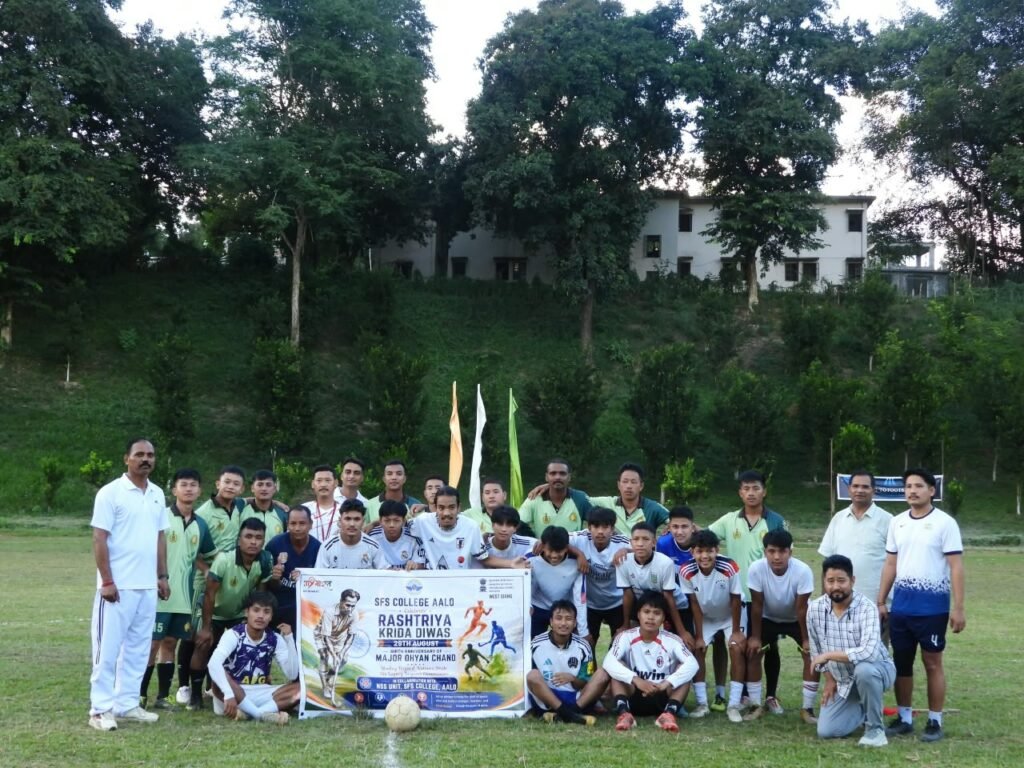
AALO, AUG 30: The National Service Scheme (NSS) Unit and Sports Club of SFS College Aalo, in collaboration with the 20th Indo-Tibetan Border Police (ITBP) Aalo, observed National Sports Day by organising a friendly football match between the college team and the 20th ITBP team on Saturday. The programme was organised to commemorate National Sports Day and honour legendary Indian hockey player Major Dhyan Chand whose remarkable achievements and contribution to Indian sports continue to inspire generations. Before the match, players and participants took a pledge to uphold the values of sportsmanship, discipline, unity and teamwork. The match witnessed enthusiastic participation and healthy competition, with the SFS College boys’ team emerging victorious.  

Latest News, National, Popular News, State News

PM Modi calls for drug-free youth, stronger India in monthly ‘Mann ki baat’

NEW DELHI, AUG 30: Prime Minister Narendra Modi on Sunday appealed to citizens to join hands to free India from the menace of drug abuse, and build a stronger future for the youth. Sign in for a more personalized Business Standard experience and never miss the stories that matter. In his monthly radio address ‘Mann Ki Baat’, Modi noted that the ‘Drug-Free Youth for a Developed India’ campaign is gaining momentum across the entire country. “Its goal is crystal clear – drug-free youth, drug-free India. Let us come together to build a drug-free India and a stronger future for our youth,” he said. The Drug-Free India through the ‘Nasha Mukt Bharat Abhiyaan’ (NMBA) is a flagship initiative of the government launched on August 15, 2020 under the National Action Plan for Drug Demand Reduction (NAPDDR). The campaign seeks to prevent substance abuse through awareness generation, community participation, treatment, rehabilitation, aftercare and social reintegration while fostering a nationwide movement against drug abuse. Referring to the PM SVANidhi Yojana, a welfare scheme for street vendors, the prime minister said the scheme is helping lakhs of women street vendors expand their businesses, increase their incomes and build a better future for their families. He said millions of mothers and sisters are gaining new strength through the ‘PM SVANidhi Scheme’ and this aspect of ‘women’s empowerment’ does not receive as much discussion as it should. “Nearly 46 percent of the beneficiaries of the ‘PM SVANidhi Scheme’ are women. That means around 35 lakh women across the country are connecting with this scheme to advance their businesses,” he said. Launched in June 2020, the PM SVANidhi scheme was formulated to assist street vendors to overcome the adverse effects of financial constraints and to restart their lost businesses during the Covid pandemic. Since the inception of the scheme, it has proved to be more than financial support for street vendors and has given them a sense of identity and formal recognition for their contribution to the economy. Initially launched till December 31, 2024, the scheme has been extended till March 31, 2030. The prime minister is currently on a state visit to Uzbekistan and the radio broadcast is usually recorded a few days in advance and played on the last Sunday of every month. (Source: PTI)    

Latest News, National, Popular News, State News

‘One nation, one time’: Govt notifies rules to make IST common time reference

NEW DELHI, AUG 30: The Department of Consumer Affairs has notified the Legal Metrology (Indian Standard Time) Rules, 2026, paving the way for Indian Standard Time (IST) to become the common time reference for legal, administrative, commercial and other official purposes across the country, it was announced. The rules were notified on August 27 and will come into force 180 days after their publication in the Official Gazette. The transition period is intended to give government departments, businesses, institutions and other organisations time to make the necessary changes to their systems and processes. The move comes amid growing dependence on accurate and synchronised time across technology-driven systems. Banking and digital payments, telecommunications, railways, power networks, computer systems and government records increasingly rely on precise timestamps, making consistency in timekeeping critical for their smooth operation. Under the new framework, the common IST reference is expected to improve the accuracy of timestamps for banking and digital payment transactions, support coordination across transport systems such as railways and airports, and strengthen the reliability of telecommunications and internet networks. Accurate and synchronised time will also be important for power systems, government and legal records, as well as emergency and other time-sensitive services. The framework is part of the government’s broader ‘One Nation, One Time’ initiative aimed at establishing a secure and uniform time-distribution system across India. The government is developing infrastructure to disseminate accurate Indian Standard Time through Indian institutions and Legal Metrology laboratories. The rules also provide for the use of NavIC, India’s satellite navigation system, along with other approved Indian timing sources for secure and reliable time dissemination. At present, several systems rely on foreign satellite-based sources for timing. The development of an indigenous time-dissemination infrastructure is expected to provide an additional source for critical systems and reduce reliance on external timing infrastructure. As part of the initiative, a White Rabbit Technology-based Indian Standard Time Dissemination Demonstration Network was commissioned at the Regional Reference Standard Laboratory in Bengaluru in July 2026. The system has demonstrated the dissemination of IST for sectors including banking, telecommunications, power, transportation and digital governance. The government has also demonstrated secure dissemination of Indian Standard Time between RRSL Bengaluru and NSE Chennai, in collaboration with CSIR-NPL, ISRO, SEBI, NSE, BSNL and other stakeholders. The 180-day transition period will allow stakeholders to assess their existing systems, carry out technical modifications and prepare for compliance before the rules take effect. (Source: IANS)  

Latest News, Popular News, State News

Eight people from Assam safely rescued from Nepal after flash flood: Himanta

GUWAHATI, AUG 30: At least eight people from Assam have been rescued from Nepal, which was struck by a devastating flash flood on August 26, and are being brought back to the state, Chief Minister Himanta Biswa Sarma said. The state government is coordinating with the authorities concerned to trace other missing people for bringing them back safely to Assam, he said in a social media post on Saturday. “I just spoke to eight people from Assam, who have been safely rescued in Nepal,” Sarma said. The rescued persons — Pankaj Verma, Samar Bezbaruah, Gautam Das, Gopal Debnath, Soneswar Narzary, Sarbison Marak, Silva Marak and Elphison Sangma — are safe and will return home on Sunday, he added. “Efforts are continuing to trace the others and ensure their safe return at the earliest,” the CM said. On Saturday, the Assam State Disaster Management Authority (ASDMA) said that 10 people from Assam were reported missing in Nepal since devastating flash floods struck the Himalayan country. However, the several names Sarma mentioned as safely rescued in his social media post were not on the list of missing people shared by ASDMA. As per the ASDMA list, the missing persons were Dr Dipali Sarkar, Pankaj Neog, Manash Kumar Ghosh, Rhituporno Brahma, Montri Basumatary, Someswar Narzary, Arun Nath, Dr Tirtha Chaliha, Rahul Daimary and Shatadal Nath. Among the missing, three each are from Kamrup Metropolitan and Karbi Anglong, two from Nalbari, and one each from Golaghat and Hojai districts. Earlier, the ASDMA had reported that 12 people from the state were missing in the Nepal floods. Later, it said that the family members of two persons from Nalbari have confirmed that they are safe. The death toll from flash floods in central Nepal rose to 734 on Sunday, with more bodies being recovered even as nearly 2,500 people are still missing, including 85 security personnel and 320 foreigners, following the disaster. The flash floods on Wednesday began after an ice-rock avalanche following a glacial collapse blocked the flow of the Lhende tributary of the Bhote Koshi River, with the resulting surge hitting Timure near Nepal’s border with Tibet and causing widespread destruction downstream. The torrent of water, mud and debris wiped out towns and villages, damaged crucial infrastructure and washed away hydropower stations throughout central Nepal. (Source: PTI)    

Latest News, Popular News, State News

Ahead of 24-hour shutdown over NRC demand, Manipur CM says bandhs create hardship for people

IMPHAL, AUG 30: Ahead of a 24-hour shutdown over NRC demand, Manipur Chief Minister Y Khemchand Singh on Sunday urged people not to observe bandhs or road blockades as a form of protest, and asserted that such demonstrations do not resolve issues and will only create hardship for people, particularly daily-wage earners and students. Singh also said these modes of protest sometimes lead to violence. His comment comes before the 24-hour bandh called by the Campaign for Just and Fair Delimitation (JFD) from midnight on August 31 to press the demand for the National Register of Citizens (NRC) ahead of the census exercise in the state. The chief minister, who left for New Delhi during the day, said his government and the Centre are committed to fulfilling the aspirations of the people of the state. “Calling a bandh will not serve any purpose and will instead create more hardship for the people. During a bandh, the main sufferers are daily wage earners and students,” Singh said in a statement issued by the state government. The chief minister said women vegetable sellers suffer a lot during a bandh as they earn their livelihood by selling their farm produce daily, and any disruption in their work causes immense hardship to their families. He also said students suffer a lot as their normal academic atmosphere gets disrupted by bandhs. Singh cautioned against attempts to create a chaotic situation and asserted that stringent action would be taken against law violators. The chief minister appreciated the role played by leaders of the 14 civil society organisations and a delegation of MLAs, who recently campaigned in New Delhi and met central leaders and officials to press demand for the implementation of NRC in the state. “Their campaign has yielded a positive response,” Singh said. The chief minister said he was travelling to New Delhi to meet top central leaders and discuss various ongoing issues of the state. After more than three years, the road transport services connecting Imphal, Dimapur, and Guwahati have resumed without any trouble, he said. “The Imphal-Dimapur-Guwahati bus services will surely ease the burden of people who had to buy costly air tickets to travel from Imphal to Guwahati,” he added. More than 260 people have been killed and thousands rendered homeless in ethnic strife between Meiteis and Kuki-Zo groups in the state since May 2023. (Source: PTI)      

National, State News

Suitcase murder case: Couple nabbed in Manipur after pan-India hunt

CHENNAI/IMPHAL, AUG 30: Police have arrested two persons, suspected to be the prime suspects behind the murder of a 38-year-old woman, whose dismembered body was found in a suitcase onboard the Tamil Nadu Express train in Agra earlier this month. Manik Uddin Laskar (22), a native of Assam’s Cachar district, and his wife Bhagabati Majhi (21) from Kendujhar district in Odisha were apprehended from Kashimpur in Manipur’s Jiribam following a multi-state hunt, police sources in Chennai said on Sunday. The duo were nabbed by a joint team of Manipur and Tamil Nadu Police, officials in Imphal said. “The arrested persons are being handed over to the SHO of Guduvanchery Police Station,” a Manipur Police official said. The crime came to light on August 5, when passengers onboard the Tamil Nadu Express noticed an unbearable smell from an abandoned red suitcase in an unreserved compartment after the train pulled into Agra station. Government Railway Police officials inspected the luggage and discovered the headless, dismembered remains of an unidentified woman. Subsequent investigation and forensic analysis identified the victim as Hayathun Nisha (38), a native of Odisha who lived in Guduvanchery and worked in a private firm. During the investigation, police analysed hours of CCTV footage from Chennai Central railway station, eventually spotting a man and a woman lugging the heavy red suitcase through the station premises. Tracing their movements back to the suburbs of Chennai, police located a rented house on Mosque Street in Guduvanchery. A search of the premises revealed more horrific details, as officers recovered additional dismembered body parts stored inside a large cooking vessel. While the case was initially registered as a missing woman’s report at the Guduvanchery police station, authorities promptly altered the charges to murder following the findings. Police swiftly identified the suspects as Laskar and Majhi, who had gone into hiding shortly after disposing of the body. Special police teams launched a pan-India search operation to trace the accused. On August 29, officers tracked the fugitive couple to Kashimpur in the Jiribam district of Manipur. The duo will be produced before a local magistrate in Manipur, and the Guduvanchery police will bring them to Tambaram on a transit warrant, police sources said. The motive for the gruesome murder would be known only after they are interrogated, they added. (Source: PTI)    

Latest News, Popular News, State News

Frontier security, development must get top priority: APCC

ITANAGAR, AUG 29: The Arunachal Pradesh Congress Committee (APCC) on Saturday said frontier communities and security forces in strategically important areas must be accorded the highest priority, as it called for stronger infrastructure and adequate logistical support for troops in border areas. APCC president Bosiram Siram made the remarks after completing a four-day visit to the Taksing sector of Upper Subansiri, where he and other party leaders along with panchayat representatives interacted with local residents and security personnel. “Those who speak about the frontier must also have the courage to reach the frontier, meet the people and understand the realities on the ground. Taksing is not a distant corner of India, it is the frontline of India,” Siram said in a statement. Siram also urged the Centre to facilitate a joint all-party parliamentary delegation to visit Taksing and other strategically important frontier areas. He said such visits would strengthen democratic oversight and allow elected representatives to directly assess the ground situation, interact with frontier communities, security personnel and local authorities. The APCC chief also called for uninterrupted supplies, equipment, communication facilities, accommodation, medical support and adequate manpower for troops deployed in difficult frontier areas. Siram also advocated for creation of an ‘Arunachal Regiment’, with substantial recruitment of indigenous tribal youth of the state. “The people of Taksing are not living at the periphery of India. They are living at the frontline of India. If the nation expects them to stand firm on the frontier, it must stand firmly behind them,” he added. (Source: PTI)  

Latest News, Popular News, State News

Nocte community adopts script at general body meeting

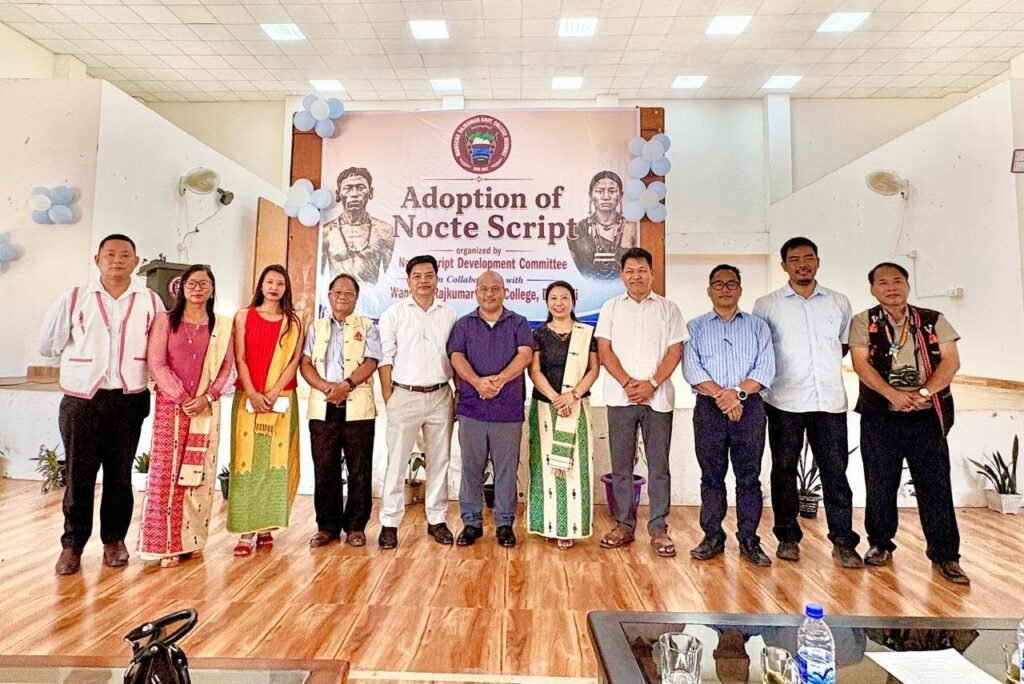
DEOMALI, AUG 29: The Nocte community on Saturday took a significant step towards preserving and strengthening its linguistic heritage with the adoption of a proposed Nocte script at a General Body Meeting organised by the Nocte Script Development Committee in collaboration with Wangcha Rajkumar Government College (WRGC), Deomali. Representatives of various Nocte-speaking groups, including Hahwakhun, Ollo, Khappa, Tang and Phungsung, participated in the meeting and offered suggestions to make the script more inclusive, while keeping scope for further amendments and refinement. The meeting was chaired by Arunachal Pradesh Environment and Forests Minister Wangki Lowang. The central highlight was the presentation of the proposed Nocte script by Dr Wanglit Mongchan. Representatives of different Nocte dialect groups discussed the script and future strategies and endorsed the proposed script as presented by Mongchan. Addressing the gathering, Lowang appreciated Mongchan and members of the Nocte Script Development Committee for their contribution towards preserving and developing the linguistic heritage of the community. He termed the initiative a landmark achievement that would benefit future generations. The minister also called for the development of a Nocte multidialectal dictionary to facilitate wider understanding and communication among different Nocte-speaking groups. He stressed the need for greater linguistic and cultural assimilation and urged the community to rise above minor differences and work collectively for the preservation and development of its identity. The programme also featured cultural performances by students of Government Higher Secondary School, Deomali, and WRGC. The programme concluded with a vote of thanks by WRGC Principal Dr Watsen Bangsia. The adoption of the script marks an important milestone in efforts to preserve the linguistic identity of the Nocte community and pass it on to future generations.    

Latest News, Popular News, State News

Kiyak Laam Kraam Tourism and Culture Experience Tour concludes

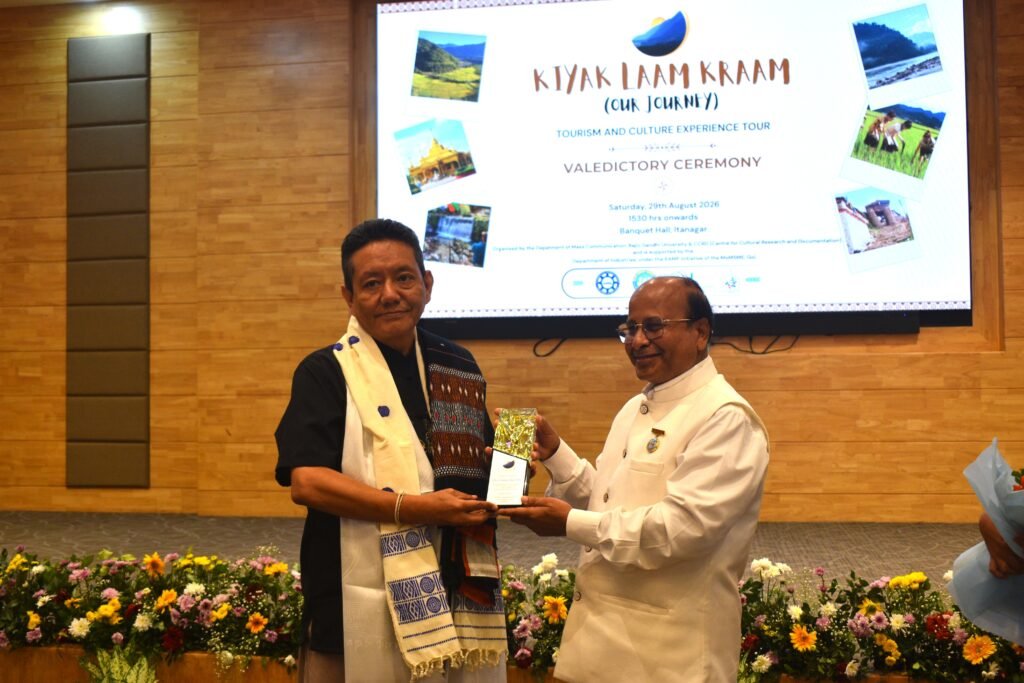
Tourism collaboration can open new window of opportunity: Sona ITANAGAR, AUG 29: The six-day Kiyak Laam Kraam: Our Journey – Tourism and Culture Experience Tour concluded here on Saturday with a valedictory ceremony at the State Banquet Hall, bringing together around 100 tourism stakeholders, tour operators and homestay owners from the eight northeastern states. The participants from Arunachal Pradesh, Assam, Manipur, Mizoram, Meghalaya, Nagaland, Sikkim and Tripura visited 11 destinations across Arunachal Pradesh during the tour. The programme provided a platform for participants to share experiences and explore opportunities for greater collaboration in tourism, hospitality and cultural exchange across the Northeast. Arunachal Pradesh Tourism and Education Minister Pasang Dorjee Sona, who was the chief guest, described the initiative as a unique collaboration between the university and tourism stakeholders that had opened a “new window of opportunity” for interaction and mutual understanding among the people of the Northeast. Emphasising the importance of recognising shortcomings and working towards improvement, Sona said, “Your strength is identifying your weakness, and growing from.” He expressed hope that such initiatives would help make the Northeast one of India’s leading tourist destinations. Stressing the need to preserve the region’s natural beauty, he called for sustainable and responsible tourism development as well as stronger collaboration among the northeastern states and tourism stakeholders to dispel misconceptions and showcase the region’s cultural heritage, natural beauty and tourism potential. Rajiv Gandhi University (RGU) Vice-Chancellor (in-charge) Jayadeba Sahoo, who chaired the programme, said tourism was not merely about travelling to destinations but also about experiencing and understanding different cultures. He called for collective efforts to strengthen tourism in the region and highlighted the spirit of “Atithi Devo Bhava”. He also underlined tourism’s impact on local communities and the need to remain open to both its opportunities and challenges. In his opening remarks, RGU Registrar NT Rikam expressed hope that the Raising and Accelerating MSME Performance (RAMP) initiative of the Ministry of Micro Small and Medium Enterprises (MSME), under which the programme was organised, would continue its engagement with the university and create greater opportunities for all stakeholders. Rikam explained that Kiyak Laam Kraam, meaning “Our Journey” in Meyor, an endangered language of Arunachal Pradesh, reflected the spirit of the initiative. He stressed that tourism and hospitality were complementary and emphasised the importance of promoting greater tourism and cultural exchange among the northeastern states. The genesis of “Our Journey” was explained by event director, cultural activist and RGU the Northeast is often viewed as a single region, interaction and awareness among its people remain limited. “Just like there is a need for international and domestic tourists to visit our region, there is also a felt need for regional tourism where we visit each other and share experiences,” Riba said, describing the initiative as a step in that direction. A key highlight of the programme was the signing of a Memorandum of Understanding (MoU) between the Department of Industries, Government of Arunachal Pradesh, and the North East India Tourism Confederation (NEITC). The agreement seeks to facilitate greater collaboration and synergised initiatives in tourism and related activities. The programme also featured an interaction with delegates from the eight participating states. The session began with feedback from NEITC president Tsering Wange, followed by representatives from the participating states, who shared their experiences of travelling across Arunachal Pradesh and discussed its destinations, cultural heritage, hospitality, homestay practices and community-based tourism. The discussions covered tourism infrastructure, homestay development, cultural tourism, connectivity and accessibility, tourist expectations, digital promotion, sustainable tourism, inter-state cooperation, capacity building and community participation. A short film showcasing highlights of the tour was screened during the ceremony. The programme also featured The Arunachal Story, a fusion presentation of priestly chants, folk melodies and traditional dance forms, besides a performance by students of the Department of Fine Arts and Music, RGU, showcasing the state’s rich cultural traditions. The programme concluded with closing remarks by Industries Joint Director and RAMP Nodal Officer Goli Angu, followed by a group photograph and high tea. The initiative was curated by the Department of Mass Communication, RGU, and the Centre for Cultural Research and Documentation (CCRD), with support from the Department of Industries, Government of Arunachal Pradesh, under the RAMP initiative of the Ministry of MSME, Government of India. Tourism stakeholders, delegates, students and faculty members of the university and invited guests attended the programme.