

ONLINE AGE

(Online version of the Arunachal Age newspaper)

Author name: OnlineAge

Latest News, Popular News, State News

Lower Siang registers significant improvement in CBSE exam results

LIKABALI : A district-level coordination meeting of heads of schools, block and district education functionaries was held at the Deputy Commissioner’s conference hall in Likabali on Friday under the chairmanship of Lower Siang ADC (HQ) Mokar Riba. The meeting was attended by Lower Siang District Deputy School Education Officer Tage Kakki. Presenting the district’s academic performance, Block Education Officer (Academic) Dajo Ngomle highlighted the progress achieved during the academic session and stressed the need for collective efforts to further improve learning outcomes across schools in the district. The meeting noted a significant improvement in the Class X Central Board of Secondary Education (CBSE) examination results, with the district’s pass percentage rising from 41.44 per cent in 2024-25 to 66.89 per cent in 2025-26. Among the top-performing schools were Government Secondary School (GSS) Kangku with a 100 per cent pass rate, GSS Lipu (87.50 per cent) and GSS Dipa (82.35 per cent). In the Class XII CBSE examinations, the district recorded an overall pass percentage of 71.81 per cent. Notable performances were registered by Kasturba Gandhi Balika Vidyalaya (KGBV) Seren with a 100 per cent pass rate, Government Higher Secondary School (GHSS) Gensi (93.75 per cent), GHSS Likabali (76.85 per cent) and GHSS Telam (75.86 per cent). Addressing the gathering, Lower Siang DDSE Tage Kakki called upon principals, headmasters and block-level functionaries to strengthen coordination and continue efforts towards raising educational standards across the district. Several key resolutions were adopted during the meeting, including strict adherence to the academic calendar, fixation of school-wise board examination targets, strengthening of Foundational Literacy and Numeracy (FLN), ensuring 100 per cent Aadhaar enrolment and student bank account coverage, timely submission of infrastructure proposals, and enhanced academic monitoring and data management. In his concluding remarks, Lower Siang ADC (HQ) Mokar Riba congratulated heads of schools, teachers and education officials for the marked improvement in board examination results and urged them to maintain the momentum. He also assured continued support from the district administration for initiatives aimed at improving the quality of education in the district. (DIPR)  
REGIONAL

With sustainable agriculture, NE has potential to become India’s next growth engine: Sitharaman

BHOIRYMBONG : Union Finance Minister Nirmala Sitharaman on Friday said the Northeast has the potential to become India’s next engine of growth by leveraging its strengths in sustainable agriculture and premium organic produce. She also asserted that Meghalaya is uniquely positioned to lead because of the trust it commands in global markets. Inaugurating the Northeast’s largest organic spice processing plant of the Eastern Ri-Bhoi Organic Farmer Producer Company Ltd here, Sitharaman said, “The future of agriculture increasingly belongs not to those who produce the most, but to those who produce the best — cleaner, more traceable, more trusted and more premium.” “When Meghalaya’s farmers rise, the Northeast rises. And when the Northeast rises, India’s growth acquires a new engine,” she said, congratulating the Meghalaya government, women collectives and entrepreneurs for driving the state’s organic farming movement forward. Emphasising Meghalaya’s competitive advantage, the finance minister said the state need not compete with large agricultural states in volume as the future increasingly belongs to trusted quality and trusted producers. (Source: PTI)    

REGIONAL

115 people from Assam rescued from Bihar; 9 traffickers held

GUWAHATI : As many as 115 people, including many minors, hailing from different parts of Assam, have been rescued from the clutches of a suspected human trafficking network in Bihar, and nine persons have been arrested, a Sashastra Seema Bal (SSB) official said here on Friday. He said all the victims have been brought back to Assam and are undergoing counselling. “The racket was targeting financially poor families in the state, especially along the Bhutan border in Assam. The victims were lured with the promise of government jobs,” the SSB official, who was part of the rescue operation, said. Many of the rescued victims, of whom 48 are females, are minors, he said. The official said some parents of the victims had approached the SSB, Tezpur, after they could not contact their children, taken by the traffickers. Coordinated operations conducted by multiple agencies, including the SSB and Bihar police, with the help of local intelligence network, led to the rescue from Samastipur district in the eastern state, the official said. He added that nine suspected traffickers have been arrested so far. “The victims have reached Assam and are currently undergoing counselling before heading back home,” the SSB official said. (Source: PTI)  

REGIONAL

Naga students’ body launches statewide agitation over delay in girls’ hostel project

KOHIMA : The All Nagaland College Students’ Union (ANCSU) on Friday launched the first phase of its statewide agitation, observing ‘Black Friday’ across its affiliated colleges to protest the government’s failure to begin the construction of the long-pending 100-bed girls’ hostel at Kohima Science College (Autonomous), Jotsoma. The agitation follows the expiry of an ultimatum served by the students’ body to the authorities. ANCSU alleged that despite repeated representations and appeals, the government had failed to take any concrete action on the issue. As part of the protest, black flags were hoisted at affiliated colleges across Nagaland to symbolise what the union described as the government’s “continued indifference” towards a crucial educational infrastructure project affecting the welfare, safety and academic prospects of female students. In a statement, ANCSU said the widespread participation of its affiliated and associate units reflected collective resentment of the student community over the delay in implementing the hostel project. The students’ body reiterated that its demand for the immediate construction and completion of the 100-bed girls’ hostel was “non-negotiable” and accused the government of forcing students to resort to democratic forms of protest through prolonged inaction. Warning of an escalation of the agitation, ANCSU said responsibility for any further developments would rest with the authorities concerned if the issue remains unresolved.   The students’ body demanded immediate and concrete action from the state government and directed its affiliated units to remain prepared for the next phase of agitation. It said a massive statewide protest rally would be launched in the coming days if its demand continues to be ignored. (Source: PTI)  

REGIONAL

Assam CM bats for hike in fund limits through externally aided projects

GUWAHATI : Assam Chief Minister Himanta Biswa Sarma on Friday urged Union Finance Minister Nirmala Sitharaman to allow the northeastern states to have access to enhanced funds through externally aided projects, citing “exceptional track record and honest implementation of schemes and projects” in the region. He said that such projects, worth Rs 53,000 crore, are underway in Assam alone. “On behalf of Assam and our sister states in the northeast, I made a passionate appeal to Finance Minister Nirmala Sitharaman to allow our governments access to enhanced limits through Externally Aided Projects (EAP), keeping in view our exceptional track record and honest implementation of schemes and projects,” Sarma said on X. After attending a seminar on ‘Leveraging EAPS in North-Eastern States’ in Shillong, he said that over the past few years, these projects, backed by multilateral financial agencies, have empowered Assam to initiate multiple mega transformative projects, which were initially considered unviable due to the high cost of capital. Currently, such projects worth Rs 53,000 crore are underway in Assam alone, in sectors such as building bridges and embankments, hospitals, robotics, mega power and infrastructure projects, Sarma said. “Needless to say, Externally Aided Projects also bring in vibrant project management skills and global best practices into our government machinery,” he added. Sarma maintained that the inaugural session of the seminar was “an excellent platform to improve collaboration and planning in the implementation of such projects”. The Chief Minister’s Office (CMO), in a post on social media, said Sarma highlighted the transformative growth of Assam. Sarma cited the successful completion of the EAP-funded Lower Kopili Hydroelectric Project in just three-and-a-half years. He also mentioned projects such as the Kumar Bhaskar Varma Setu in Guwahati and the ongoing Dhubri–Phulbari Bridge as examples of the state’s strong development momentum and effective utilisation of Externally Aided Projects, the CMO said. (Source: PTI)          

Editorial

Now, a measure of unseen labour

By assigning a notional value to a homemaker’s labour, the Supreme Court of India has established an important guideline for monetising women’s household work. This is, critically, a recognition of the social and economic value of the labour. A bench of Justices Sanjay Karol and N Kotiswar Singh described homemakers as “nation-builders”, ruling that unpaid domestic work should be monetised at a minimum of Rs 30,000 per month, with a 10% increase every three years. The ruling came in a 25-year-old case involving a road accident in Punjab. A claims tribunal awarded an insignificant amount as compensation for the death of the victim, a woman. After her family filed appeals in higher courts, the Supreme Court finally decided the case. The principle laid down by the Court is set to guide decisions in similar cases. The Court said: “…it is ironic to describe a homemaker as dependent on earning members when, in reality, the household’s functioning depends substantially on the homemaker”. It said the Rs-30,000 benchmark should serve as the basic minimum monthly income for calculating the loss of domestic care, which should be considered a separate head of compensation. The apex court also directed that in cases where the homemaker is a part of the family’s earning workforce, the value of domestic care as prescribed should be added to the monthly income. This ruling will have far-reaching implications not only for calculating compensation in accident cases but also in situations where women’s role as an economic agent must be considered. According to the Time Use Survey conducted in 2019, women aged between 15 and 59 years spend over seven hours daily on unpaid domestic and caregiving work, compared to less than three hours by men. The Court cited the survey, which also found that women perform 2.6 times more unpaid domestic and caregiving work, even when they contribute economically. Women’s unpaid work is estimated to contribute 15-17% of India’s GDP. These figures point to entrenched patterns of a society where domestic work is taken for granted, and where traditional roles assigned to women are normalised, significantly lowering their participation in the labour force. While the ruling is unlikely to change the financial dynamics within families, it should lead to a better understanding of women’s contributions to the household. It has done well to provide a legal framework to measure the value of women’s work in situations where it did not count until now. (Source: DH)

Latest News, National, Popular News, State News

Four of five glacial lakes in Arunachal basin expanded between 2016 and 2026: Study

NEW DELHI : Four out of five potentially dangerous glacial lakes located at Mago Chu Basin in Arunachal Pradesh’s Tawang district expanded in size between 2016 and 2026, according to a satellite-based assessment released on Thursday. Glacial lakes result by melting glaciers. Sudden releases of water from these lakes can trigger floods in downstream areas, a phenomenon known as glacial lake outburst (GLOFs) While GLOFs have occurred since the ice age, scientists say the risk has increased significantly due to rising global temperatures and accelerated glacier melt. The assessment, conducted by Noida-based geospatial intelligence firm Suhora Technologies, found that one of the lakes –” Sanhapo Lake — showed particularly notable expansion during the study period. According to the analysis, the lake’s area increased from 55.87 hectares (ha) in 2016 to 87.02 ha in 2026, before expanding further to 88.81 ha by June 15, 2026. The report noted that the expansion of glacial lakes does not, by itself, indicate an imminent flood event. However, it reflects a general trend of glacial retreat and increasing meltwater accumulation. As glacier lakes grow larger, they can become more dangerous because they are mostly dammed by unstable ice or sediment composed of loose rock and debris. The boundary around a glacier lake can break due to several triggers, including large landslides or ice avalanches entering the lake, which can result in a GLOF. In a statement, Amit Kumar, co-founder and COO of Suhora Technologies, said, “With the monsoon season approaching, continuous observation of glacial lakes becomes increasingly important and satellite-based observations can complement field investigations by providing timely information on lake expansion, glacier retreat and broader landscape changes across remote high-altitude environments. “Such assessments help build long-term datasets that can support scientific research, planning, and informed decision-making,” he added. (Source: PTI)      

Latest News, Popular News, State News

Govt committed to resolve forest, land management issues: Mein

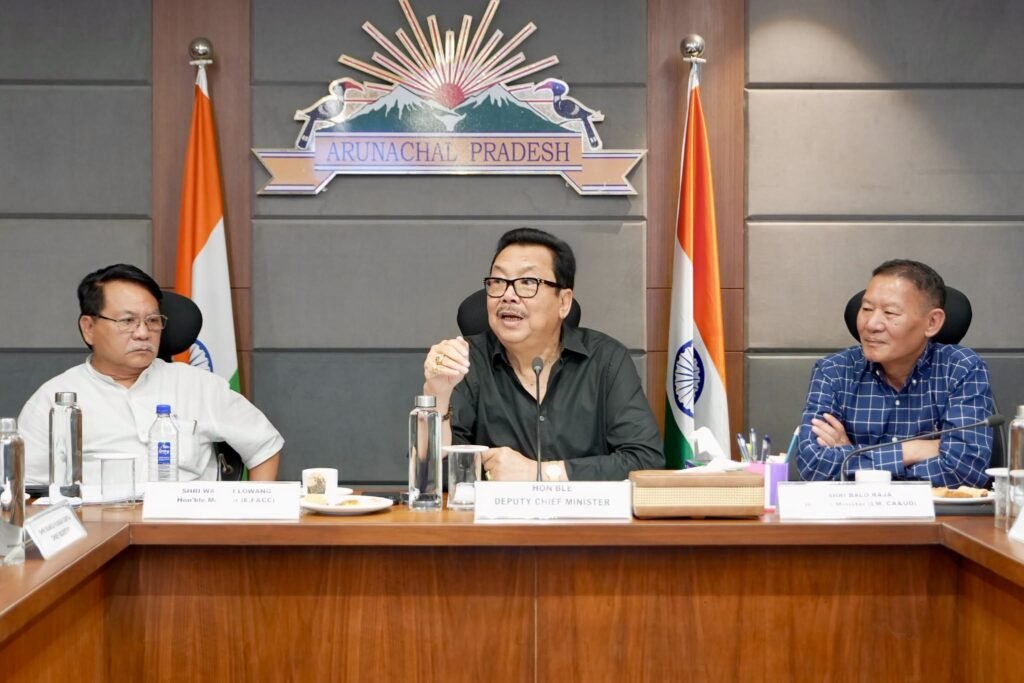
ITANAGAR : Deputy Chief Minister Chowna Mein on Thursday said the state government is committed to resolving long-pending forest area and land management issues through collaborative decision-making and improved inter-departmental coordination. Mein made the remarks after chairing a high-power committee (HPC) meeting, which deliberated on measures for addressing forest-related concerns and associated land management issues. The meeting was attended by Environment and Forest Minister Wangki Lowang, Urban Development & Land Management Minister Balo Raja, and Chief Secretary Manish Kumar Gupta. The meeting focused on identifying practical solutions to long-standing challenges, strengthening coordination among departments, and ensuring that developmental needs are addressed without compromising environmental priorities, officials said. Mein said the deliberations centred on identifying practical solutions, strengthening inter-departmental coordination and ensuring a balanced approach towards conservation and developmental needs. Reaffirming the government’s commitment to finding lasting solutions, he said efforts would continue to resolve pending issues through consensus-based decisions and effective governance. (Source: PTI)      

Latest News, Popular News, State News

State BJP marks 12 years of Modi govt with ‘Pragati Path Yatra’

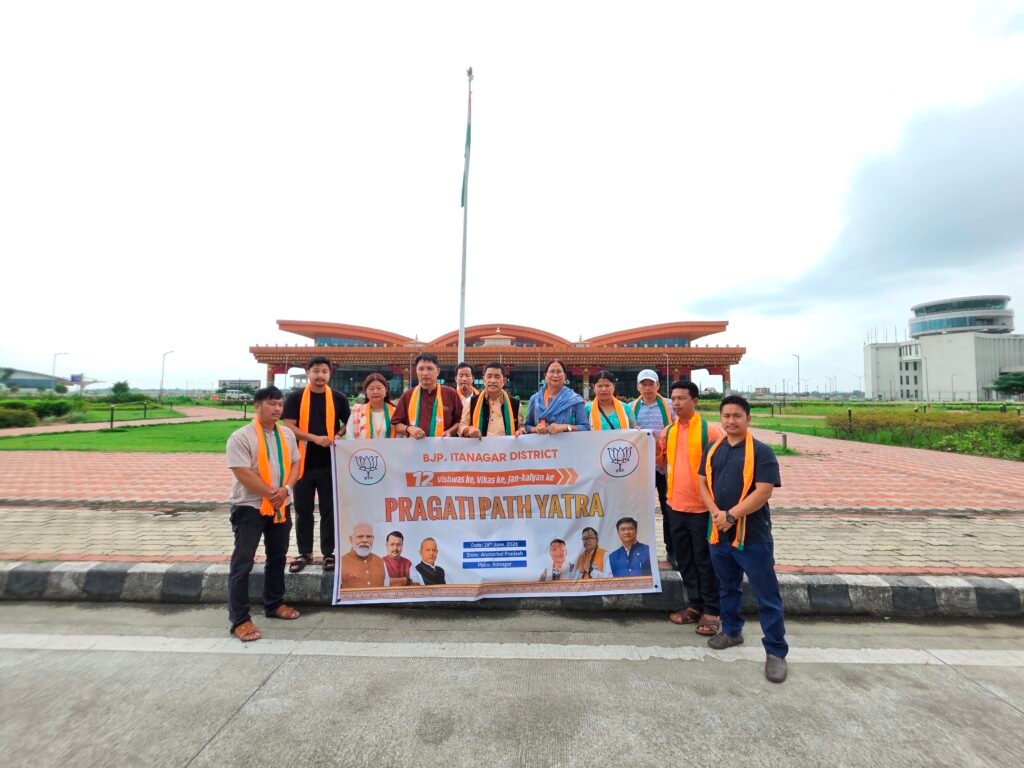
ITANAGAR : The State Unit of Bharatiya Janata Party (BJP) on Thursday celebrated 12 years of the Narendra Modi-led government at the Centre and 10 years of the Pema Khandu-led government in Arunachal Pradesh through a series of public outreach programmes across the capital region. As part of the campaign themed “12 Vishwas Ke, Vikas Ke, Jan-Kalyan Ke,” the Itanagar BJP district unit organised a Pragati Path Yatra, visiting key public infrastructure and government institutions, including Donyi Polo Airport at Hollongi, the State Civil Secretariat, the Arunachal Pradesh Legislative Assembly and other locations. Party leaders interacted with members of the public and highlighted the significance of various public services and development initiatives. The yatra was led by State BJP Vice President Tayeng Shakuntala, Senior Vice President Dongoli Libang, and district BJP leaders Yarda Raja, Tadar Towmin and Kiogi Gida Gagung, among others. Addressing the gathering, Shakuntala highlighted the developmental strides achieved during the past 12 years under PM Modi, citing progress in connectivity, infrastructure, education, healthcare, hydropower and other sectors. She said Arunachal Pradesh had witnessed significant transformation during the period, pointing to projects and institutions such as Donyi Polo Airport, the Arunachal Pradesh Civil Secretariat, the Arunachal Pradesh Legislative Assembly, expanded road and mobile connectivity, the Tomo Riba Institute of Health and Medical Sciences (TRIHMS), and the establishment of the state’s own university. Shakuntala also spoke on initiatives related to good governance, digital transformation, women empowerment, youth development, national security, inclusive growth and welfare-oriented policies. She said the benefits of infrastructure and development projects should reach all sections of society. Meanwhile, a BJP team from Naharlagun also visited and reviewed facilities at key institutions, including Naharlagun Railway Station at Borum, the Mini Secretariat and TRIHMS. Speaking on the district-level campaign activities, Itanagar BJP leader Kiogi Gida Gagung said the “12 Years of Modi Sarkar” campaign commenced on June 5 with the nationwide Ek Ped Maa Ke Naam initiative and would continue through public outreach programmes, awareness drives, exhibitions and community engagement activities before concluding on June 21. The yatra was attended by BJP presidents, mandal and morcha leaders, office-bearers and party workers.    

Latest News, Popular News, State News

ACF alleges political motive behind APFRA campaign

Staff Reporter ITANAGAR : The Arunachal Christian Forum (ACF) on Thursday accused the Indigenous Faiths and Cultural Society of Arunachal Pradesh (IFCSAP) of pursuing a politically motivated campaign for the implementation of the Arunachal Pradesh Freedom of Religion Act (APFRA), 1978, and urged the state government to investigate the organisation’s activities. Addressing a press conference at the Arunachal Press Club, ACF president James Techi Tara alleged that the renewed demand for implementation of the Act was being influenced by external forces seeking to create social unrest and disrupt the state’s long-standing communal harmony. Questioning the timing of the renewed campaign, Tara noted that APFRA had remained largely dormant for more than four decades. “For over 40 years, there was little demand for the implementation of APFRA. However, under the present leadership of IFCSAP, the issue has repeatedly been raised, resulting in growing tensions among communities,” he said. The ACF president urged the government to examine whether attempts were being made to incite public sentiment and create division. He further stated that if such activities were established, the authorities should consider declaring IFCSAP a “radical group.” Referring to IFCSAP’s recent ultimatum to the government to implement the Act by June 24, Tara questioned what he described as contradictory statements regarding the status of the legislation. “If the Act is already operational, as claimed by some of its leaders, why is there a fresh push for its implementation?” he asked. Expressing concern over the possible implications of the campaign, Tara said it could eventually lead to legal challenges against the Scheduled Tribe status of Christians in Arunachal Pradesh. Drawing parallels with developments in neighbouring Manipur, he alleged that similar legal strategies could be pursued in the state. Tara also accused IFCSAP president Dr. Emi Rumi of harbouring political ambitions and called on the organisation to publicly disclose the identities of political leaders it claims are supporting its campaign. Questioning the scope of APFRA, Tara argued that the legislation does not adequately reflect the diversity of indigenous faith traditions practised across Arunachal Pradesh. Clarifying ACF’s position on the High-Power Committee constituted to deliberate on the APFRA Rules, Tara said the Forum had stayed away from the proceedings due to concerns over unequal representation of religious stakeholders. He maintained that ACF’s opposition was directed at the proposed Rules and not the Act itself. He also rejected claims that ACF had endorsed the committee’s recommendations, describing such assertions as “false and misleading.”