


ONLINE AGE

(Online version of the Arunachal Age newspaper)

Author name: OnlineAge

Latest News, National, Popular News, State News

LGBTQ+ youth complete culinary entrepreneurship training at IHM Kolkata

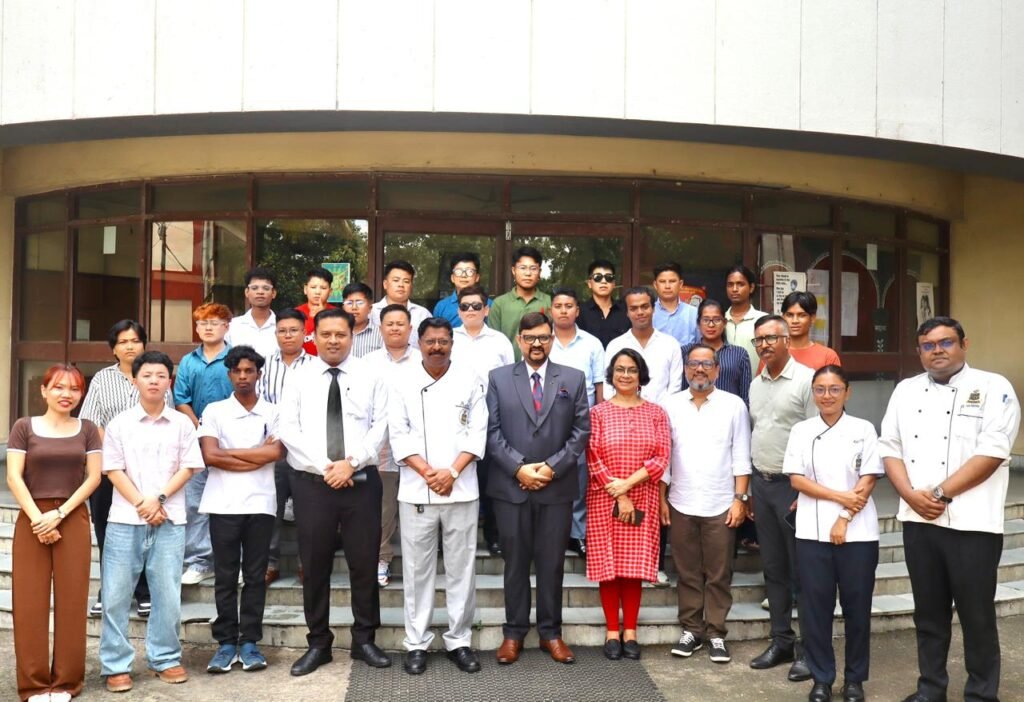
KOLKATA : Twenty-one LGBTQ+ youth from Arunachal Pradesh, Assam, Manipur and West Bengal successfully completed a five-day intensive training programme on food production and bakery at the Institute of Hotel Management (IHM) Taratala Kolkata. Organised jointly by IHM Kolkata under the Ministry of Tourism and Kolkata-based non-profit organisation Bridge India, the programme was held from June 8 to 12 with the objective of enhancing livelihood opportunities and entrepreneurial skills among LGBTQ+ food business micro-entrepreneurs. The participants, comprising both aspiring and existing entrepreneurs, received hands-on training in food production and bakery, along with sessions on food hygiene and safety, food standards, kitchen management, food ethics and entrepreneurship. The programme also included an exposure visit to ITC Royal Bengal Kolkata and a session on entrepreneurial awareness and business idea validation conducted by experts from Tata Strive. The initiative provided participants from eastern and northeastern India, including several from remote regions, an opportunity to acquire industry-relevant skills, refine business ideas and build professional networks to support their future careers and entrepreneurial ventures. Four members of AP QueerStation from Arunachal Pradesh, representing Kra Daadi, Papum Pare and East Kameng districts, participated in the training. The organisation expressed gratitude to Bridge India and IHM Kolkata for facilitating the programme and hoped that more LGBTQIA+ individuals from the state would benefit from similar initiatives in the future. All participants were awarded certificates during the valedictory function on June 12. Among those present were IHM Kolkata Principal Raja Sadhukhan, Ministry of Tourism Regional Director (East) Pranav Prakash, The Lalit Great Eastern Kolkata Rooms Division Manager Riaz Rizvi, Bridge India Founder Director Prithviraj Nath, Rainbow Room Kolkata Co-Founder Mahua Seth and Supreme Tours and Travels Founder Koushik Banerjee, along with faculty members and officials of IHM Kolkata. Speaking on the occasion, IHM Kolkata Principal Raja Sadhukhan said the institute remains committed to creating opportunities for the LGBTQ+ community through skill development, employment and entrepreneurship initiatives. He expressed hope that participants would carry their learning back to their communities and inspire others. Bridge India Founder Director Prithviraj Nath said the programme had enabled marginalised LGBTQ+ youth from remote parts of eastern and northeastern India to strengthen their skills and pursue dignified livelihood opportunities. He also expressed gratitude to IHM Kolkata for supporting the initiative. Rainbow Room Kolkata Co-Founder Mahua Seth described the collaboration as an encouraging example of how institutions can work together to create meaningful opportunities and contribute towards a more inclusive and equitable future for marginalised communities.  
Latest News, Popular News, State News

Indian Army, Airtel join hands to bring mobile connectivity to remote Kameng areas

ITANAGAR : In a significant step towards nation-building through military-civil integration, the Indian Army and Bharti Airtel Pvt Ltd have signed a memorandum of understanding (MoU) to expand communication infrastructure and establish mobile connectivity in remote areas of Kameng district in Arunachal Pradesh, a Defence source said today. The initiative aims to provide reliable mobile connectivity to communities that have remained disconnected for more than a decade, addressing a critical developmental need in one of the country’s strategically important frontier regions. By bridging the digital divide, the project is expected to enhance access to government services, digital education, healthcare, financial inclusion and communication facilities, thereby improving the quality of life of local residents. Officials said enhanced connectivity would also promote tourism and create fresh opportunities for economic growth and socio-economic development across the region. Improved communication infrastructure is expected to strengthen the integration of remote border communities with the national mainstream, supporting the government’s vision of inclusive development. From a strategic perspective, the upgraded network infrastructure will support the operational effectiveness of Indian Army personnel deployed in forward areas by enabling improved communication capabilities and strengthening logistical coordination. The initiative highlights the growing synergy between civil and military stakeholders in advancing both developmental and strategic objectives in border regions. The partnership underscores a shared commitment to strengthening frontier areas through sustainable infrastructure development and aligns with the national vision of Viksit Bharat @ 2047. (Source: UNI)    

Latest News, Popular News, State News

World Blood Donor Day observed with donation drives, awareness campaigns

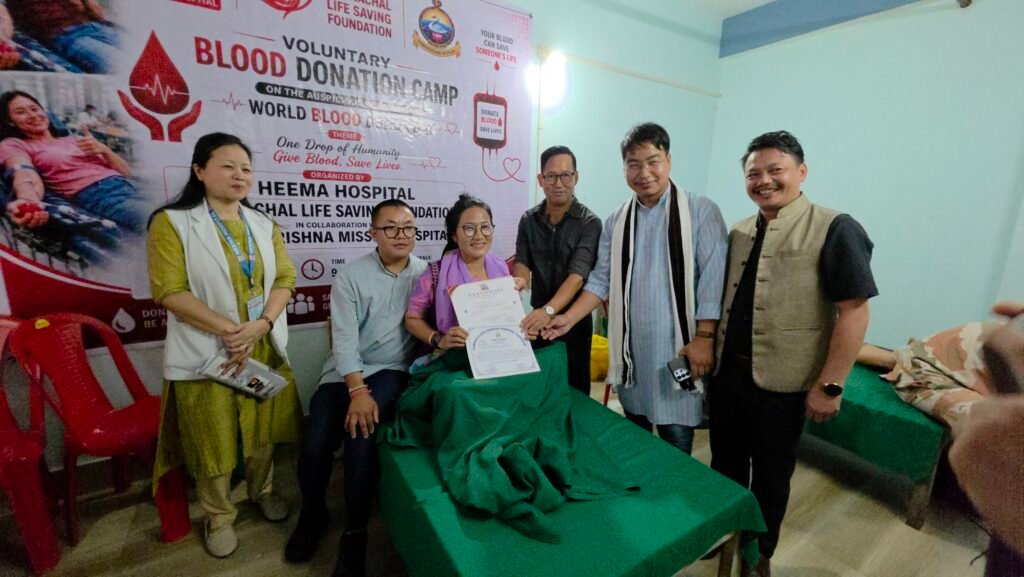
ZIRO : World Blood Donor Day was observed across Arunachal Pradesh on Sunday with voluntary blood donation camps, awareness programmes and felicitation ceremonies aimed at promoting regular blood donation and strengthening emergency blood reserves. In Itanagar, Heema Hospital organised a mega voluntary blood donation camp in collaboration with the Arunachal Life Saving Foundation (ALSF) and the Blood Bank of Ramakrishna Mission Hospital. Attending the programme as chief guest, Itanagar Municipal Corporation (IMC) Mayor Likha Nari Tadar said blood donation remains one of the most effective ways to save lives during medical emergencies. Emphasising the importance of voluntary donation, she noted that blood cannot be manufactured despite advances in medical technology and appealed to citizens to come forward and donate regularly. Heema Hospital Medical Superintendent Dr Kesang W Thongdok said the state requires around 15,000 units of blood annually, while only about 13,000 units are currently collected, leaving a significant gap between demand and supply. He stressed the need for more intensive blood donation drives to bridge the shortfall. Arunachal Life Saving Foundation Chairman Ramesh Jeke highlighted the organisation’s efforts in creating awareness and organising blood donation camps across the state. A total of 55 units of blood were collected during the camp and transferred to the Ramakrishna Mission Hospital Blood Bank. Mayor Likha Nari Tadar also donated blood during the programme. The event was attended by Heema Hospital Chairman and Managing Director Dr Byabang Rana, Rajiv Gandhi University Department of Social Work Head Prof K P Singh, Bharatiya Janata Yuva Morcha State President Tame Siang Tarh and others. Personnel from the National Disaster Response Force, Central Reserve Police Force, Bharatiya Janata Yuva Morcha members, students of Dera Natung Government College and staff of Heema Hospital and Ramakrishna Mission Hospital participated in the camp. Meanwhile, in Ziro, the Blood Centre of Gyati Takka Zonal General Hospital, in collaboration with CRC Hapoli Youth (26th Youth Foundation), organised a voluntary blood donation camp and felicitation programme under the theme “One Drop of Humanity, Give Blood, Save Life”. The initiative resulted in the collection of 15 units of blood, including three units of A-positive, two units of B-positive, nine units of O-positive and one unit of AB-positive blood, providing a valuable boost to the hospital’s emergency reserves. 756 Border Roads Task Force (General Reserve Engineer Force) Project Arunank Captain Chirag Singhal attended the programme as chief guest and underscored the importance of community participation in strengthening healthcare services, particularly in remote areas. A felicitation ceremony was also held to recognise individuals and organisations for their contributions to blood donation awareness, donor mobilisation and emergency blood support. Among those honoured were 756 Border Roads Task Force Project Arunank Captain Chirag Singhal, Indo-Tibetan Border Police 60th Battalion Second-in-Command Ajit Kumar Pegu, Arunachal Baptist Association Executive Secretary Dani Tadu, Hapoli Youth Organisation General Secretary and Ziro Residents’ East Vice Chief Hage Duyu, CRC Hapoli General Secretary Jiren Teron, St Claret College Ziro National Service Scheme Programme Officers Tage Tagyung and Nending Sumpi, District Health Youth Association President Hage Chobing, Joram Tado, Topi Sora, Hano Usha, Tumter Riba, Pebi Gamlin and Perpum Gamlin. Special recognition was accorded to Pyagang Tapu for his consistent support during emergencies requiring rare Rh-negative blood donations. The organisers and hospital authorities expressed gratitude to all donors, volunteers and partner organisations for their support and reiterated the importance of regular blood donation in ensuring timely access to safe blood for patients in need.

Latest News, Popular News, REGIONAL, State News

Modi transformed NE from ‘no-hope’ zone to attractive destination: Sonowal

AGARTALA : Union Minister Sarbananda Sonowal on Sunday said Prime Minister Narendra Modi has transformed the Northeast from a “no-hope” zone to an attractive destination in the past 12 years. Addressing the ‘Jan Kalyan Shivir’ to mark PM Modi’s 12 years in office at Rabindra Bhavan, the Union minister for Ports, Shipping and Waterways said the northeast was known for violence, kidnapping, blockade and shooting before Narendra Modi became the Prime Minister. “A sense of security was missing before 2014, and the Northeast was infamously tagged as a disturbed area. Now, the region is witnessing a sea change in all-round growth with peace returning. At least 10,000 armed insurgents have shunned the path of violence to usher in peace,” he said. Asserting that PM Modi has transformed the northeast from a “no-hope zone to an attractive destination”, he said peace has paved the way for faster development in the region to meet the people’s aspirations. “Under PM Modi, development works—whether infrastructure, railway connectivity or communication—are proceeding at the highest ever speed. Modiji has made it mandatory for his cabinet colleagues to regularly visit the northeast to expedite development,” he said. Sonowal also claimed that PM Modi removed the distance between Delhi and the northeast by boosting connectivity and communication. He said Modi ji is the only Prime Minister since independence who pushed for financial inclusion drive across the nation, resulting in the opening of 61 crore bank accounts. “Due to the success of the financial inclusion drive, Direct Benefit Transfer (DBT) is possible to transfer money to the accounts of crores of beneficiaries. This ensures transparency and accountability of the Modi government,” he said. “Tripura has been receiving the benefit of the double-engine government during the past 8 years. The connectivity – be it railway or airway, the state witnessed a massive change. The state is now well connected with first-class train service and air service, accelerating the development process,” he stated. (Source: PTI)      

Latest News, Popular News, REGIONAL, State News

21 infiltrators prevented from entering India: Assam CM

GUWAHATI : Assam Chief Minister Himanta Biswa Sarma on Sunday said 21 illegal immigrants were prevented from entering India by the state police and the BSF. “In an excellent joint effort by @assampolice and @BSF_India, 21 infiltrators were swiftly identified and prevented from entering into India,” Sarma said in a post on X. He, however, did not share details about the operation. “Safeguarding borders, strengthening security… Our multi-pronged approach of safeguarding our border continues,” Sarma said. Assam’s Sribhumi, Cachar, Dhubri and South Salmara-Mankachar districts share 267.5 km of international border with Bangladesh. (Source: PTI)

Latest News, Popular News, REGIONAL, State News

CAG flags issues in Assam’s social audit unit

GUWAHATI : Assam’s Social Audit Unit, set up to ensure transparency and accountability in rural development schemes, has faced severe operational and governance challenges, according to a CAG report. The report of the Comptroller and Auditor General of India on ‘Local Bodies’ for the period ending March 2024 highlighted that the registration of SAU expired long back due to infrequent governing Body meetings that hindered budget approvals and annual account certifications. “The registration of the SAU under the Societies Act remained invalid for almost five years, since December 2019. Gross shortfall in holding of governing body meetings implies the deficiency in monitoring at the government level,” it added. The CAG recommended that governing body meetings should be held at stipulated intervals to ensure approval of the budget and annual accounts of SAU, and to facilitate effective monitoring of the activities. It also pointed out that the manpower policy of SAU is yet to be firmed up, even after the same had been proposed in August 2017 and reviewed by the Finance Department. “The SAU operates with a significant manpower shortage (43 per cent overall vacancy), particularly among key field personnel, impacting its ability to meet social audit targets and conduct timely audits,” it added. The CAG suggested that the manpower policy should be finalised and that initiatives should be taken for the recruitment of resource persons in requisite numbers. Besides, the Code of Ethics were not introduced, though it is required under the Auditing Standards of Social Audit. It said that the Code of Ethics should be developed and deployed by the SAU for social audit facilitators. “The State Employment Guarantee Council (SEGC) at the state level had not monitored the action taken by the state government on social audit reports and action-taken reports. SAU did not submit quarterly reports in the format specified by the Ministry of Rural Development to the principal accountant general/accountant general,” it said. The impact of the social audit is diluted by a deficient follow-up mechanism, like insufficient public hearings at the block and district level, poor recovery of amounts objected to in social audit reports, the report said. It recommended strengthening of follow-up actions on social audit reports through public hearings at all levels. “Some village panchayats have not provided records to social audit teams, indicating a lack of sensitisation on social audit among panchayati raj institutions,” it added. Furthermore, there is a critical lack of follow-up on audit observations, evidenced by a less than four per cent recovery rate of misappropriated funds, weak state-level monitoring and ineffective public awareness campaigns, the CAG said. SAU was first registered in December 2016 for the functioning of the MGNREGS Audit of Scheme Rules 2011. It has an independent director and is governed by a governing body, headed by the chief secretary. (Source: PTI)

Latest News, National, Popular News, State News

Rebel TMC MPs announce merger with Nationalist Citizens Party

NEW DELHI : The rebellion in the Trinamool Congress appeared to reach a crescendo on Sunday as dissident MPs announced their merger with the Nationalist Citizens Party and met Lok Sabha Speaker Om Birla seeking a separate seating arrangement in the House. Speaking to reporters after meeting the Speaker, rebel MP Kakoli Ghosh Dastidar claimed that two-thirds of the TMC’s Lok Sabha members had submitted a letter seeking recognition as a separate group. “Two-thirds MPs of TMC have given a letter to the Speaker for a separate seating arrangement. We will merge with the Nationalist Citizens Party and support the NDA,” she said. Senior TMC leader and Lok Sabha MP Sudip Bandyopadhyay said the dissident camp had already merged with the Nationalist Citizens Party, which he described as a regional party. The Nationalist Citizens Party is a lesser-known registered, unrecognised party from Tripura. Asked about the competing claim of the Mamata Banerjee-led faction, Bandyopadhyay said the issue of who constitutes the “real TMC” would be decided by the courts, and added that they would claim the party’s electoral symbol of two flowers. “Court will decide later who is the real TMC. We met the Speaker and gave him our request,” he said. The development came as TMC leaders Kirti Azad and Sagarika Ghosh also met Speaker Birla on Sunday and submitted a letter by TMC Lok Sabha leader Abhishek Banerjee, urging him not to accord any recognition to any purported separate faction, arguing that the Constitution does not permit the formation of a separate group within an existing political party. The letter dated June 10, which was sent through email earlier, said that the anti-defection law does not permit such a split.          

REGIONAL

Peace unlikely in Manpur unless people possessing illegal arms are disarmed: CM

IMPHAL : Manipur Chief Minister Y Khemchand Singh on Sunday said that peace is unlikely in the state unless all the people who are in possession of illegal weapons are disarmed. The illegal weapons, including firearms looted from the security forces and those purchased illicitly, have been used since the beginning of the ethnic violence in Manipur in 2023. “Until and unless those in possession of illegal arms are disarmed, peace is unlikely in the state. Be it Meitei, Kuki or Naga, we are calling for disarming everyone. Several meetings with security forces have been conducted,” the chief minister told reporters. Manipur Governor Ajay Kumar Bhalla had in February 2025 urged warring groups to voluntarily surrender weapons robbed from security forces and other illegally held arms. The state was then under President’s Rule, which was lifted a year later. The chief minister said that Imphal valley is just 10 pc of the total state area, so more effective operations are needed in the hills. Imphal valley is home to the Meitei community, while the Kuki and Naga communities live in the hills. At least 260 people were killed and thousands became homeless in the conflict between the Meitei and Kuki people since May 3, 2023. “The total number of CoBRA battalions to be deployed in Manipur would be increased from two to three. Their operations would start after the necessary 45 days of training in the terrains and environment suitable to the state,” the CM said. CoBRA (Commando Battalion for Resolute Action) is an elite, specialised unit of the Central Reserve Police Force (CRPF). “Law is above all of us. The particular case involving the death of six Nagas has been handed over to the NIA and all culprits — whether a minister, an MLA or anybody — would be punished,” he said. Singh was referring to the June 10 recovery of the bodies of six Naga men, believed to be of those held hostage for around a month following the killing of three church leaders in Kangpokpi district. Their mortal remains were found a day after 14 Kuki individuals who were abducted at the same time by armed groups in Senapati district were released. “To develop Manipur into an ideal state, the involvement of all communities is required. As for illegal immigrants, that would be detected through the SIR, and the government is also considering the demand for NRC implementation in the state,” Singh said. The chief minister also said that proper fencing and patrolling are equally needed. On the Suspension of Operations (SoO) ceasefire pact among the Kuki Zo militant groups, the Centre and Manipur government, he said the state cabinet had previously sought abrogation of the pact. (Source: PTI)  

REGIONAL

Those who fire at security forces will be dealt with in self-defence: Manipur DGP

IMPHAL/CHURACHANDPUR : Manipur police chief Mukesh Singh has warned that those who try to take the law into their hands or fire at security forces will be strictly dealt with. Addressing a press conference after his first visit to Churachandpur district on Saturday, he said that “around 70 per cent of looted weapons have been recovered”. “Anyone with arms who tries to take laws into their own hands will be dealt with very strictly. We will deal with them as per the law. Those with weapons would be arrested. Those who try to fire at us will be dealt with in self-defence. Proactive operations will continue till the situation is normal,” Singh said. The director general of police (DGP) also said, “A lot of misinformation is spreading on social media. We have a social media monitoring cell which takes action against those spreading false information that can lead to inter-community conflict. We are proactively engaging them and taking down those sites which are anti-social or anti-national.” Singh also said he visited Bishnupur and Churachandpur during which he held meetings with police, para-military and army officers. A police statement on Sunday said the DGP chaired meetings with District Police officers, CAPFs/Assam Rifles, and civil society organisations. “He appreciated the efforts of all units in maintaining law and order and praised the district police for drug seizures, arrests of armed miscreants, and recovery of illegal weapons”, it said. (Source: PTI)      

Editorial

Reimagining Centre, State relations

When Prime Minister Narendra Modi chaired the 11th NITI Aayog Governing Council meeting, his assertion that “states play a vital role in furthering national progress” resonated with constitutional wisdom. After a long time, Chief Ministers of all 28 states sat together at the Governing Council table – a symbolic moment for cooperative federalism. Yet symbolism and structural reality remain stubbornly apart in India’s Centre-State relationship. The Indian Constitution envisioned a strong Centre with empowered states. Seventy-five years on, that balance remains contested. The grievances of states are not new, but they have grown louder and more urgent. At the heart of state frustrations lies the money question. The GST regime, hailed as a transformative reform, has effectively curtailed states’ independent tax powers. Compensation promises have been honoured in part and delayed in practice. States routinely complain of shrinking untied funds – money they can spend according to local priorities – while centrally sponsored schemes come with rigid conditions that often ignore ground realities. A state like Tamil Nadu or Kerala, with strong development metrics, resents being subjected to the same formula applied to a newly formed state. The Finance Commission devolution figures tell only part of the story. What states receive on paper and what actually flows into their treasuries are different things. Delayed transfers, high cess and surcharge collections that do not enter the divisible pool, and the expanding footprint of central schemes leave state finance ministers perennially short. Beyond money lies the question of jurisdiction. Governors appointed by the Centre have, in recent years, become a flashpoint in states governed by opposition parties. Prolonged delays in giving assent to Bills passed by elected state assemblies – in Kerala, Tamil Nadu and Punjab – have raised serious constitutional questions about the role of Raj Bhavan as an instrument of political interference rather than a constitutional check. The elected legislature’s mandate is being held hostage to the Governor’s pleasure, which cuts to the core of democratic federalism. The deployment of central agencies in states in ways perceived as politically motivated, often without the consent of the state concerned, is another irritant in Centre-State relations. What is needed is structural reform. A revamped Finance Commission framework that ring-fences state transfers from cess dilutions would be a start. A codified, time-bound process for gubernatorial assent would restore constitutional propriety. Expanding the role of the Inter-State Council – a body that has met far too infrequently – as a genuine deliberative forum rather than a ceremonial gathering would give states a real voice. PM Modi’s Viksit Bharat vision is unachievable without genuinely empowered states. Districts, blocks and villages – the units he invoked – answer to state governments, not Delhi. A thriving democracy must trust its constituent units to lead. That trust must be backed by an institutional architecture that makes cooperative federalism real in its truest form. (Source: The Pioneer)