



ONLINE AGE

(Online version of the Arunachal Age newspaper)

Author name: OnlineAge

Popular News, State News

Teams battle for quarter final spots at Hangpan Dada Memorial Trophy

AALO : The 9th State Level Hangpan Dada Memorial Trophy 2026 witnessed another day of intense competition on Day 6 of the league stage, with teams from across Arunachal Pradesh displaying strong performances in the volleyball events. In the boys’ volleyball category, Lohit registered a hard-fought 2-1 win over Leparada, while Upper Subansiri defeated West Siang in straight sets. West Kameng edged past Kamle 2-1 in a closely contested match, and Kra Daadi secured a comfortable 2-0 victory against Changlang. Kurung Kumey also recorded a convincing 2-0 win over Keyi Panyor. In the girls’ volleyball matches, Longding defeated Changlang 2-0, while Kurung Kumey overcame Lower Siang by the same margin. Papum Pare defeated Lower Dibang Valley in straight sets, and Itanagar Capital outclassed Kra Daadi 2-0. Kamle continued its winning run with a 2-0 victory over Siang, while Bichom defeated East Siang 2-1 in a closely fought encounter. The tournament will move into the quarter final stage of boys’ football on May 22. At ITBP Ground-I, Capital Complex will take on Papum Pare at 1 pm, followed by Longding versus Siang at 2:45 pm. Simultaneously at Aalo Stadium main ground, Upper Siang will face Keyi Panyor at 1 pm, while Lower Siang will clash with Upper Subansiri at 2:45 pm. The girls’ football quarter finals will also be played on May 22. At Ground-III, Pakam, Longding will meet Namsai at 1:30 pm, followed by West Siang versus Itanagar Capital at 3 pm. At Ground-IV, APPBN, Shi Yomi will play Upper Subansiri at 1:30 pm, while East Kameng will take on Tawang at 3 pm.        
REGIONAL

Assam CM Sarma takes oath as MLA

GUWAHATI : Assam Chief Minister Himanta Biswa Sarma on Thursday took oath as an MLA on the first day of the new assembly. Protem Speaker Chandra Mohan Patowary administered the oath to Sarma for the 16th Assam Legislative Assembly. Sarma took his oath in the Assamese language. Patowary said, “All the members can take an oath in any recognised language they wish to. They can submit their oath copies to the assembly office.” After the CM, the other MLAs have started taking oath in different languages such as Assamese, Bengali, Bodo and Sanskrit. The NDA, comprising the BJP, Asom Gana Parishad (AGP) and Bodoland People’s Front (BPF), secured a sweeping mandate in the assembly polls, winning a record 102 seats in the 126-member House. The BJP alone bagged 82, while the AGP and BPF won 10 seats each. The Congress and Raijor Dal, who were part of a six-party opposition alliance, won 19 and two seats respectively. The AIUDF and Trinamool Congress fought as single entities and have two and one MLA, respectively. (Source: PTI)

REGIONAL

Driver’s death mourned

PAPUNALLAH : Officers and officials of the Transport Department at the Arunachal Pradesh Civil Secretariat, Itanagar, held a condolence meeting on Thursday to mourn the untimely demise of Dusu Rika, a driver attached to the Secretariat, who passed away on May 7 at the Tomo Riba Institute of Health and Medical Sciences (TRIHMS), Naharlagun. Late Dusu Rika had served the state government for 12 years, two months and six days. During the meeting, the assembled officers and staff expressed deep sorrow over his sudden demise and observed a two-minute silence as a mark of respect. Prayers were also offered for eternal peace of the departed soul.

REGIONAL

Upper Siang DC reviews SIR preparations

  YINGKIONG : A meeting on the Special Intensive Revision (SIR) of electoral rolls was held at the Deputy Commissioner’s conference hall here on Thursday under the chairmanship of Upper Siang Deputy Commissioner-cum-District Election Officer (DEO) Talo Jerang. Addressing the meeting, Talo Jerang highlighted the key features, objectives, process and schedule of the SIR exercise in Arunachal Pradesh. Emphasising the important role of political parties in ensuring successful conduct of the revision process, he advised party representatives to organise training programmes and appoint Booth Level Agents (BLAs) to assist Booth Level Officers (BLOs) during the exercise. He also called for active cooperation and coordination among all stakeholders, including Heads of Departments and political party representatives, to ensure a smooth, transparent and error-free revision process in Upper Siang district. Earlier, Additional Deputy Commissioner (Headquarters)-cum-Electoral Registration Officer (ERO) Natek Nonang briefed participants on the objectives of the meeting and the importance of the SIR exercise. The meeting was attended by Heads of Departments, administrative officers and representatives of various political parties. (DIPR)

REGIONAL

Nagaland launches Eliona AI supercomputer for climate and disaster intelligence

KOHIMA : Eliona, an AI-native Climate and Disaster Intelligence Supercomputing Platform developed under the Nagaland State Disaster Management Authority (NSDMA), was officially launched on Thursday, marking a major technological step towards strengthening disaster preparedness, climate resilience and scientific governance in the state. The supercomputer was launched by Advisor for NSDMA and New & Renewable Energy, Z. Nyusietho Nyuthe, at the Nagaland Centre for Disaster Management and Atmospheric Research (NaCDAR) in Kohima. Giving an overview, Joint Chief Executive Officer of NSDMA under the Home Department, Dr Johnny Ruangmei said Eliona has been designed as a next-generation AI-accelerated high-performance computing infrastructure focused on climate intelligence, disaster analytics, geospatial risk computation and predictive disaster governance. According to the profile presentation, the platform will support weather and climate modelling, earth observation analytics, disaster simulations, AI and machine learning research, and decision intelligence systems. It integrates atmospheric science, geospatial intelligence, big data analytics, remote sensing and disaster governance frameworks. Eliona’s core mission is to transform disaster management “from reactive response to predictive intelligence” through AI-enhanced forecasting, real-time data assimilation, predictive hazard intelligence and simulation-driven governance. The platform is expected to enable near real-time weather prediction, climate anomaly detection, terrain-aware hazard modelling and disaster impact simulations. Speaking at the launch, Nyuthe said the establishment of Eliona marks a significant step in strengthening disaster preparedness, climate resilience, scientific research and technology-based governance in the state. He noted that Nagaland’s terrain, heavy rainfall, seismic sensitivity and exposure to landslides, flash floods and thunderstorms require robust systems for monitoring, analysis, early warning and timely response. He said Eliona would support advanced weather modelling, rainfall prediction, flood and landslide analysis, geospatial hazard mapping and climate risk assessment. Nyuthe added that the facility would also strengthen NSDMA initiatives including disaster risk financing, parametric insurance, urban resilience planning and community-based preparedness. Chief Secretary Sentiyanger Imchen said the system would support high-resolution weather modelling, hazard mapping, flood and landslide analysis, damage assessment and climate risk studies, while stressing the importance of prevention and mitigation through predictive modelling. Home Commissioner Abhijit Sinha termed Eliona a major advancement in disaster preparedness, early warning systems and evidence-based decision-making. He said the AI-enabled platform would help the state better understand changing weather patterns and contribute towards building a safer and more resilient Nagaland. (Source: PTI)    

REGIONAL

Meghalaya one of India’s fastest-growing states with 4-fold rise in capital investments: CM

SHILLONG : Chief Minister Conrad K Sangma on Thursday said Meghalaya has emerged as one of the country’s fastest-growing states with a 15.3 per cent five-year nominal GDP growth and a fourfold rise in capital investments since 2018. He cited a report, Client Associates State of Indian States 2026, and said it highlighted Meghalaya among the country’s top-performing economies, recording a 97 per cent rise in gross state domestic product (GSDP) between FY’21 and FY’26. “Pleased to share that Meghalaya has emerged as one of India’s fastest-growing states, reaffirming the strength of our collective vision and hard work,” Sangma said in a statement. This achievement reflects the government’s sustained focus on infrastructure, connectivity, tourism, power, livelihoods, entrepreneurship and governance reforms, he said. “Most importantly, it is a testament to the resilience, aspirations and efforts of the people of Meghalaya,” the chief minister said. (Source: PTI)    

REGIONAL

Tripura CM bats for technology-driven policing

AGARTALA : Tripura Chief Minister Manik Saha on Thursday exhorted the police to focus on technology-driven methods to detect crimes swiftly and ensure speedy justice. Addressing the passing-out parade of 476 police constables at an academy in west Tripura, he said the state government has been making efforts to bring in modernisation in the force. “From maintaining law and order to crowd control to handling cyber crimes and investigation, the police have different roles to play. Therefore, it must focus on technology-driven policing, displaying the highest degree of professionalism and integrity,” Saha said. The CM said the government has already initiated the process to strengthen the state police by inducting constables and officers of different ranks. “The Tripura government has begun the process to recruit 218 sub-inspectors and approved a proposal for the appointment of 916 constables,” Saha said. He also asserted that the police have been given a free hand to control law and order across the state. Saha also highlighted his government’s initiative to increase the participation of women in the force. “It is heartening to know that 318 out of these 476 police constables are females. This shows the government’s commitment towards women empowerment,” he said. (Source: PTI)    

REGIONAL

Over 3.6 lakh livelihood opportunities created from FY’19 to FY’25: Meghalaya CM

TURA : Meghalaya Chief Minister Conrad K Sangma on Thursday said the state has created over 3.6 lakh livelihood opportunities between FY’19 and FY’25 through investments in skills, entrepreneurship and market linkages. Addressing a programme – Skillerate 2026 – here, Sangma said Meghalaya’s “biggest strength is its youth”, and stressed the need to create sustainable livelihood opportunities through skill development and entrepreneurship support. The chief minister distributed start-up tools and work orders worth over Rs 16.59 crore. During the programme, 34 work orders were issued under the Skills Meghalaya and Supporting Human Capital Development in Meghalaya (SHCDM) for training 4,830 people. Start-up tools worth Rs 44.72 lakh were distributed to 798 beneficiaries across multiple trades and livelihood sectors, including plumbing, automotive servicing, gardening, farming systems, mobile phone repair and mushroom cultivation. “Training alone is not enough. A skilled youth must also have access to tools, handholding, market linkages and opportunities,” Sangma said. The government realised that many trained individuals were unable to start independent work because they lacked basic tools and equipment, he said. “This programme is not only about distributing toolkits. It is about creating dignity, confidence and livelihood opportunities for our youths,” he said. Highlighting Meghalaya’s economic progress, Sangma said the state is now recognised as one of the fastest-growing economies in the country, but stressed that growth must remain inclusive. “Economic growth alone is not enough if the benefits do not reach every household, every farmer and every entrepreneur,” he said. The chief minister also announced that the government aims to train 30,000 candidates during FY’27, while focusing on improving placement outcomes and future-ready skills. Labour, Employment and Skill Development Minister Methodius Dkhar, who attended the programme as the guest of honour, said skill development serves as a bridge between a person’s potential and purpose in life. (Source: PTI)

Editorial

Bail, liberty and delay: Uneasy questions raised in Umar Khalid case

The Supreme Court’s questioning of its earlier verdict denying bail to Umar Khalid, in connection with the 2020 Delhi riots, exposes judicial mishandling that also extended the injustice the State meted out to him. Khalid and co-accused Sharjeel Imam have been in jail for over five years. Courts, including the Supreme Court, have rejected multiple pleas for bail.  On Monday, a bench of Justices B V Nagarathna and Ujjal Bhuyan made it clear, while hearing another bail case, that an earlier rejection of bail by a two-judge bench violated principles laid down by a three-judge bench of the Court in Union of India vs. K A Najeeb (2021). In that case, the bench affirmed that bail is the rule and jail the exception, even in cases under the draconian Unlawful Activities [Prevention] Act (UAPA), if the trial is delayed. Pointing to earlier rulings that established the primacy of individual rights, the Court underlined the importance of compliance with these precedents. It observed that smaller benches have hollowed out the reasoning of larger benches without expressly disagreeing with them. These are strong comments that should guide the Court, especially its smaller benches, while hearing such cases. The continued incarceration of Khalid – accused of conspiracy in connection with the riots – defies reason and principles of justice, while the Union government appears determined to keep him in jail. The Court noted that pre-trial incarceration would begin to acquire a post-trial punitive character if prima facie accusations made by the investigating agency were accepted as true to deny bail. This happened in Khalid’s case, where the process became punishment. In a striking validation, a day after the apex court’s critique, a Delhi court dismissed Khalid’s interim plea for bail to take part in his uncle’s post-death rituals and to take care of his ailing mother. The Court did well to reiterate that the basic principle about bail also applies to UAPA cases. It said the right to personal liberty and speedy trial cannot be subordinate to the stringent bail provision laid down by Section 43-D(5) of the UAPA. It also pointed out that the conviction rate in UAPA cases is a low 2-6%. These observations are important in an environment where the State wields tools that can place fundamental rights under strain. The Umar Khalid case is a telling example of oppressive State conduct. It is rare that the Supreme Court questions its own judgment. These questions, raised on both technical and substantive grounds, must be heard and answered. (Source:  DH)  

Latest News, National, Popular News, State News

Arunachal seeks revised funding pattern for urban sanitation projects

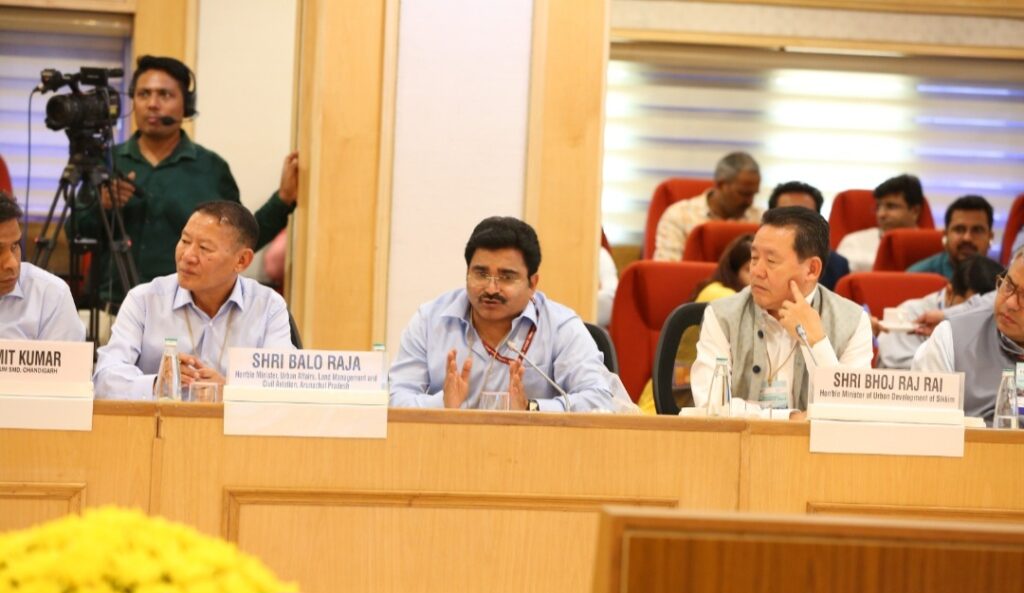
NEW DELHI : Arunachal Pradesh has urged the Centre to revise the existing funding pattern for urban sanitation projects under the Swachh Bharat Mission (SBM) 2.0, citing the unique geographical challenges and low population density of Northeastern states. The issue was raised by Urban Affairs Minister Balo Raja during the two-day National Review Meeting on Swachh Bharat Mission 2.0 (Urban) held at Vigyan Bhawan in New Delhi from May 19 to 20. The meeting, chaired by Union Housing and Urban Affairs Minister Manohar Lal Khattar, reviewed progress and implementation challenges related to urban sanitation and solid waste management across the country. During the deliberations, Raja sought special attention from the Ministry for Arunachal Pradesh and other Northeastern states, stating that the present funding model based on per capita urban population leaves states like Arunachal at a disadvantage despite their large geographical area and difficult terrain. The review meeting focused on strengthening urban sanitation systems, visible cleanliness initiatives and public participation, especially at heritage and tourist destinations. Discussions were also held on waste segregation, collection and transportation systems, Material Recovery Facilities (MRFs), Refuse Derived Fuel (RDF) management, waste-to-energy initiatives, composting projects and legacy waste remediation. Special emphasis was laid on improving implementation mechanisms in the Northeastern region. The meeting also reviewed the Solid Waste Management Rules, 2026, and discussed challenges faced by states in implementing SBM 2.0 in urban areas. The Arunachal Pradesh delegation included Urban Affairs Commissioner Vivek Pandey and Urban Local Bodies Director Hano Takka, who participated in the deliberations and highlighted the state’s initiatives and challenges in urban sanitation and waste management.